

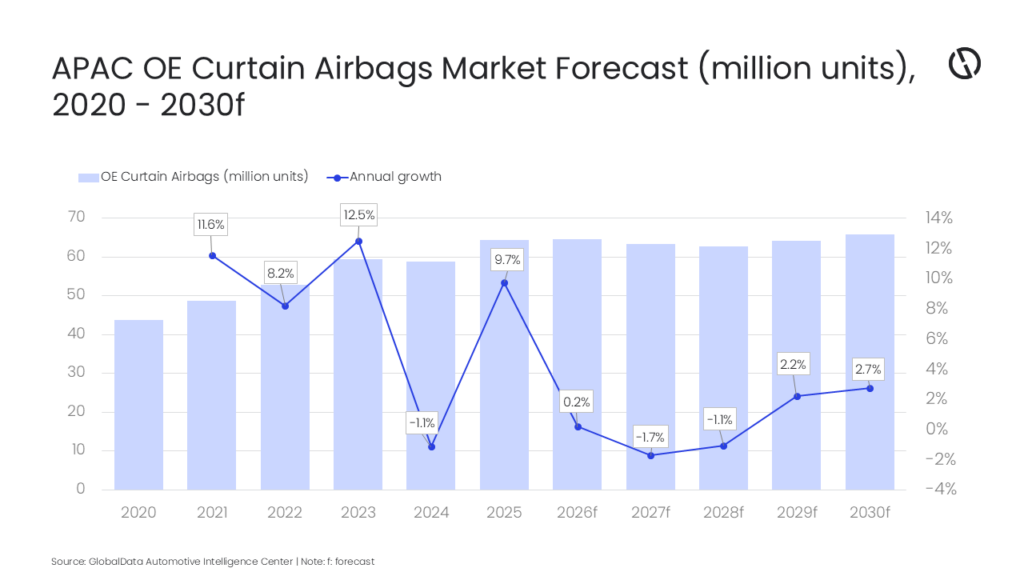
Passive safety in automobiles is becoming a decisive differentiator in vehicle choice and brand credibility in the Asia-Pacific (APAC) region, where dense urban traffic, rapid mobility growth, and a widening spread of vehicle price points raise expectations for safety. As airbags evolve from single frontal cushions into coordinated systems of sensors, algorithms, and multi-format protection, they align with rising consumers and regulatory demands. Against this backdrop, the APAC original equipment (OE) curtain airbags market is projected to grow at a compound annual growth rate (CAGR) of 0.5% during 2025-30, according to GlobalData, a leading intelligence and productivity platform.
GlobalData’s latest report, “Global Sector Overview & Forecast: Passive Safety Systems Q1 2026” reveals that the APAC automotive OE curtain airbags market is poised to grow from an recorded volume of 64.4 million units in 2025 to 65.9 million units in 2030.
Madhuchhanda Palit, Automotive Analyst at GlobalData, comments: “Passive safety is moving beyond basic frontal airbags toward a broader, more specialized “airbag ecosystem.” Side, curtain, knee, and center airbags are becoming mainstream, while new concepts, such as pedestrian protection and even external side airbags, are emerging. This matters in a region such as APAC, defined by highly varied driving conditions, from family commuting and ridesharing to mixed traffic environments and frequent stop-start urban use, where different crash scenarios demand different protection. Moreover, modern airbag control units are evolving into decision hubs, fusing data from multiple sensors to deploy the right restraints at the right time.”
Palit adds: “Technological advancement is reshaping APAC’s passive safety market in two ways: smarter actuation and tighter integration with broader vehicle sensing. The industry’s move toward adaptive airbags—multi-stage deployment based on crash severity and occupant-related factors—supports a more “personalized protection” narrative that resonates in APAC, where vehicles are often shared across households and usage contexts.”
At the same time, the growing interplay between ADAS and passive safety is influencing product planning across APAC. Modern systems are increasingly able to use richer sensor input, and the direction of travel suggests more anticipatory behavior—airbags that are not purely reactive, but informed by pre-crash sensing and, potentially, V2X-driven awareness.
Palit concludes: “While the region’s curtain airbag volumes are forecast to rise only modestly through 2030, the strategic importance of this segment is growing. As APAC OEMs balance cost, packaging, and performance across increasingly diverse vehicle portfolios, curtain airbags remain a core pillar of occupant protection and an essential enabler of higher safety ratings. The next phase of growth will be defined less by fitment alone and more by capability—how effectively airbags integrate with smarter control units and broader sensing to deliver consistent, real-world protection across APAC’s varied driving environments.”
