

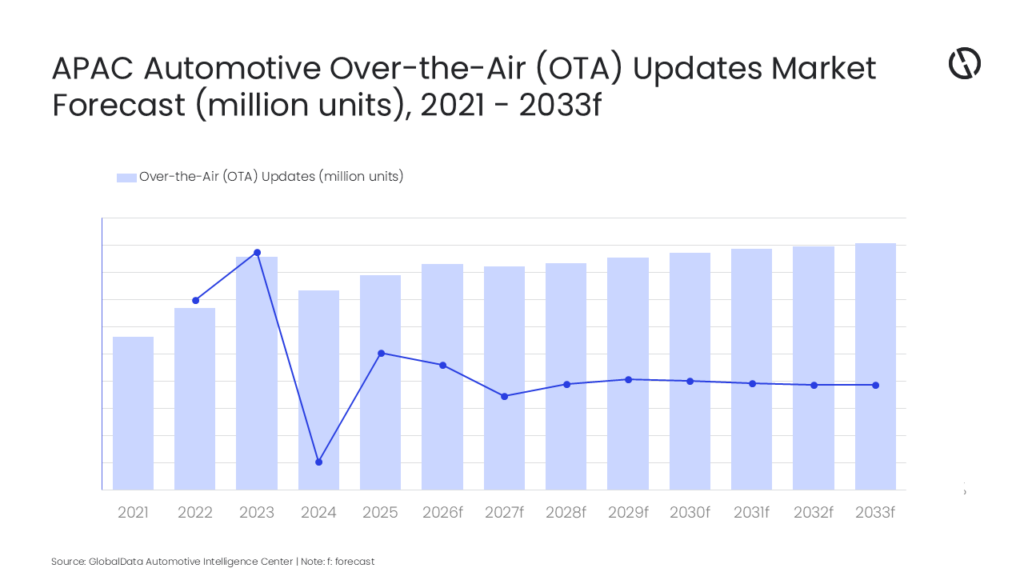
Over-the-air (OTA) updates allow manufacturers to deliver wireless software upgrades, bug fixes, and feature changes to vehicles without requiring a dealership visit. In Asia-Pacific (APAC), their relevance is likely to grow as consumers adopt increasingly connected vehicles while manufacturers seek more efficient ways to support large and geographically dispersed vehicle fleets. Against this backdrop, the APAC automotive OTA updates market is projected to grow at a compound annual growth rate (CAGR) of 1.2% between 2026 and 2033, according to GlobalData, a leading intelligence and productivity platform.
GlobalData’s latest report, “Global Sector Overview & Forecast: Connected Vehicle Technologies Q3 2026”, reveals that the APAC automotive OTA updates market is poised to grow from an estimated volume of 16.6 million units in 2026 to 18.1 million units in 2033.
Madhuchhanda Palit, Automotive Analyst at GlobalData, comments: “APAC combines highly digitized urban markets with developing mobility markets where dealership access and service capacity can vary substantially. OTA updates can reduce the inconvenience of scheduling service appointments for software-related issues, particularly for consumers in congested cities or in locations far from authorized workshops.
“The rapid expansion of electric vehicles (EVs) and connected-car services is also increasing the importance of remote software management. Software can influence charging information, energy-use displays, navigation, infotainment, and selected vehicle-control functions. For consumers, the appeal is not solely the introduction of new features; it is the ability to keep core systems current during ownership without repeated physical intervention.”
Manufacturers are positioning OTA capability as part of their broader connected-vehicle and software-defined vehicle strategies. Some use it to maintain infotainment and navigation services, while others are extending wireless updates to vehicle control units, battery systems, driver-assistance software, and cybersecurity measures. In the APAC market, established global manufacturers, regional automakers, and technology-led EV companies are likely to differentiate through the scope and frequency of updates.
OTA systems are becoming more sophisticated through centralized vehicle computing architectures, secure cloud platforms, improved cybersecurity controls, and the ability to update multiple electronic control units. Some manufacturers are introducing staged deployment processes, allowing software to be tested across selected vehicles before a broader release.
Palit continues: “For APAC consumers, these capabilities could improve the ownership experience by enabling timely security patches, more accurate navigation services, enhanced mobile app functions, and refinements to energy-management or driver-assistance features.”
Palit concludes: “OTA updates are likely to become an important element of vehicle ownership across APAC as software takes a larger role in vehicle performance and customer experience. Their value lies in reducing avoidable service visits and enabling manufacturers to maintain vehicles over time. Adoption will depend on dependable connectivity, robust cybersecurity, regulatory alignment, and manufacturers’ ability to make software updates useful without creating unnecessary complexity for consumers.”
