

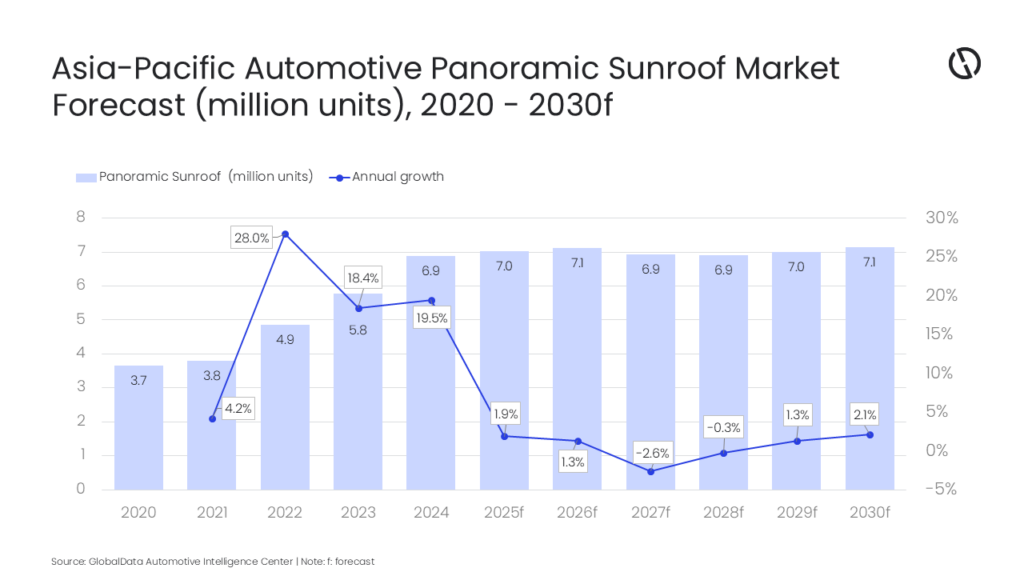
As disposable incomes rise across key markets like China and India, consumers are increasingly demanding vehicles that offer more than just transportation—they want an immersive driving environment. Panoramic glass roofs, once the preserve of luxury saloons and high-end SUVs, are now gaining traction as a valued option across broader vehicle segments in the Asia-Pacific (APAC) region. Against this backdrop, the APAC automotive panoramic roofs market is projected to grow at a compound annual growth rate (CAGR) of 0.3% between 2025 and 2030, according to GlobalData, a leading data and analytics company.
GlobalData’s latest report, “Global Sector Overview & Forecast: Roof Systems Q3 2025”, reveals that the APAC automotive panoramic roofs market is estimated at 7.0 million units in 2025 and is expected to reach 7.1 million units by 2030.
Madhuchhanda Palit, Automotive Analyst at GlobalData, comments: “SUV proliferation is central to the growing acceptance of panoramic roofs in APAC. In countries where versatile, rugged, or high-clearance vehicles suit both urban roads and rougher terrain, the SUV boom has prompted manufacturers to bundle premium features—even previously niche ones—as standard or affordable options. Panoramic roofs are increasingly being offered even in mid-tier SUVs, driven by consumer interest in natural light, visibility, and a more open cabin ambience.”
Palit adds: “Consumers in APAC are also being influenced by evolving lifestyles and aspirational design cues. Young buyers expect more advanced features even in vehicles priced for mass-market segments. The rising popularity of panoramic roofs underlines a desire for premium aesthetics and better visibility—attributes aligned with Western luxury car trends but now deeply adapted to local preferences. Additionally, as more entry-level electric and hybrid models enter the market, panoramic roofs—especially those with energy-efficient and solar-integrated features—are being considered desirable differentiators rather than luxuries reserved for top-tier models.”
Advanced opening and closing mechanisms, automated climate-control tinting, rain sensors, and app-controlled or voice-operated interfaces are becoming more sophisticated and more widespread. These enhancements cater to consumers who expect seamless connectivity, safety, and comfort—even in cars at price points once thought too modest for such features.
One of the most promising areas of innovation is solar-powered panoramic roofing. In APAC’s sunny climates, solar panels integrated into roofs can assist in powering secondary functions—such as ventilation systems, battery trickle charging, or electronics—thereby reducing strain on the electrical system and improving overall energy efficiency.
Moreover, vehicle design is also adapting structurally to accommodate large glass roofs without compromising safety, passive thermal comfort, or cost. UV filtering, insulation, soundproofing, and lightweight glass technologies are being refined to meet performance demands in APAC’s diverse climates—from tropical humidity to colder, high-altitude zones.
Palit concludes: “As SUVs dominate sales charts and lifestyle preferences tilt toward elevated comfort and visibility, panoramic roofs are evolving from optional luxuries into expected features across more segments. Manufacturers that strategically incorporate solar technologies, smart controls, and localized engineering may turn out to be best positioned to satisfy rising consumer expectations without disproportionate cost.”
