

The automotive sector is experiencing an increasing demand for electronic sensors, driven by ongoing technological advancements and innovations. The emphasis on electrification, autonomous vehicle technology, and heightened concerns regarding road safety have intensified the necessity for high-precision sensors. In this context, the automotive parking assistance sensor market is projected to experience a compound annual growth rate (CAGR) of 6.9% in the Asia-Pacific (APAC) region between 2024 and 2029, according to GlobalData, a leading data and analytics company.
GlobalData’s latest report, “Global Sector Overview & Forecast: Sensors Q4 2024” reveals that the APAC automotive parking assistance sensor market size is estimated to increase from 95.2 million units in 2024 to 133.0 million units in 2029.
Madhuchhanda Palit, Automotive Analyst at GlobalData, comments: “Government initiatives play a crucial role in promoting the adoption and innovation of sensor technologies. In Japan, both the private and public sectors are actively working to implement self-driving technologies. Numerous companies have announced plans to introduce autonomous driving solutions, while the Japanese government aims to deploy such services in approximately 50 locations across the country by March 2026.
“Furthermore, in August 2024, the Chinese Ministry of Public Security reported that 32,000 kilometers of roadway have been designated for autonomous vehicle testing, and 16,000 testing licenses have been issued nationwide. These initiatives are designed to facilitate the growth of autonomous vehicle technology, which, in turn, is expected to drive demand for sensors and enhance market volume.”
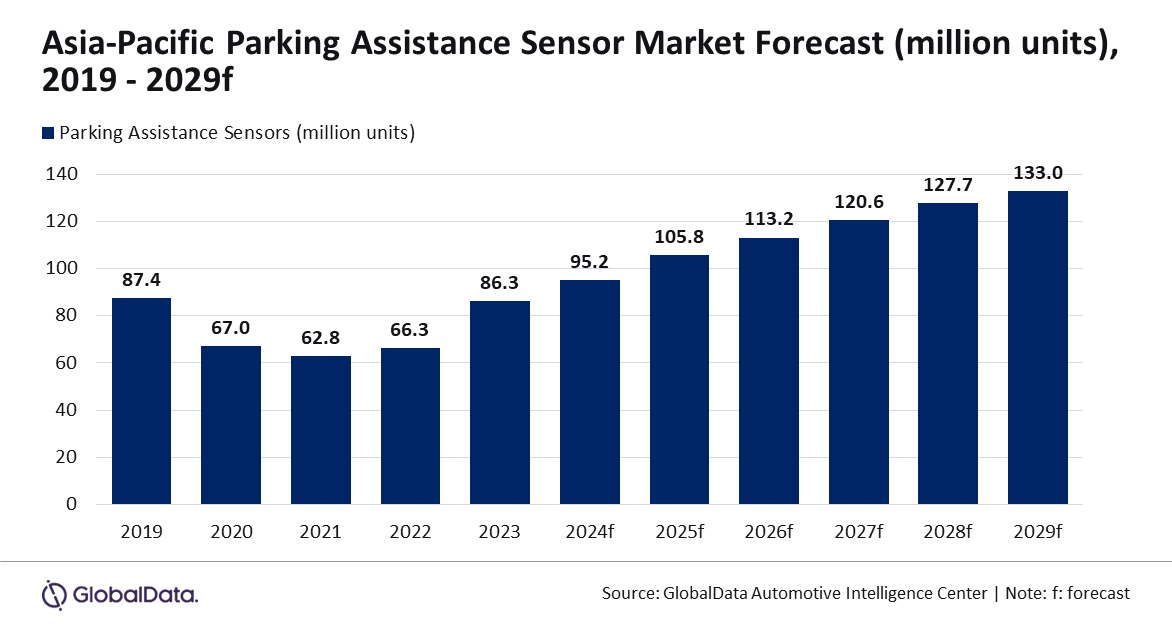
Parking assistance sensors enhance the efficiency and ease of parking maneuvers, particularly in confined spaces or congested parking lots, which are commonly found in major urban areas across the APAC countries. Furthermore, parking sensors play a vital role in safeguarding vehicles from scratches, dents, and other damages that may occur from collisions with obstacles, thereby reducing potential repair costs.
Additionally, sensors instill greater confidence in drivers even with less expertise, enabling them to navigate crowded environments with the assurance of obstacle detection support. Collectively, these factors contribute to the increasing popularity and demand for parking assistance sensors.
Palit adds: “The compatibility of parking assistance sensors with a diverse range of vehicles, including passenger cars and commercial vehicles, has significantly expanded the customer base and enhanced the overall market volume. Furthermore, the integration of safety benefits, heightened consumer demands, advancements in technology, and relatively affordable pricing has led to their incorporation in more economical vehicle segments, thereby broadening the consumer base and driving market growth.”
Additionally, the rise in electric vehicle (EV) adoption and the growing preference among consumers in the Asia-Pacific region for SUVs and luxury models are further contributing to the demand for parking assistance sensors.
Palit concludes: “Despite the projected high growth, the parking sensor market still presents significant opportunities for technological advancements that could enhance both efficiency and safety measures. For instance, parking assistance sensors may exhibit a limited detection range, particularly concerning low-lying obstacles or objects situated close to the vehicle. Additionally, there might be circumstances where parking sensors fail to detect obstacles obscured from view, such as items located beneath the bumper or behind the vehicle.
“Furthermore, it is important to note that not all vehicles are equipped with parking assistance sensor systems, and retrofitting aftermarket sensors may not be feasible for all makes and models. Therefore, a concentrated emphasis on research and development (R&D) is essential to drive innovation within the parking assistance sensor market, as well as the broader sensors market in the APAC region.”
