

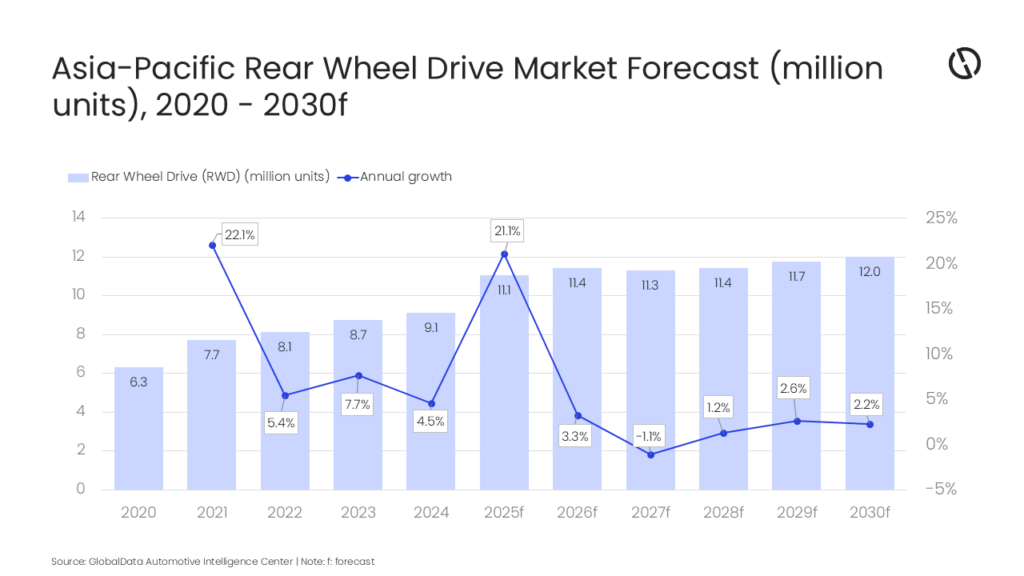
Bolstered by rapid industrialization, rising incomes, and evolving automotive tastes across China, India, Japan, and throughout Southeast Asia, demand for performance, prestige, and specialty vehicle segments is accelerating. As luxury cars, sporty models, and utility-class vehicles grow in popularity, rear wheel drive (RWD) architectures are becoming central to quality, driving dynamics, and engineering sophistication in the Asia-Pacific (APAC) automotive landscape. Against this backdrop, the APAC rear wheel drive market is projected to grow at a compound annual growth rate (CAGR) of 1.6% between 2025 and 2030, according to GlobalData, a leading data and analytics company.
GlobalData’s latest report, “Global Sector Overview & Forecast: Automotive Final Drive Systems Q3 2025”, reveals that the APAC rear wheel drive market is poised to grow from an estimated volume of 11.1 million units in 2025 to 12.0 million units in 2030.
Madhuchhanda Palit, Automotive Analyst at GlobalData, comments: “A pivotal force driving the adoption of rear-wheel drive in APAC is the quest for an engaging, dynamic driving experience. In emerging luxury and sports vehicle segments, consumers are increasingly valuing performance characteristics such as weight balance, handling precision, and the sense of connection between driver and machine. RWD vehicles inherently distribute mass closer to a balanced front-rear ratio, enabling more planted stability, especially when navigating twisty roads or during spirited acceleration.
“This heightened emphasis on driving feel is resonating particularly among younger, affluent buyers in APAC’s growing urban centers. They demand vehicles that are not just functional but also emotionally satisfying. The tactile thrill of initiating a corner, the assurance during high-speed highway merges and the measured control in tight traffic all become decisive factors in purchase decisions. ”
Beyond driving thrills, several structural forces are shaping the rear-wheel drive axle landscape in APAC. Commercial vehicles, luxury sedans, sport models, and truck-based SUVs—all staples in APAC consumers’ aspirations—rely on robust rear axles capable of handling greater torque, load, and performance. With luxury vehicle sales climbing and the trucking and light commercial sectors expanding significantly, the demand for stronger, more durable rear axles is becoming considerable. At the same time, the push toward electric and hybrid vehicles across APAC is opening new frontiers for rear axle design.
Palit concludes: “As APAC’s rear wheel drive market enters a phase of moderate but meaningful expansion, it is clear that this shift is about more than raw power—it is about the refinement of driving: balance, control, and engagement. Indicators across demand, technology, and policy suggest that RWD will become an increasingly visible element of APAC’s automotive identity.”
