

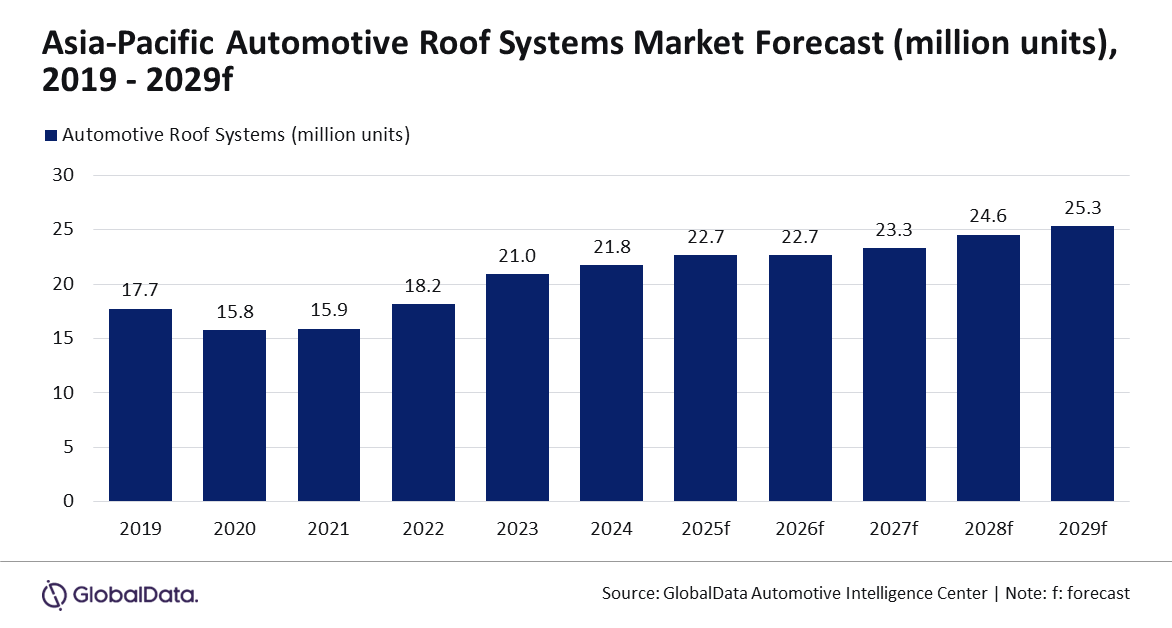
Automobile manufacturers in the Asia-Pacific (APAC) region are focusing on enhancing vehicle aesthetics and offering a premium experience in affordable car segments, with roof systems playing a key role in their efforts to stay competitive. Sunroofs have become a major consumer requirement, leading manufacturers to integrate them into budget cars. Additionally, factors like rapid urbanization, rising disposable incomes, growing demand for premium vehicles, and the rise of electric vehicles (EVs) are fueling market growth of roof systems. Against this backdrop, the APAC automotive roof systems market is expected to record a CAGR of 3.0% over 2024-29, according to GlobalData, a leading data and analytics company.
GlobalData’s latest report, “Global Sector Overview & Forecast: Automotive Roof Systems Q4 2024” reveals that the automotive roof systems market was at 21.8 million units in 2024 and is forecast to reach 25.3 million units in the APAC region by 2029.
Madhuchhanda Palit, Automotive Analyst at GlobalData, comments: “Sunroofs like panoramic and moonroofs, once exclusive to premium cars, are now becoming popular in budget segments. With the rise of EVs, R&D on roof systems is increasing, including innovations like solar-powered sunroofs. For example, Hyundai has developed a solar roof that charges a vehicle’s battery while driving or parked. As hybrid and electric vehicles gain traction due to emission regulations and sustainability concerns, solar roof technology is drawing significant interest from both manufacturers and consumers, particularly to address battery range issues.
“Moreover, the trend of using lightweight materials for automotive body making is rising to decrease the overall car weight that contirbutes to reducing emissions and increasing fuel efficiency. Lightweight materials such as carbon fiber, polycarbonate, or advanced composites are being looked for by manufacturers and actively being researched on.”
Premium vehicle consumers seek innovations that enhance aesthetics and driving comfort. Examples include transparent OLED roofs, ambient lighting, and switchable glazing, which contribute to a premium feel. Additionally, better thermal management is a key focus, with companies like Renault and Saint Gobain Sekurit developing the “Solarbay” opaque glass roof. This roof uses polymer-dispersed liquid crystal technology and infrared reflective coating to maintain cabin comfort by blocking heat in summer and retaining warmth in winter.
Moreover, manufacturers are focusing on innovations that are especially useful for autonomous vehicles. For instance, Webasto has developed a concept of Roof Sensor Module (RSM) especially for autonomous vehicle applications such as robotaxis, integrated sensor technologies, such as camera, radar, and lidar integrated in the roof module for cleaning and thermal management systems that clean, heat, cool or de-ice, depending on the weather conditions.
Palit concludes: “The automotive roof systems market is growing rapidly, driven by rising consumer demand for advanced features, vehicle electrification, and stricter emission regulations. Innovations like solar-powered sunroofs, lightweight materials, and advanced glazing are transforming the industry. With a focus on aesthetics, comfort, and sustainability, roof systems are becoming essential. The APAC region, fueled by urbanization and a growing middle class, is a key market, positioning the industry to shape the future of automotive design and functionality.”
