

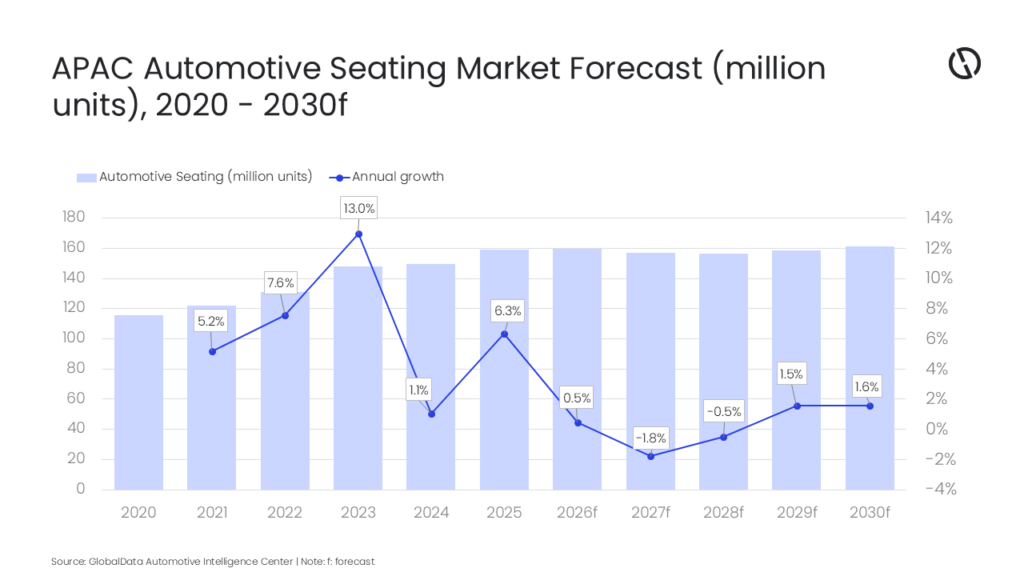
The automotive seating market in Asia-Pacific (APAC) is entering a decisive phase, driven by how quickly the region’s vehicle interiors are being reimagined. Seats are no longer a passive components—they are becoming a primary enablers of space utilization, safety integration, comfort, and in-cabin functionality. As electrification and assisted driving features expand across APAC vehicle line-ups, seating is increasingly positioned as a strategic system that can differentiate brands. Against this backdrop, the APAC automotive seating market is projected to grow at a compound annual growth rate (CAGR) of 0.3% between 2025 and 2030, according to GlobalData, a leading intelligence and productivity platform.
GlobalData’s latest report, “Global Sector Overview & Forecast: Automotive Seating Q1 2026”, reveals that the APAC automotive seating market is poised to grow from an recorded volume of 159.1 million units in 2025 to 161.2 million units in 2030.
Madhuchhanda Palit, Automotive Analyst at GlobalData, comments: “Flexibility is becoming a growth multiplier in the APAC automotive market. Reconfigurable seating and cargo systems that support multiple use cases are increasingly relevant as consumers in the region expect vehicles to function as adaptable personal spaces. Lear’s Configure+ approach to selective seat positioning or removal reflects this shift toward “one cabin, many lifestyles,” a theme likely to strengthen as mobility needs diversify. Hyundai Transys’ “multi-purpose mobility seat system,” offers another example, framing the cabin as a moving living space with modes spanning easy access, child care, wellness support, personalization, and VIP-style experiences.”
Palit adds: “Sustainability expectations are also gaining commercial weight in APAC procurement conversations. Adient’s work to increase recycled content and improve recyclability—supported by collaboration across partners—signals where the market is heading: circularity will increasingly influence which seating architectures scale regionally, especially as global end-of-life pressures ripple through APAC supply chains.”
Moreover, simulation-led design and validation—highlighted through multiphysics modeling and tools such as Keysight’s Virtual Seat Solution—supports faster iteration, fewer physical prototypes, and more efficient compliance with varied global standards, including Guobiao requirements relevant to APAC.
Palit concludes: “The strategic importance of seating in APAC is rising as vehicle interiors evolve into flexible, feature-led living spaces. Growth is likely to be shaped less by volume increases and more by value migration toward reconfigurable architectures, wellness-oriented and personalized seating experiences, and circular-material strategies that can scale across regional supply chains. At the same time, wider adoption of simulation-led engineering should help suppliers accelerate development, manage cost and complexity, and meet diverse regulatory demands—including China’s Guobiao requirements—positioning seating innovation as a meaningful lever for APAC OEM competitiveness in the next phase of mobility.”
