

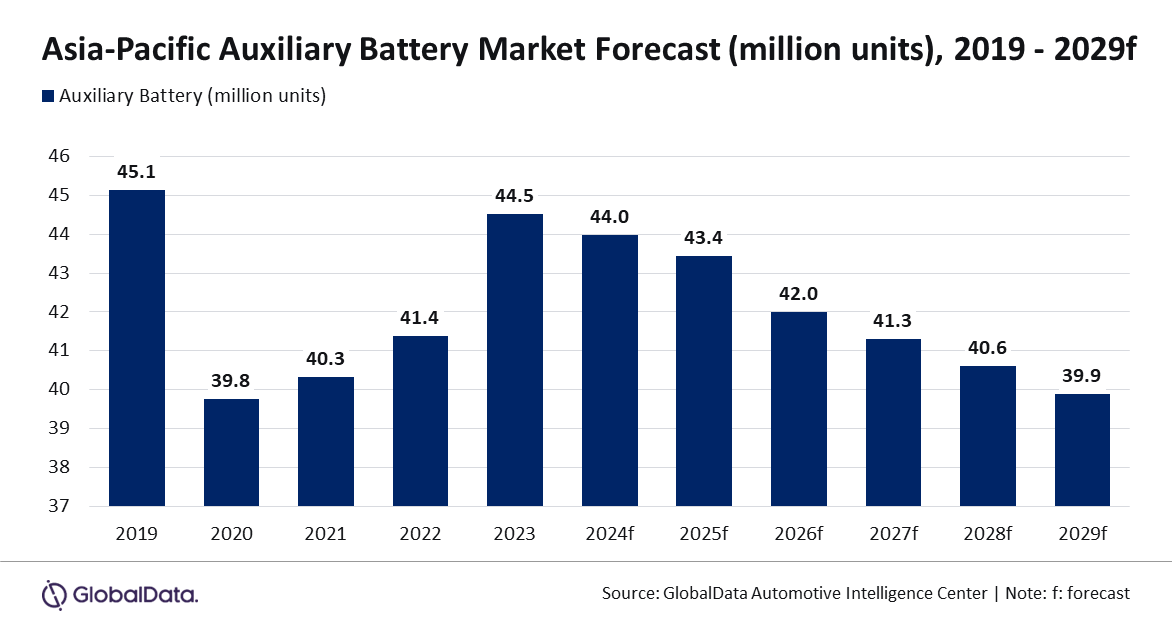
Driven by its status as the world’s largest automotive hub, the Asia-Pacific (APAC) region leads the lead-acid auxiliary batteries market in terms of volume, with India and China being the dominant markets. However, as electric vehicles (EVs) continue to gain popularity worldwide, the demand for internal combustion engine (ICE) cars is anticipated to decline, which is expected to impact the auxiliary batteries market volume negatively. Against this backdrop, the APAC auxiliary battery market is expected to record a negative compound annual growth rate (CAGR) of 1.9% over 2024-29, according to GlobalData, a leading data and analytics company.
GlobalData’s latest report, “Global Sector Overview & Forecast: Auxiliary Batteries Q4 2024” reveals that the auxiliary batteries market to decline from 44.0 million units in 2024 to 39.9 million units by 2029 in the APAC region.
Madhuchhanda Palit, Automotive Analyst at GlobalData, comments: “In the auxiliary battery sector, lead-acid batteries maintain a competitive edge over lithium-ion low-voltage batteries due to their ease of recycling, making them a more environmentally friendly and cost-effective option. To enhance performance and ensure consumer safety, manufacturers are actively pursuing innovations in this field. A key advancement in lead-acid battery design is the integration of Absorbent Glass Mat (AGM) technology. This innovation improves the battery’s resistance to vibration and shock damage, reduces maintenance requirements, and enhances overall performance.”
The automotive lead-acid battery market is highly competitive, with several prominent industry players making significant investments in production. Key market participants are adopting organic growth strategies such as acquisitions, mergers, partnerships, and collaborations to expand their product portfolios.
Additionally, they are increasing investments in research and development (R&D) to address the evolving demands of electric and hybrid vehicle technologies. For example, in April 2024, GS Yuasa Battery Ltd. announced the relaunch of its ECO.R HV auxiliary VRLA battery*1 series for Toyota hybrid vehicles. According to the company, this updated version features an improved performance, designed to reduce the likelihood of sudden battery failure and safeguard against the risk of the vehicle being unable to start.
Palit concludes: “Despite having an established market, the automotive lead-acid auxiliary battery sector has faced several challenges, including concerns related to gassing, safety issues, and water loss from the electrolytes. In response, manufacturers have either upgraded or are in the process of upgrading their products to improve the efficiency of lead-acid batteries. These enhancements aim to address key consumer concerns while offering benefits such as improved corrosion resistance and extended battery life. Several leading manufacturers have already introduced corrosion-free lead-acid batteries, and others are expected to follow suit in order to remain competitive in the dynamic market.”
