

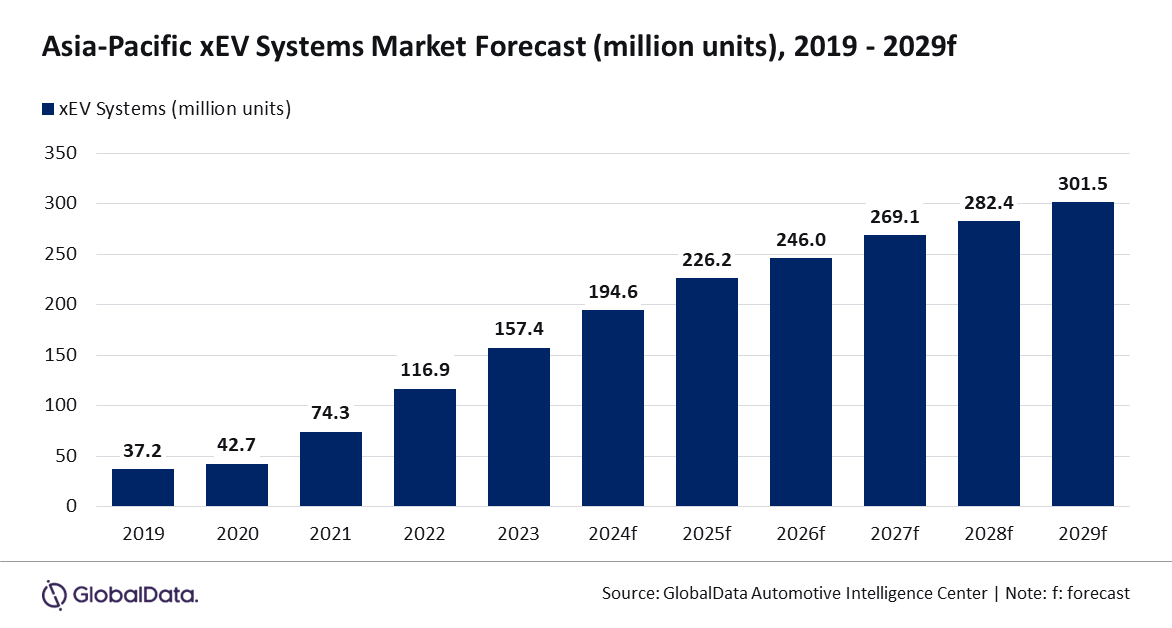
The electric vehicle (EV) market in the Asia-Pacific (APAC) region is experiencing rapid growth, with governments playing a pivotal role in driving the adoption of EVs through supportive policies and incentives. So, as the demand for EVs is rising, the market for xEV systems such as battery management systems, thermal management systems, battery covers, and charging cables, is also growing. Against this backdrop, the APAC xEV systems market is expected to record a compound annual growth rate (CAGR) of 9.1% over 2024-29, according to GlobalData, a leading data and analytics company.
GlobalData’s latest report, “Global Sector Overview & Forecast: xEV Systems Q3 2024” reveals that the xEV systems market is estimated at 194.6 million units in 2024 and is forecast to increase to 301.5 million units by 2029 in the APAC region.
Madhuchhanda Palit, Automotive Analyst at GlobalData, comments: “China has emerged as a global leader in the EV market, significantly advancing the transition to EVs through extensive government support. The government’s subsidies for EV manufacturing and sales have made them increasingly competitive in comparison to traditional internal combustion engine vehicles. Furthermore, China has made substantial investments in charging infrastructure, with plans for ongoing expansion, thereby solidifying its status as a frontrunner in the EV sector.”
In addition to China’s initiatives, other Asian governments are implementing significant measures to promote the EV ecosystem. For instance, in India, the government has introduced various schemes throughout the EV value chain to incentivize production, adoption, and usage. The National Institution for Transforming India (NITI Aayog) has established specific targets by vehicle type, aiming to achieve 30% EV sales penetration by the year 2030.
Meanwhile, Indonesia’s Ministry of Finance has introduced a series of tax incentives to stimulate EV production and sales within the country. These incentives include the removal of the luxury tax on EVs for the year 2024, the waiver of import tax until 2025, and a reduction in value-added tax on EV sales.
Manufacturers are increasingly prioritizing research and innovation in the development of components for xEV systems to enhance battery performance, efficiency, and thermal management. This focus aims to bolster consumer confidence in the adoption of electric vehicles. For instance, Hanon Systems, a key player in automotive thermal management for electrified mobility, has introduced the world’s first fourth-generation heat pump system, which, as per the company, serves as a vital component for EVs and has been commercially available since July 2024.
Palit concludes: “The adoption rate of EVs in the APAC region is increasing significantly; however, several challenges must be addressed to sustain this growth. Key issues include the necessity for a comprehensive charging infrastructure, advancements in technology to enhance adoption for both personal and commercial use, and the enhancement of consumer awareness regarding the benefits of electric vehicles and sustainability concerns. To effectively tackle these challenges, substantial public and private investments, along with suitable government policies, are essential.”
