
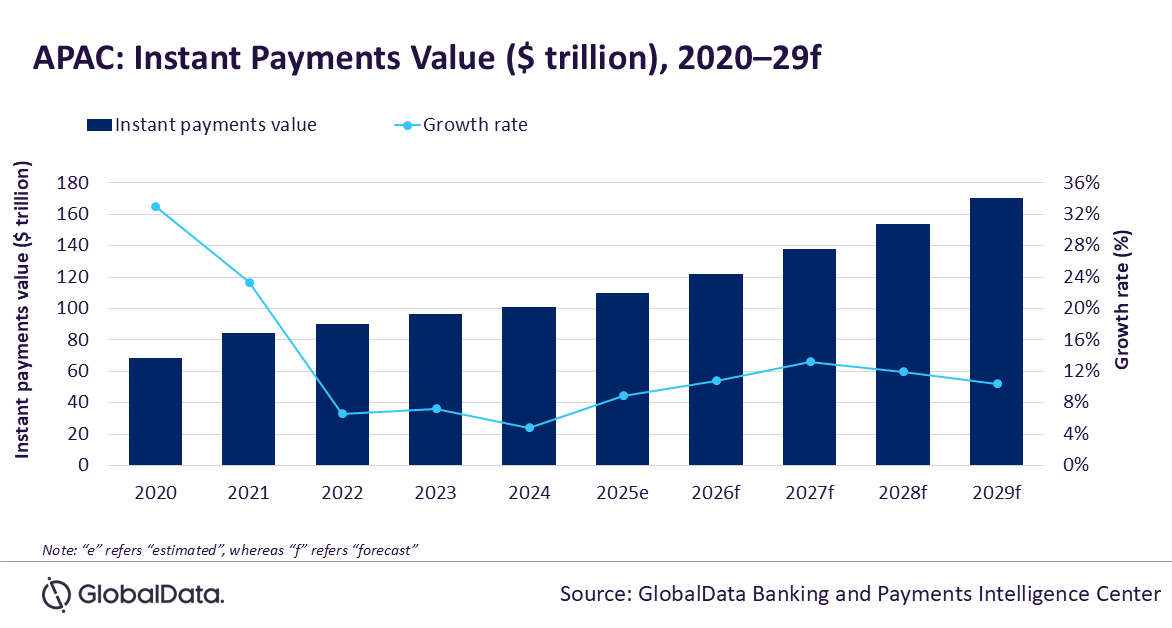
Asia-Pacific (APAC) is home to some of the world’s leading instant payments (or real-time payments) markets such as China and India. Overall, the instant payments market in the region is expected to register a compound annual growth rate (CAGR) of 11.6% between 2025 and 2029 to reach $170.2 trillion, supported by the growing preference for electronic payments, according to GlobalData, a leading data and analytics company.
GlobalData’s Payment Instrument Analytics reveals that the instant payment value in the APAC region (covering 14 markets) registered a CAGR of 10.2% between 2020 and 2024 to reach $ 100.9, driven by the increasing use of electronic payments for day-to-day transactions and rising banked population.
Ravi Sharma, Lead Banking and Payments Analyst at GlobalData, comments: “China, Japan, South Korea and India are robust instant payments markets with high instant payments value. Other markets within the region are also catching up, supported by improving payment infrastructure, rising banked population, and growing financial awareness.”
The APAC instant payments market is led by China, which is expected to grow by a CAGR of 15.4% to reach $ 81.9 trillion in 2029. It will be followed by South Korea and Japan, with expected instant payments value of $35.8 and $31.5 trillion, respectively, in 2029. They are distantly followed by India at the fourth place with total value of $7.5 trillion.
India, however, leads the region with the number of instant payment transactions accounting for 191.5 billion in 2024. India has registered a significant acceleration in the digital payments space in the last few years, with Unified Payments Interface (UPI), the country’s instant payment scheme, registering a significant growth. Other countries are also gradually pushing instant payment adoption through various financial awareness campaigns as well as by introducing favorable regime.
APAC leads the way in cross-border payments initiatives, with many countries are now even integrating their instant payment systems. For example, UPI’s integration with international schemes such as Singapore’s instant payment scheme “PayNow” further expanded its usage for international fund transfers.
Sharma continues: “The increasing cross-border linkages open doors to new business opportunities and enhance trade by facilitating faster, cheaper, transparent and inclusive cross-border payments.”
On the core of instant payment infrastructure, the availability of low-cost smartphones, rising Internet penetration, growing awareness of mobile payments and the proliferation of digital wallets remained key factors which resulted in many Asian countries shifting from cash transactions to mobile wallet-based instant payments. Many consumers in the region leapfrogged from cash to digital wallets skipping card payments driving the growth of instant payment.
Sharma concludes: “Looking ahead, the total instant payments market in APAC is expected to continue its upward trajectory, driven by the ongoing government initiatives, improving payment infrastructure, high preference of QR code-based payments over traditional POS, and a consumer shift towards electronic payments. Moreover, high preference for mobile payments remains a major for their faster adoption. Overall, the instant payments value in APAC is expected to grow by 8.9% in 2025 to reach $109.9 trillion.”
