

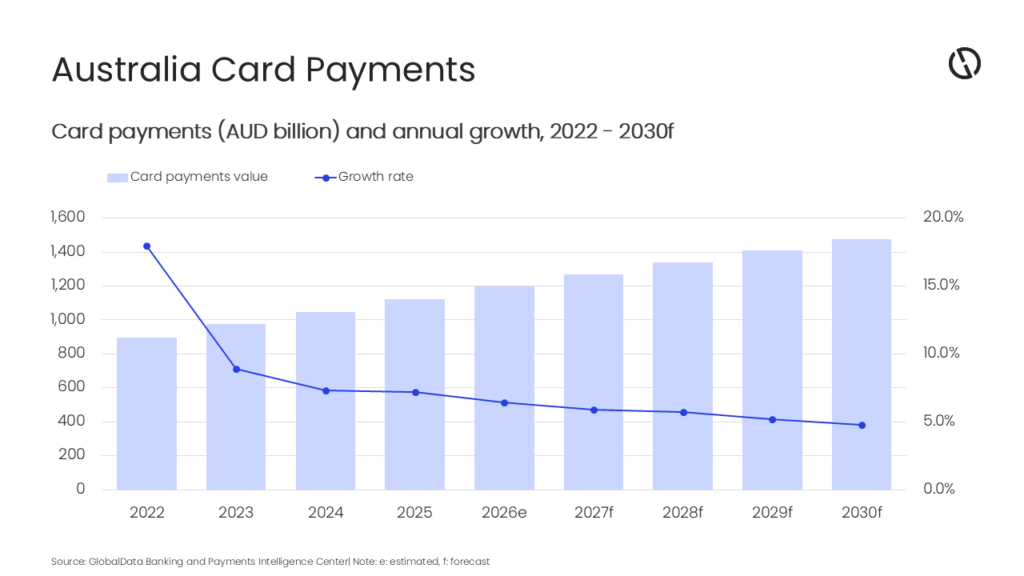
The Australia card payments market is set to reach AUD1.2 trillion ($789.9 billion) in 2026, underpinned by near-universal banking access, a well-developed POS acceptance network, and rising contactless usage. While debit cards dominate, credit usage is accelerating, indicating a subtle but notable shift in consumer spending patterns across the country, according to GlobalData, a leading intelligence and productivity platform.
GlobalData’s Payment Cards Analytics reveals that the total card payment value in Australia registered a compound annual growth rate (CAGR) of 10.3% over 2021-2025 to reach AUD1.1 trillion ($742.3 billion) in 2025. However, growth is expected to moderate over the forecast period of 2026-2030, reflecting a shift from rapid adoption-led expansion to steadier growth, even as enabling factors—such as increasing POS penetration, rising ecommerce demand, and digital-only bank competition—continue to underpin card usage.
Shivani Gupta, Lead Banking and Payments Analyst at GlobalData, comments: “Australia’s card payments market continues to expand, but growth is moving into a more mature phase. Card usage is being reinforced by rising contactless adoption—particularly in transit—ongoing innovation in merchant acceptance solutions for SMEs, and strong financial inclusion supported by accessible basic bank accounts. At the same time, The Reserve Bank of Australia (RBA)’s major overhaul to merchant card payment costs and surcharges are set to further promote payment card adoption.”
Debit cards remain the preferred payment card type in Australia, supported by consumers’ tendency to spend within their means amid economic uncertainty, as well as strong cardholding fundamentals.
Credit and charge cards, while smaller than debit in value terms, remain important—especially for higher-ticket spending. Despite rising inflation and interest rates, and mounting competition from Buy Now Pay Later services, their usage is still driven by rewards programs such as discounts, cashbacks, and instalment features.
Regulatory momentum is also reshaping market dynamics. In March 2026, the RBA finalized its review of merchant card payment costs, mandating the removal of surcharges for eftpos, Mastercard, and Visa cards—including credit, debit, and prepaid—effective 1 October 2026.
Concurrently, the RBA also imposed lower interchange fee caps—including on foreign-issued cards—and introduced new transparency obligations for major payment networks and large acquirers. These reforms aim to simplify pricing, enhance competition, and reduce costs for businesses, especially SMEs, thereby encouraging greater use of card payments by consumers and reducing friction at the point of sale.
Gupta concludes: “Australia’s payment card market will continue to benefit from a well-developed payment infrastructure, rising consumer trust in contactless payments, and regulatory reforms. However, the ongoing geopolitical uncertainties, rising competition from alternative payment solutions such as mobile wallets and BNPL, and rising inflationary pressures represent key challenges.”
