

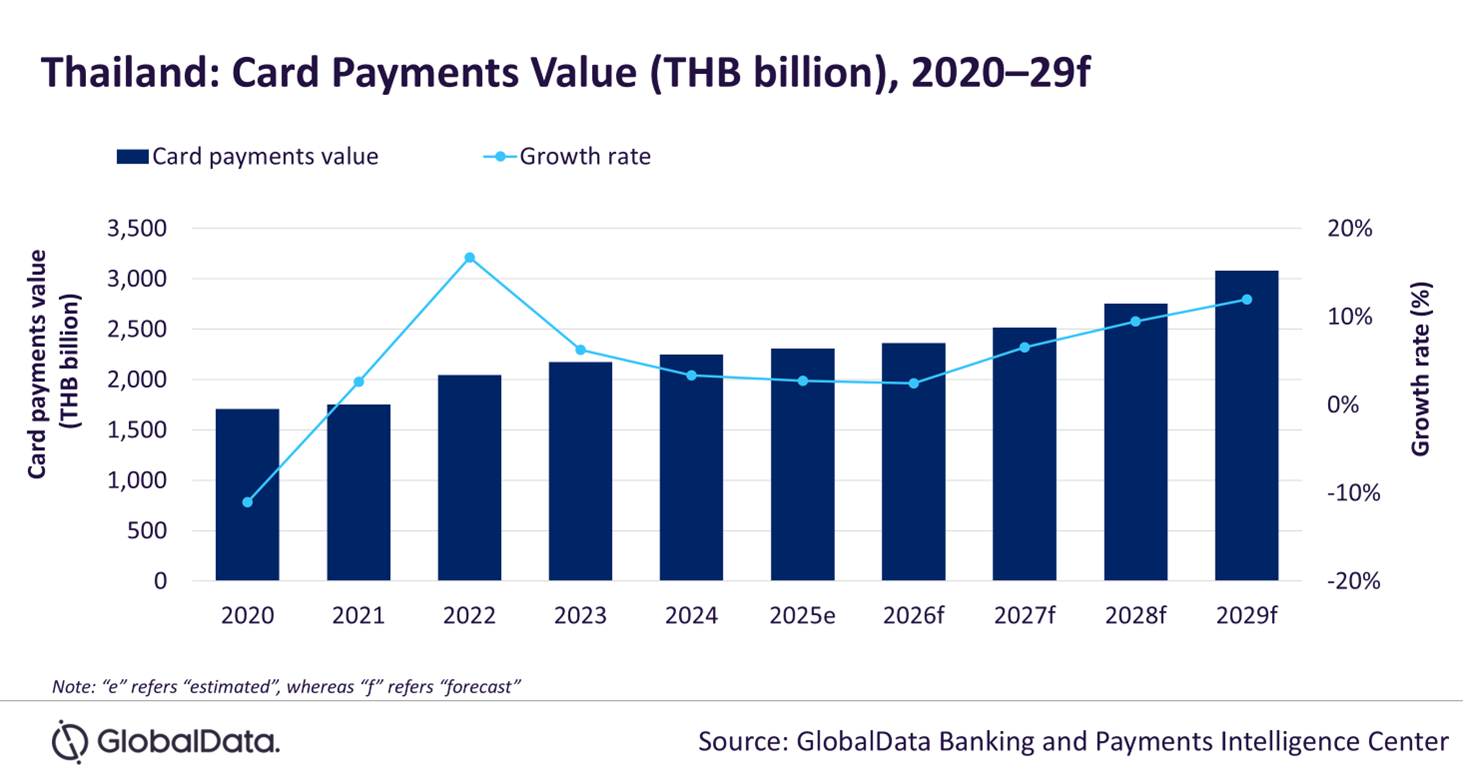
Thailand’s card payment market is set to grow by 2.7% to reach THB2.3 trillion ($65.4 billion) in 2025e, driven by growing consumer preference for digital transactions, rising financial inclusion, and robust POS infrastructure. Although cash and PromptPay dominate, card usage, especially credit and charge cards, is gaining momentum, signaling a shift in consumer behavior and paving the way for sustained digital payment adoption, reveals GlobalData, a leading data and analytics company.
GlobalData’s Payment Card Analytics reveals that card payments in Thailand registered a healthy compound annual growth rate (CAGR) of 7.1% between 2020 and 2024 to reach expected THB2.2 trillion ($63.6 billion) in 2024, driven by the rise in consumer spending.
Shivani Gupta, Lead Banking and Payments Analyst at GlobalData, comments: “While credit transfers and cash remains the preferred mode of payments in Thailand, payment cards are also gaining prominence, supported by the rising banked population, government push for digital payments and expanding POS infrastructure. Furthermore, the availability of low-cost basic banking accounts and cards as well as banks expanding their reach via agent banking networks, and introduction of digital banking channels, have all contributed to the overall rise in financial inclusion, which in turn supported the shift towards digital payment methods.”
Debit card penetration is high in Thailand, with penetration rate of 75.8 cards per 100 individuals in 2024, driven by the growing banked population and the proactive initiatives by banks and government bodies to drive financial inclusion. However, their usage has primarily been confined to cash withdrawals, rather than payments. In 2024, debit cards only represented a 6.1% share of the overall card payment value.
Credit and charge cards, on the other hand, accounted for 93.9% share of the overall card payment value in 2024. Thai consumers are increasingly opting for credit and charge cards when making payments, with the frequency of payments per card standing at 37.6 times in 2024, compared to 3.1 times for debit cards. The popularity of credit and charge cards can be attributed to the rewards, discounts, cashback, and interest-free installment facilities offered by these cards. The rise of the middle class and young working populations in Thailand is also expected to drive the adoption and usage of credit and charge cards.
The Bank of Thailand (BoT), the central bank of Thailand, has implemented measures to advance digital payments through initiatives such as the Payment Systems Roadmap (2022-2024). This roadmap is designed to enhance digital payments through the establishment of an interoperable payment infrastructure, the development of a biometric standard for identity authentication, the introduction of cross-border payment, and the promotion of widespread adoption of digital payments, including card transactions.
BoT has been taking initiatives to help consumers repay credit card debt. In August 2024, it extended the minimum payment rate for credit cards to 8% until the end of 2025, further postponing the return to the standard rate of 10% initially proposed from 1 January 2025.
Gupta concludes: “The Thai card payment market is poised for sustained growth over the next five years, supported by the government initiatives and increasing consumer awareness for digital payments. The rise in e-commerce and contactless payments will also contribute to this growth. Consequently, the market is forecast to grow at a CAGR of 7.5% between 2025 and 2029 to reach THB3.1 trillion ($87.3 billion) in 2029.”
