

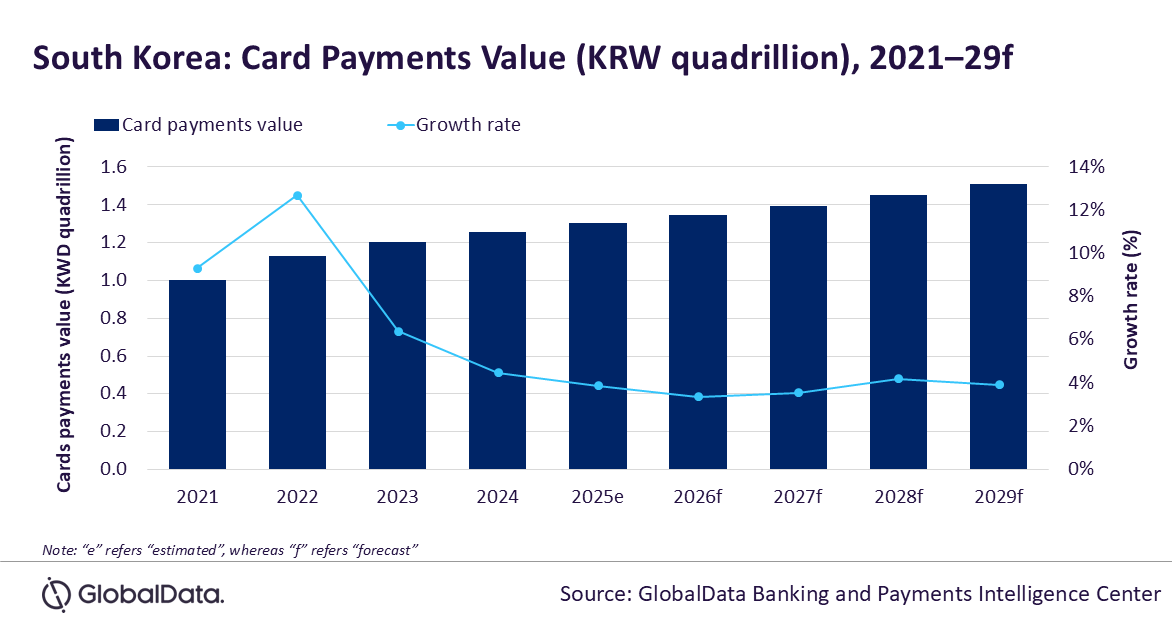
South Korea’s card payments market is set to grow by 3.8% in 2025, reaching KRW1.3 quadrillion ($969.8 billion), driven by rising consumer spending. Despite economic challenges, the country’s high card usage, expanding POS infrastructure, and strong preference for credit cards with value-added benefits continue to support digital payment adoption and maintain South Korea’s leadership in cashless transactions across Asia-Pacific, reveals GlobalData, a leading data and analytics company.
GlobalData’s Payment Card Analytics reveals that card payments in South Korea registered a healthy compound annual growth rate (CAGR) of 6.8% between 2021 and 2025e. However, the value is expected to register a slow growth in 2025 due to the nation’s prolonged economic downturn. The country’s GDP growth rate decreased from 4.3% in 2021 to 2.1% in 2024 and is projected to decline further to 0.8% in 2025.
Kartik Challa, Senior Banking and Payments Analyst at GlobalData, comments: “On average, each South Korean individual holds 6.1 cards, while the frequency of card payments increased from 85.7 times per card in 2021 to 97.4 times per card in 2025e. High banked population, high financial awareness, banks incentivizing customers through a range of benefits, government support to boost cashless payment methods, and an expansion in merchant acceptance have driven payment card adoption in the country.”
Debit card penetration is notably high in South Korea, with each individual holding 3.4 debit cards in 2025e. However, they are used comparatively less than credit cards for payments. In 2025e, debit cards represent a 20.1% share of the overall card payment value, while credit cards, on the other hand, account for 79.9% share of the overall card payment value.
Furthermore, consumers are increasingly opting for credit cards with frequency of payments per card standing at 143.5 times in 2025e, compared to 61.5 times for debit cards. This is due to flexible repayment options and value-added benefits such as cashback, discounts, and reward programs associated with credit cards. In addition, the government offers tax benefits on credit card spending. The tax benefits associated with credit card payments also contributed to this.
South Korea has a well-developed POS infrastructure compared to its Asia-Pacific peers. In 2025, POS terminals per one million inhabitants is estimated at 66,997, compared to Singapore (56,314), New Zealand (43,768), Australia (40,055), China (36,578), Hong Kong (China SAR) (27,992), and Japan (21,966).
The rise in e-commerce payments also contributed to the growth of the payment cards market, as credit cards are the most preferred payment tool for online purchases. Credit cards alone accounted for a share of 43.1% of the total e-commerce transaction value in South Korea in 2024, according to GlobalData’s E-Commerce Analytics.
Challa concludes: “While South Korea’s card payments market has been on a growth trajectory, it continues to face challenges such as slowdown in economy, rising inflation, coupled with geopolitical uncertainties. Overall, the country’s card payments value is expected to register a slow compound annual growth rate (CAGR) of 3.7% between 2025 and 2029.”
