

Employee costs account for more than 50% of the total operating costs of leading global banks in 2021, posing challenges to banks in improving their net interest margins as the world returns to normality from the COVID-19 pandemic, says GlobalData, a leading data and analytics company.
According to GlobalData, among the top 50 banks ranked by total assets, Switzerland-based UBS Group and UK-based Standard Chartered had the highest staff costs to total operating costs ratio of 70.6% and 70.2% in 2021, respectively, followed by Spain’s CaixaBank SA at 69.4%. The ratio for US-based banks such as Morgan Stanley, Wells Fargo and Goldman Sachs was in a range of 65.1% to 67.8%.
GlobalData forecasts the US and Spain to see an increase in inflation to 7.51% and 7.70% in 2022, respectively, putting pressure on banks’ expenses, especially on staff costs.
Amongst the UK-based banks, Barclays and HSBC posted the staff costs to total operating costs ratio of 60.6% and 54.1%, respectively. The economic uncertainty from Brexit coupled with an estimated inflation of 7.78% in 2022 is further expected to increase costs for the UK banks.
Of the 12 Chinese banks in the top 50 banks by assets, Agricultural Bank of China recorded the highest staff costs to total operating costs ratio of 60.2% in 2021, while Postal Savings Bank of China witnessed a low ratio of 31.0%. The ratio for Indian public sector bank State Bank of India (SBI) that features in the top 50 banks was at 35.3%in the year.
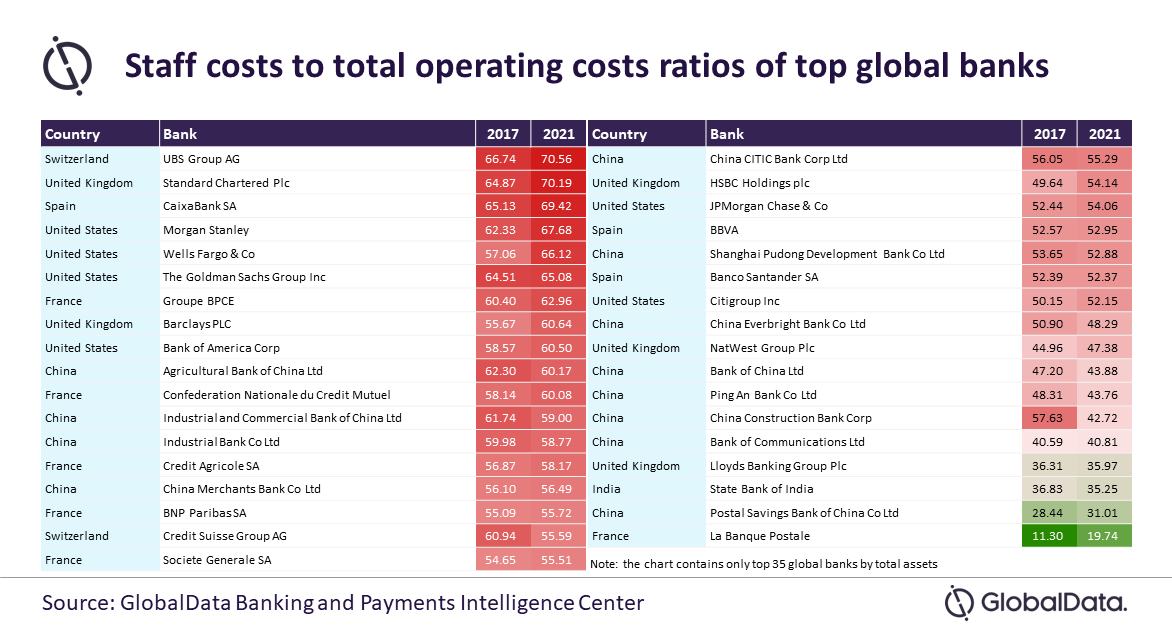
During the review period 2017 to 2021, Wells Fargo witnessed an increase of more than 9 percentage points in the staff costs to total operating costs ratio, while Standard Chartered saw an increase of 5.4 percentage points. On the other hand, China Construction Bank recorded a decline of 14.9% during the review period, with the ratio at 42.7% in 2021.
According to GlobalData, owing to the increased staff costs, banks might see it imperative to reduce workforce sizes in order to improve top line revenue numbers.
