

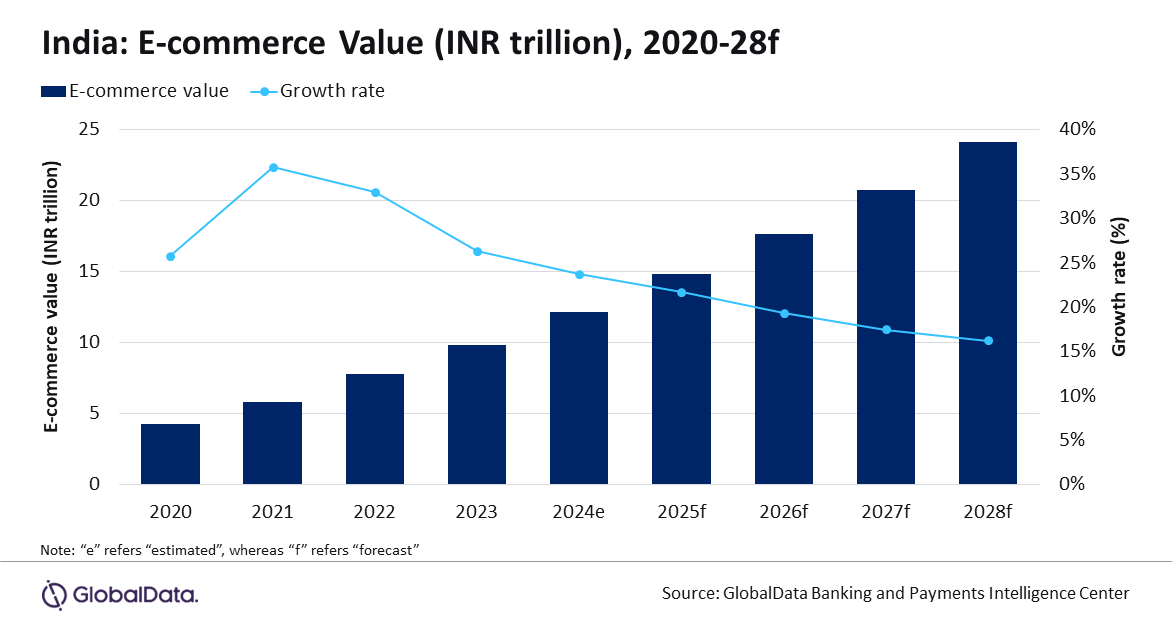
The Indian e-commerce market is growing at a fast pace and is expected to surge by 23.8% to reach INR12.2 trillion ($147.3 billion) in 2024, driven by growing consumer preference for online shopping and strong internet penetration, according to GlobalData, a leading data and analytics company.
An analysis of GlobalData’s E-Commerce Analytics reveals that India’s e-commerce market value is set to increase to INR 24.1 trillion ($292.3 billion) in 2028, registering a compound annual growth rate (CAGR) of 18.7% during 2024-28.
Ravi Sharma, Lead Banking and Payments Analyst at GlobalData, comments: “India’s e-commerce market is growing at a healthy pace, supported by increasing internet penetration (especially in rural areas), and improving digital payment infrastructure. Online shopping events have also contributed to e-commerce growth.”
According to the Telecom Regulatory Authority of India, as of March 2024, there were 954 million internet subscribers, up from 881 million in March 2023. This strong momentum is encouraging merchants, especially SMEs, to enter the e-commerce space.
Many domestic and international e-commerce retailers such as Flipkart, Amazon, and Myntra offer benefits, including discounts and cashback on various products listed on their platforms through their respective shopping events, Flipkart Big Billion Days, Amazon Great Indian Sale, and Myntra Big Fashion Festival Sale, thereby encouraging consumers to shop online.
Among payment tools, alternative payment solutions are most preferred by online shoppers. Mobile and digital wallets have eclipsed traditional payment modes, reflecting a paradigmatic change in consumer preferences and transactional behavior. Alternative payment solutions have consistently gained popularity among Indian consumers in the last five years, with some of the popular brands being Amazon Pay and Google Pay.
According to GlobalData’s 2024 Financial Services Consumer Survey*, 30% respondents indicated using Google Pay most frequently while buying goods and services online. This is distantly followed by PhonePe (13%), Amazon Pay (13%), and Paytm (12%).
Alternative payments are followed by credit and charge cards (10%), as these cards are preferred due to various reward and pricing benefits associated with these cards.
With electronic payment methods being accepted for pay-on-delivery orders, e-commerce payments are expected to see further increase from such offerings. For instance, Flipkart offers the QR code Pay-On-Delivery facility, allowing shoppers to opt for QR code payments at the time of delivery using any UPI-enabled apps such as PhonePe, Google Pay, and MobiKwik.
Sharma concludes: “The uptrend in e-commerce sales in India is likely to continue over the next few years, supported by improving payment infrastructure and the growing popularity of alternative payment solutions.”
* GlobalData’s 2024 Financial Services Consumer Survey was conducted online during Q2 2024 among 67,292 consumers in 41 markets globally.
