

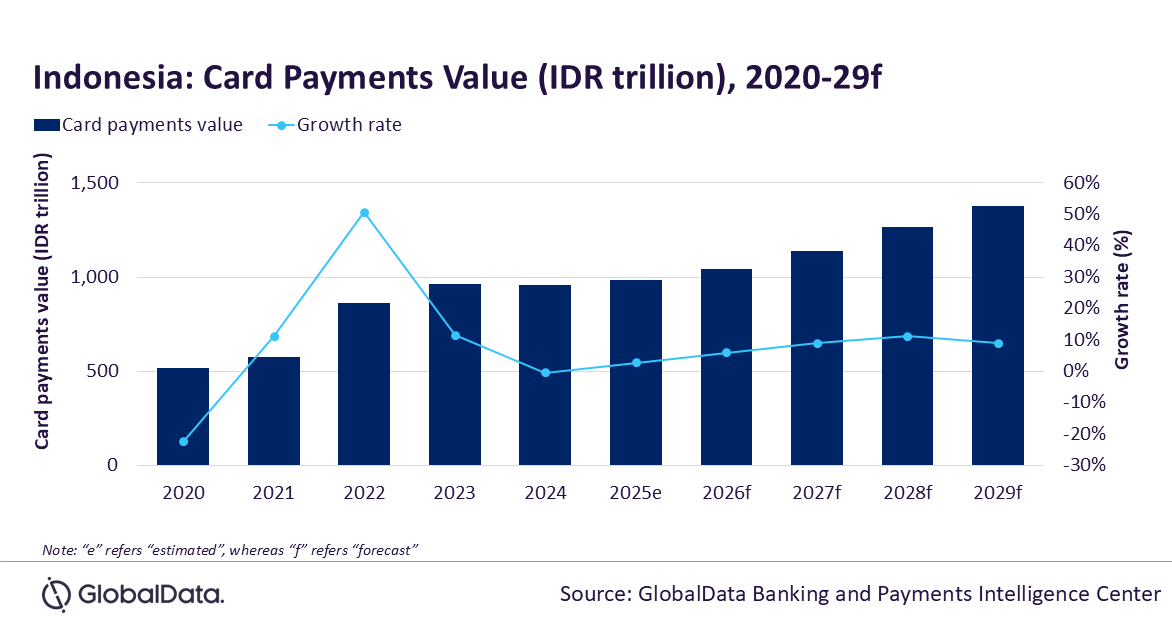
The Indonesia card payments market is forecast to register a compound annual growth rate (CAGR) of 8.8% between 2025 and 2029 to reach IDR1,379.4 trillion ($87 billion) in 2029, supported by the constant consumer shift towards electronic payments, according to GlobalData, a leading data and analytics company.
GlobalData’s Payment Cards Analytics reveals that card payment value in Indonesia is expected to register an estimated growth of 2.6% to reach IDR984.7 trillion ($62.1 billion) in 2025.
Ravi Sharma, Lead Banking and Payments Analyst at GlobalData, comments: “The Indonesian payment ecosystem has seen a gradual yet steady shift from cash to electronic payments over the past five years. In 2020, the card payment market was significantly smaller, but the introduction of various initiatives, such as the National Strategy for Financial Inclusion and the KEJAR program (One Student One Account), has catalyzed growth. The launch of domestic credit card schemes like Kartu Kredit Indonesia (KKI) and the debit card scheme, Gerbang Pembayaran Nasional (GPN) has also contributed to the rising adoption of payment cards.”
Debit cards are widely preferred which is largely attributed to the government’s financial inclusion initiatives, which have facilitated access to basic banking services. The central bank’s efforts to increase financial inclusion, particularly through the KEJAR program, have also played a pivotal role in expanding the debit card user base.
The government-backed KEJAR program (One Student One Account) has resulted in the opening of more 57 million student accounts by the end of 2024. Additionally, the deployment of agent banking services has also played a significant role in expanding the banked population.
While the market size for credit cards is smaller compared to debit cards, it is experiencing notable growth. The increasing popularity of credit cards can be attributed to the attractive reward points, discounts, and other value-added benefits they offer to consumers. Banks are also promoting credit card usage through flexible instalment payment options, allowing consumers to make purchases more manageable.
Despite the challenges posed by a limited number of POS terminals—standing at just 8,274 per one million inhabitants in 2025 —Indonesia’s payment landscape is evolving. The government and payment providers are addressing these challenges by offering cost-effective mobile POS (mPOS) and SoftPOS solutions to smaller merchants. For instance, payment service providers, ConnectPOS, Moka, and Majoo offers a mobile POS solution that allows merchants to accept multiple payment methods, including cards and mobile wallets.
Sharma concludes: “Looking ahead, the total card payments market in Indonesia is expected to continue its upward trajectory, driven by the ongoing government initiatives, increased financial literacy, and improving payment infrastructure. We are likely to see sustained growth in card payments, as more consumers transition to cashless transactions and the unbanked population gains access to formal banking services. The combination of innovative payment solutions, financial inclusion efforts, and a supportive regulatory environment will be key factors propelling the growth of Indonesia’s payments market in the coming years.”
