

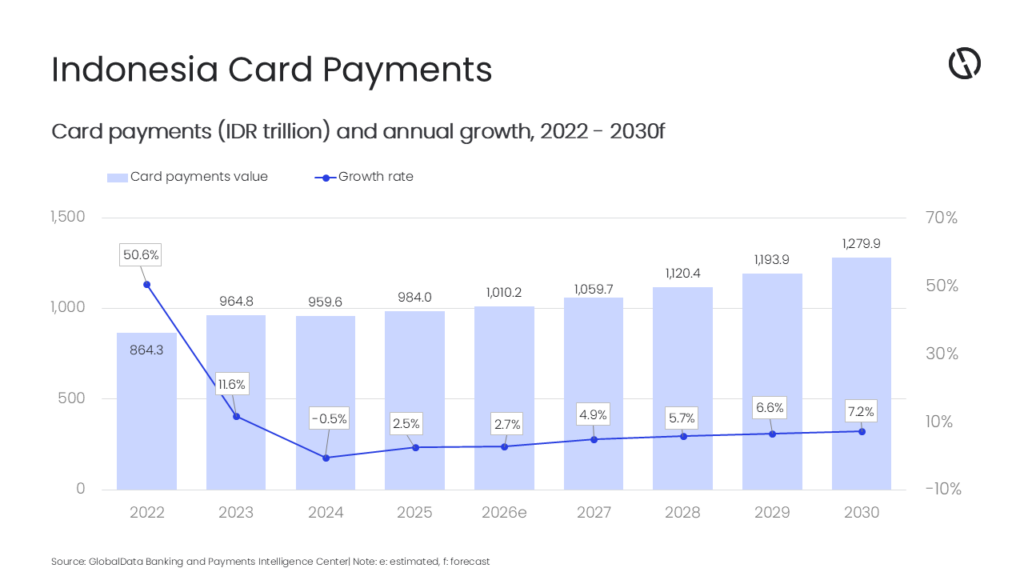
Indonesia’s card payments market is set to cross IDR1,010 trillion ($61.3 billion) in 2026, underpinned by strong financial inclusion efforts and expanding merchant acceptance. While debit cards dominate, credit usage is accelerating, signalling a gradual shift in consumer spending behavior across the country, according to GlobalData, a leading intelligence and productivity platform.
GlobalData’s Payment Cards Analytics reveals that the total card payment value in Indonesia registered a compound annual growth rate (CAGR) of 14.4% over 2021-2025 to reach IDR984 trillion ($59.7 billion) in 2025, reflecting the combined impact of accelerating payment acceptance infrastructure and increasing consumer familiarity with electronic payments.
Poornima Chinta, Senior Banking and Payments Analyst at GlobalData, comments: “The Indonesian payment card market has benefited significantly from public policy interventions—national inclusivity programs, domestic scheme mandates, and agent banking initiatives. These have been instrumental in bringing the unbanked into the formal system and encouraging the shift from cash towards card payments. Additionally, macroeconomic resilience, falling inflation, and stable central bank rates—are all fostering consumer confidence and spending in card payments.”
Debit cards were the dominant card type in Indonesia, accounting for 53% of total card payment value in 2025. Their rising popularity is attributed to the widespread campaigns offering cashback and discounts, growing proliferation of digital banks, and financial inclusion measures, such as the KEJAR (One Student One Account) program and Laku Pandai agent networks that improve banking and debit card access for underserved populations.
On the other hand, credit and charge cards accounted for 47% of total card payment value in 2025, up from 41.4% in 2021. Although debit still generates a larger absolute transaction value in some contexts, credit cards are gaining ground especially among consumers attracted by rewards, co-branding, installment plans, and other value-added benefits.
To encourage everyday payment card usage, Indonesia’s central bank introduced Gerbang Pembayaran Nasional (GPN; the national debit switching system) in 2017 to handle all domestic debit‐card transactions and rolled out Kartu Kredit Indonesia (KKI; the national credit card scheme) in 2023 to support home‐grown credit cards—both moves designed to boost card adoption across the country.
Regulatory measures are expected to further reinforce card adoption. In August 2024, the central bank launched its Blueprint Sistem Pembayaran Indonesia (BSPI) 2030 (BSPI 2030), that aims to modernize payment infrastructure, introduce a unified Payment ID tied to national identity for seamless authentication, and expand digital acceptance and regulation—including use of domestic processing and tokenization.
Combined with the integration of credit cards in government transactions and inclusion efforts for micro, small and medium enterprises, these initiatives are designed to make payment cards more accessible, secure, and widely used across the country.
Chinta concludes: “Indonesia’s card payments market is poised for growth over the next five years—fuelled by the expanding financial inclusion initiatives, the rise of domestic schemes GPN and KKI, broader merchant acceptance across urban and rural areas, and richer bank-led value-added services. However, the growth could be tempered by macroeconomic volatility and intensifying competition, particularly the rapid adoption of QR code-based payments (QRIS) and the continued expansion of BNPL, which may divert everyday spend away from cards. Total card payment value is forecast to grow at 7.2% in 2030 to reach IDR1,279.9 trillion ($77.7 billion).”
