

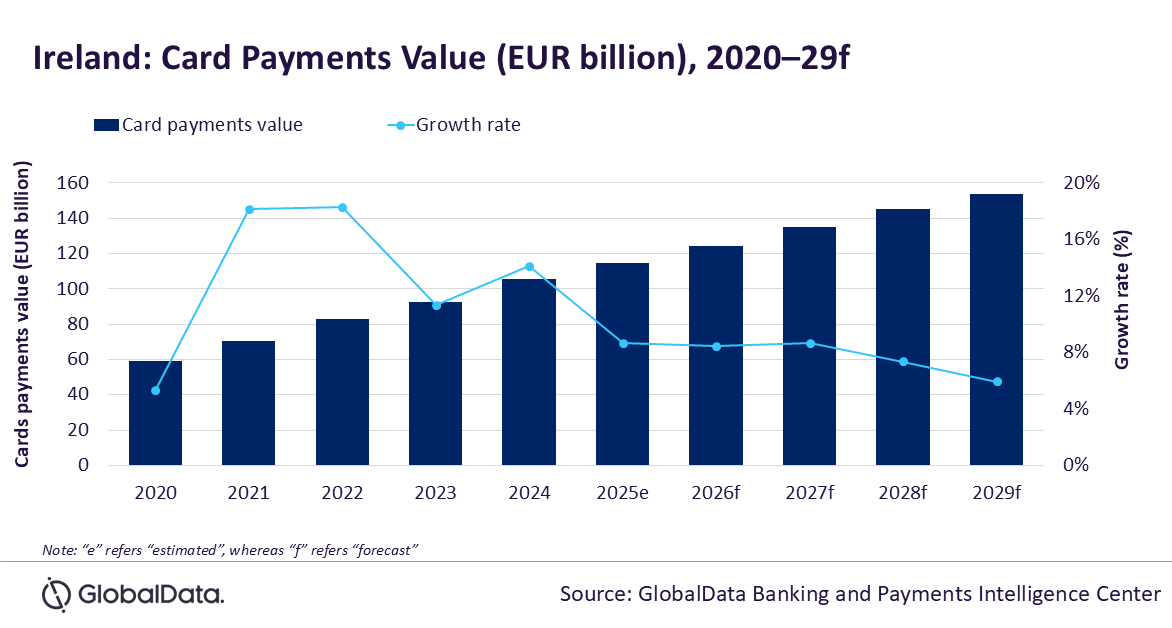
The Ireland card payments market is expected to growth by 8.7% to reach EUR114.8 billion ($124.2 billion) in 2025 supported by growing preference for electronic payments. Despite economic headwinds, including new US tariffs, strong banking infrastructure, a declining reliance on cash, and steady debit card use are supporting growth, though momentum may slow amid weakening consumer sentiment and trade uncertainty, says GlobalData, a leading data and analytics company.
GlobalData’s Payment Cards Analytics reveals that the card payment value in the Ireland registered a growth of 11.4% in 2023, driven by the rise in consumer spending. The value registered an estimated growth of 14.1% in 2024 to reach EUR105.7 billion ($114.3 billion). However, the current global uncertainty because of latest US tariffs can pose a challenge for the Ireland’s overall economic growth, resulting in slowdown in the overall card payments value in 2025.
Ravi Sharma, Lead Banking and Payments Analyst at GlobalData, comments: “Ireland’s payment card market is growing while cash usage declines. Propelled by a substantial banked population, government initiatives promoting financial inclusion, and advancements in banking infrastructure, the adoption of payment cards is high in Ireland. Meanwhile, new geopolitical events such as imposition of US tariffs carry the risk of triggering trade wars, pose challenge for Irish economy and, consequently, its payment market.”
Ireland’s economy is reliant on international trade and American multinational corporations. Ireland falls under the 20% tariff category; the implementation of tariff could result in increased costs for Irish businesses exporting goods to the US. Meanwhile, the Irish League of Credit Unions has reported that Irish consumer sentiment declined to its lowest level in nine months in March 2025, amid concerns about the impact of tariffs. Consumers are worried that household finances could be affected by weaker employment and a tighter fiscal position that could influence the consumer spending and in turn card payments market.
Debit cards are the preferred payment method in Ireland, driven by a well-banked population and their standard issuance with bank accounts. The shift from cash to debit has led to higher usage frequency, with economic uncertainty further boosting adoption as consumers opt for controlled spending.
Credit and charge card payments are also witnessing notable growth. Consumers use credit cards to benefit from value-added services such as reward points, discounts on purchases at partner retailers, facilities that allow users to convert large-value purchases into installments, and other benefits associated with these cards.
The adoption of contactless payments is becoming increasingly prevalent in public transport systems across Ireland. According to Banking & Payments Federation Ireland (BPFI) data, for the year ending on December 2024, 87.1% of domestic POS card payments were contactless, while 58.5% of the value of POS card payments. Overall, 296 contactless payments were made per person in Ireland in 2024.
Sharma concludes: “Looking ahead, the total card payments market in Ireland is expected to continue its upward trajectory, driven by the ongoing government initiatives, improving payment infrastructure and a consumer shift towards electronic payments. However, the ongoing geopolitical change due to US tariffs can have impact on country’s card payments market. The card payments value is expected to register a slower compound annual growth rate (CAGR) of 7.6% between 2025 to 2029 to reach EUR153.9 billion ($166.5 billion) in 2029.”
