

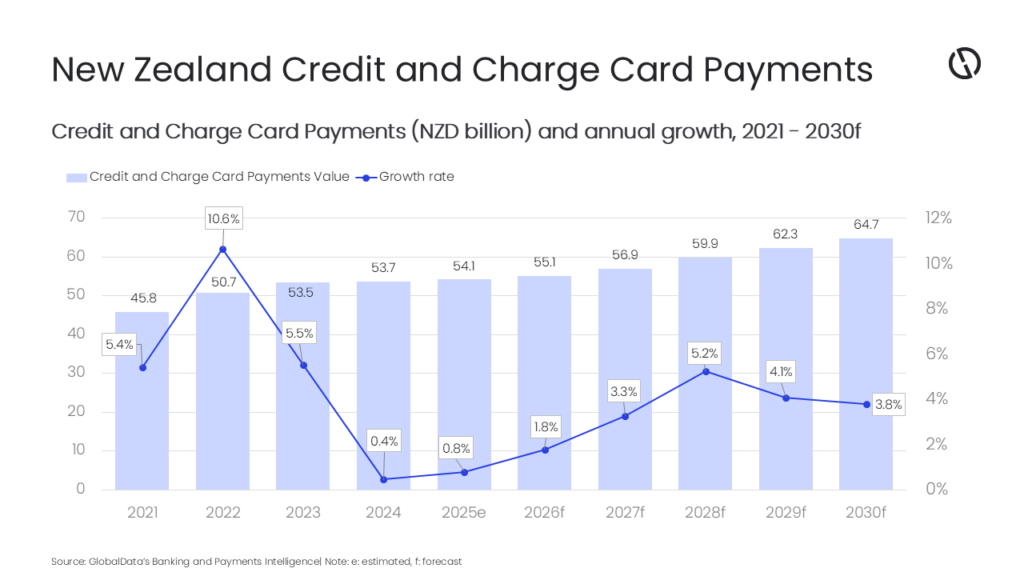
New Zealand’s credit and charge card payments are expected to reach NZD55.1 billion ($32.1 billion) in 2026, reflecting a growth of 1.8% compared to the previous year. This growth is being driven by a confluence of factors including widespread card acceptance, a near-100% banked population, and increasing adoption of contactless cards, according to GlobalData, a leading intelligence and productivity platform.
GlobalData’s Payment Cards Analytics reveals that the credit and charge card payment value in New Zealand registered an estimated growth rate of 0.8% in 2025, to reach NZD54.1 billion ($31.5 billion), driven by the rise in consumer spending.
Kartik Challa, Senior Banking and Payments Analyst at GlobalData, comments: “While debit cards enjoy strong usage, especially in everyday transactions, credit and charge cards have pulled ahead through superior value-added benefits, installment options, cashback, and reward programs. The government’s reduction in card interchange fees, high public awareness of payment cards, robust merchant acceptance, and infrastructural enhancements including broader contactless card penetration, are all reinforcing their lead.”
Rewards, discounts, and flexible payment schemes play a key role in driving the credit and charge card usage in New Zealand. For instance, ASB offers the Visa Light credit card with 0% interest on purchases of NZD1,000 ($581.84) or above for six months. A well-developed POS infrastructure is also supporting the rise of credit and charge cards.
New Zealand boasts one of the highest number of POS terminals per million inhabitants in the Asia-Pacific region, which stood at 43,359 in 2025, higher compared to some of its peers such as Australia (40,055), China (36,578), Hong Kong (27,992), and Japan (21,966).
In July 2025, the New Zealand Commerce Commission revised the interchange fees for domestic and international payment cards (debit and credit cards). As per the bill, the interchange fee for domestic contactless and online debit card transactions remained unchanged at their current level at 0.2% and 0.6%, respectively.
For swiped and inserted debit cards there is no fee. The interchange fees for credit card transactions (in person and online) are capped at 0.3% and 0.7% respectively, a decline from 0.8% (for both in person and online). For domestic payment cards, interchange fee regulation came into effect from December 2025.
Credit and charge cards are also preferred online payment method, accounting for 35.6% of e-commerce payment value in 2025. This is due to the value-added benefits they offer, including interest-free instalment payment options, reward programs, cashback, and discounts.
Challa concludes: “Credit and charge card payments in New Zealand are poised for steady growth over the next five years, underpinned by the expanding e-commerce adoption, a well-developed payment infrastructure, attractive rewards and installment offers and robust regulatory support. The credit and charge card payments market is expected to grow at a CAGR of 4.1% between 2026 and 2030 to reach NZD64.7 billion ($37.6 billion) in 2030.”
