

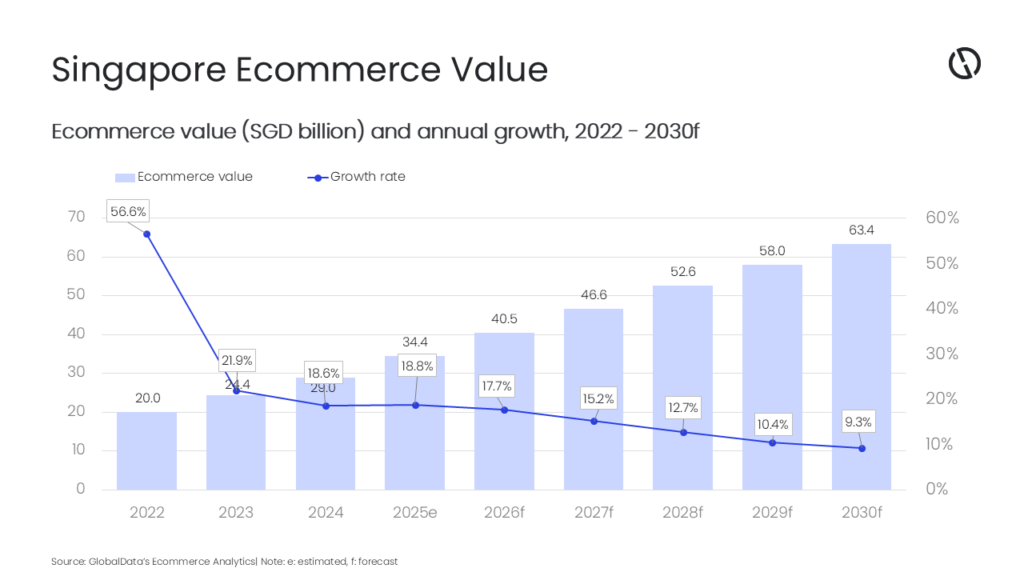
Singapore’s ecommerce market is forecast to grow by 17.7% in 2026, reaching SGD40.5 billion ($31 billion). This rapid growth will be driven by strong consumer appetite for online shopping, supported by advanced digital infrastructure, and a large population of digitally proficient consumers. The market’s momentum reflects deeper digital integration, and rising adoption of innovative online shopping methods, according to GlobalData, a leading intelligence and productivity platform.
GlobalData’s Ecommerce Analytics reveals that Singapore’s ecommerce market registered an estimated growth rate of 18.8% in 2025, to reach SGD34.4 billion ($26.3 billion). Online shopping festivals such as Black Friday, Cyber Monday, and Singles’ Day, have supported growth. Alongside this, online shopping platforms also host sales events, offering discounts at partnered merchants. The market is projected to reach SGD63.4 billion ($48.5 billion) in 2030.
Kartik Challa, Senior Banking and Payments Analyst at GlobalData, comments: “Singapore’s ecommerce market development is underpinned by a digitally-mature ecosystem that enables efficient online transactions, fast logistics, and international trade.”
Livestream shopping is emerging as a key sales channel, with consumers able to watch and purchase products through video broadcasts on various platforms, such as TikTok, Shopee Live, Lazada Live, and Facebook Live. In this context, in April 2025, DBS introduced live selling workshops for its SME clients.
Likewise, DBS partnered with TikTok and Boom Media to run two social-commerce workshops and three live-selling sessions. More than 70 participants received hands-on training in content creation, live presentation, and driving viewer engagement. This form of interactive shopping has gained popularity among consumers and is contributing to the overall growth of ecommerce in the country.
Singapore’s ecommerce infrastructure is also expanding quickly, and consumers increasingly expect delivery services that are both fast and convenient. In response to this demand, RedMart, the Singapore-based online grocery platform owned by Lazada, launched RedMart Now in February 2026, offering 30-minute delivery in select areas. The platform will address last-minute grocery requirements alongside RedMart’s existing delivery options, including same-day service and delivery slots of two or six hours. The competitive landscape includes established providers, such as Grab and foodpanda, which also provide rapid delivery services.
International brands are also entering the Singaporean ecommerce market to take advantage of the growth potential. In May 2025, the Indian fashion retailer Myntra introduced its online platform in Singapore, marking its first international expansion under the Myntra Global brand. The company aims to cater to the fashion-conscious Indian diaspora of around 650,000. Myntra offers over 35,000 product styles across more than 100 established brands, with a portfolio focused on Indian ethnic wear, apparel, footwear, home products, and accessories.
Similarly, in May 2025, Amazon Singapore launched its Everyday Essentials online store, featuring over 100,000 products sourced from both local and international brands. The platform is intended to simplify the purchase of daily necessities by providing a broad selection of household and grocery items at competitive price points, supported by delivery options, such as same-day and next-day fulfilment.
Challa concludes: “Singapore’s ecommerce market will continue its upward growth trajectory over the next few years with consumer appetite for online shopping showing no signs of waning. Going forward, the evolving consumer behavior toward interactive live shopping, combined with innovations in digital tools, will likely accelerate the growth of ecommerce and enhance competitive differentiation.”
