

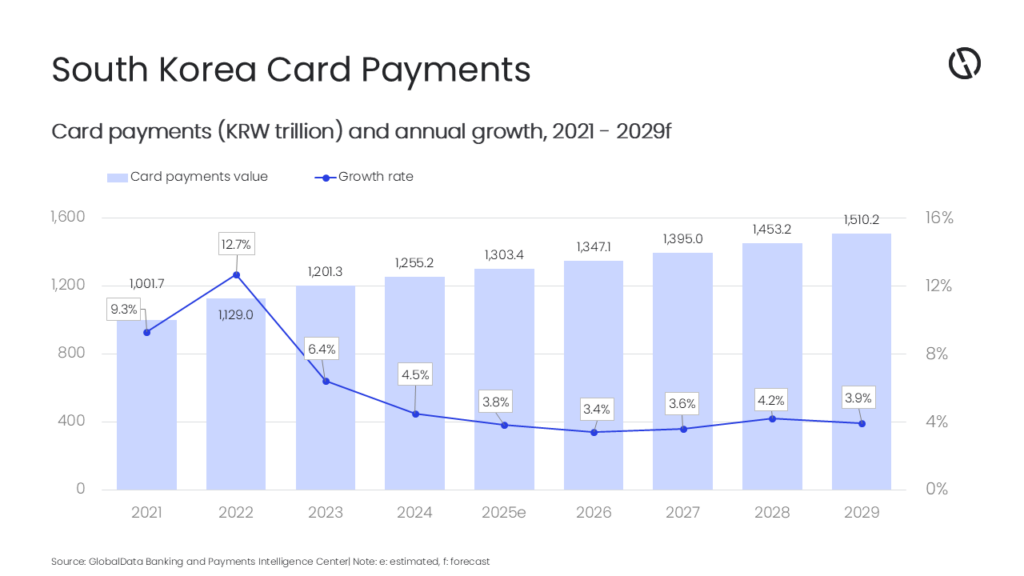
The South Korean card payments market is forecast to grow by 3.8% in 2025 to reach KRW1,303.4 trillion ($969.8 billion), supported by strong payments infrastructure, continued government support for cashless payments, and growing e-commerce demand, according to GlobalData, a leading intelligence and productivity platform.
GlobalData’s Payment Cards Analytics reveals that the total card payment value in South Korea grew by 4.5% in 2024 to reach KRW1,255.2 trillion ($933.9 billion), reflecting continued traction in card-based spending driven by high financial awareness, consumer incentives from banks, and government initiatives promoting cashless transactions.
Poornima Chinta, Senior Banking and Payments Analyst at GlobalData, comments: “South Korea’s payment card market, while already well-established, still shows robust growth due to widespread banking coverage, strong financial awareness among citizens, and a comprehensive point-of-sale network. On average, individuals carry over six cards and make almost 100 transactions per card annually, underscoring ingrained preferences for cashless transactions. Proliferation of digital banks, government initiatives to promote electronic payments, combined with banks’ rewards and incentive schemes, are further solidifying this growth in card usage.”
Debit card payments represent approximately 20.1% of the total card payment value. Despite high debit card penetration and strong banking access, debit cards are mainly used for low-value, routine transactions. Digital banks such as KakaoBank, Kbank, and Toss Bank offer streamlined digital account opening (including for foreign residents), low or zero fees, and card products integrating debit functionality. These banks target younger customers and underserved segments, thereby contributing significantly to rising debit card penetration and usage.
Conversely, credit and charge cards account for roughly 79.9% of South Korea’s total card payment value in 2025, dominating the market in spending terms. Factors boosting credit card popularity include value-added benefits like cashback, discounts, rewards, flexible repayment options, and tax incentives.
Other drivers enhancing overall card payments include the rising adoption of contactless payments, infrastructure investments, and payment innovation. In October 2025, Naver Pay introduced NPay Connect, a unified offline terminal that integrates payments and value-added services. The device accepts payment cards, QR codes, and digital wallets, and provides merchants with tools such as order and review management, coupon issuance, and reward points tracking.
Chinta concludes: “South Korea’s total card payments market is expected to see continued growth over the next five years, driven by increasing consumer awareness of digital payments, advancements in payment infrastructure, and the rise in e-commerce and contactless payments. However, economic and geopolitical pressures remain key downside risks to spending momentum. Total card payment value is forecast to rise at a compound annual growth rate (CAGR) of 3.7% over 2025-29 to reach KRW1,510.2 trillion ($1.1 trillion) in 2029.”
