

The South Korean payment card market (including POS payments and ATM cash withdrawals) is forecast to grow by 3.8% to reach KRW1.4 quadrillion ($1.0 trillion) in 2025, driven by growing preference for digital payments, according to GlobalData, a leading data and analytics company.
GlobalData’s Payment Card Analytics reveals that payment cards value in South Korea registered a healthy compound annual growth rate (CAGR) of 7.8% between 2020 and 2024, reaching KRW1.3 quadrillion ($972.4 billion) in 2024. On the other hand, total ATM cash withdrawals registered a low CAGR of 0.9% during the same period, due to a reduced usage of cards for withdrawals.
Shivani Gupta, Lead Banking and Payments Analyst at GlobalData, comments: “South Korea’s cards and payments industry is well-developed, with each individual estimated to hold over six cards, as of July 2025. The card usage frequency increased from 86.2 times per card in 2021 to an estimated 97.8 times per card in 2025. This growth in payment card adoption can be attributed to a well-banked population, heightened financial awareness, banks offering various incentives to customers, and government initiatives aimed at promoting cashless payment methods.”
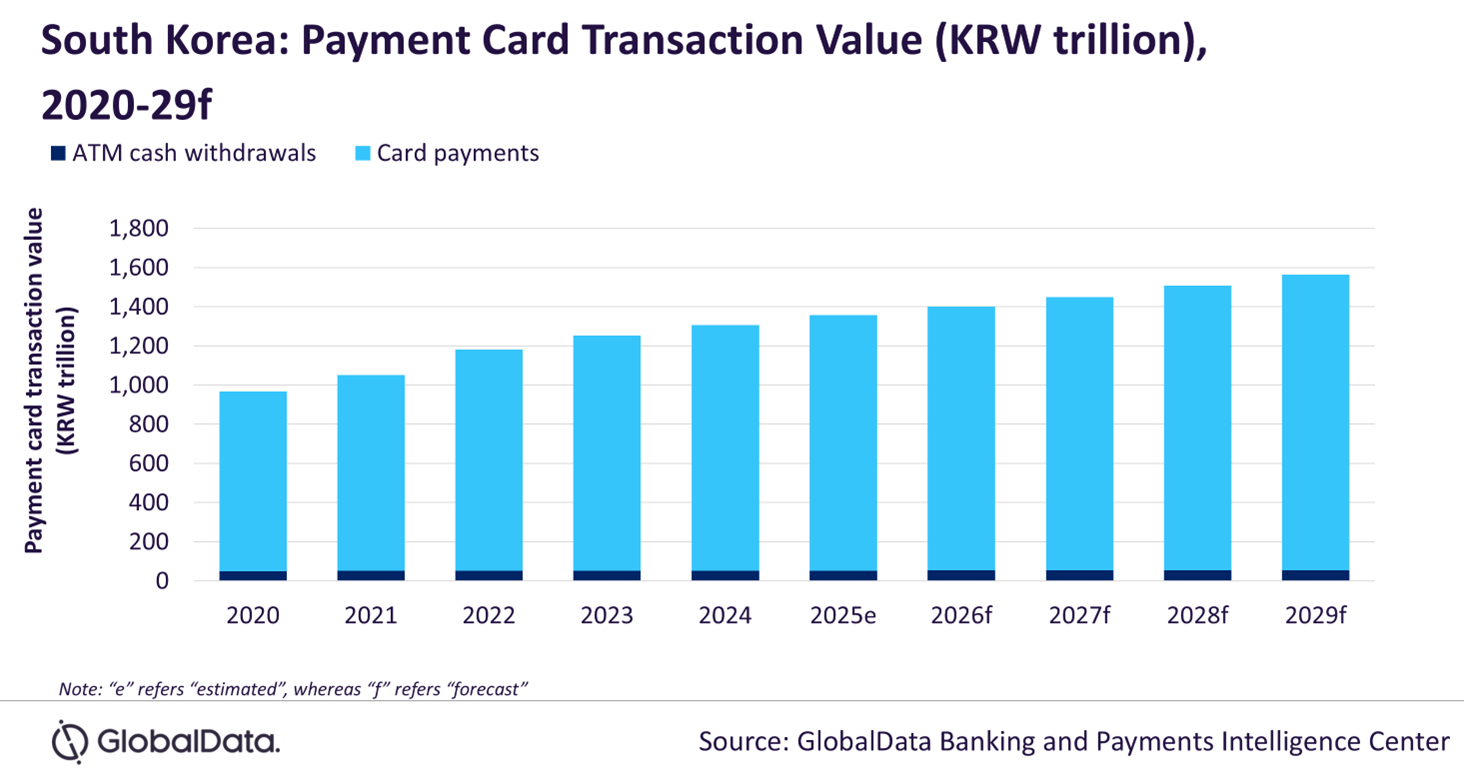
Payment cards are mostly used for payments at POS terminals rather than cash withdrawals, with the share of payments at POS estimated to reach 96.1% in 2025. The high usage of cards at POS terminals can be attributed to the rising consumer awareness and well-developed POS terminalization. Card payment transaction volume is estimated to rise from 24.2 billion in 2021 to 30.7 billion in 2025 at a CAGR of 6.2%. This figure is forecast to reach 35.9 billion by 2029.
To boost acceptance of card payments among small and medium enterprises (SMEs), payment company NHN KCP in collaboration with Verifone launched an all-in-one POS terminal called “KCP Terminal The Black” in January 2025. This versatile terminal operates as a POS, kiosk, and card payment terminal, accommodating a wide range of payment options, including cards, Apple Pay, QR and barcode payments, and various mobile wallets.
Gupta adds: “The growing popularity of contactless payment is also driving the overall card usage at POS. Backed by most banks and financial institutions in the country, contactless payments have become increasingly prevalent and are also widely accepted by most retailers.”
According to GlobalData’s 2024 Financial Services Consumer Survey*, over 53% of the respondents in South Korea indicated having access to a contactless card and used it for payments.
To broaden the applications of contactless card payments, Jeju Island signed an agreement in July 2025 with six organizations, including the Korea Payment Service Promotion Agency, to make payments for Jeju bus fares more convenient. This initiative seeks to simplify the payment process by allowing bus fares to be paid with contactless credit cards that lack transportation card functions, eliminating the necessity to buy or recharge separate transportation cards.
Gupta concludes: “The South Korean payment card market is poised for sustained growth over the next five years, supported by increasing consumer awareness of digital payments and advancements in payment infrastructure. The rise in e-commerce and contactless payments will also contribute to this growth. The payment cards market is forecasted to grow at a CAGR of 3.6% between 2025 and 2029 to reach KRW1.6 quadrillion ($1.2 trillion) in 2029.”
*GlobalData’s 2024 Financial Services Consumer Survey was carried out in Q2 2024. Approximately 2,014 respondents aged 18+ were surveyed in South Korea.
