

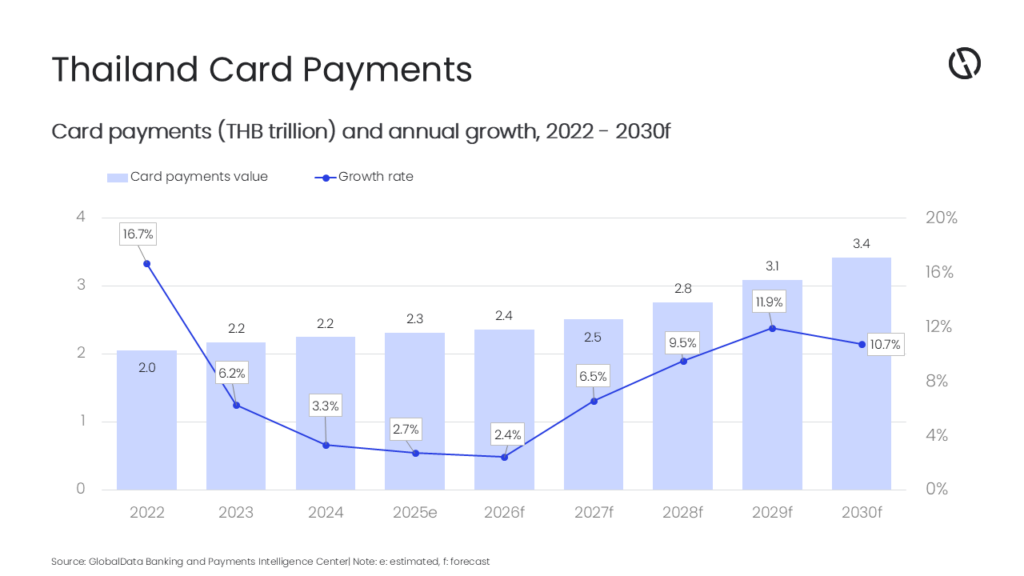
The Thailand card payments market is forecast to reach THB2.4 trillion ($71.8 billion) in 2026, supported by a gradual increase in payment card usage, expanding payment infrastructure, and the growing adoption of contactless payments, according to GlobalData, a leading intelligence and productivity platform.
GlobalData’s Payment Cards Analytics reveals that the total card payment value in Thailand registered an estimated compound annual growth rate (CAGR) of 7.1% over 2021-2025 to reach THB2.3 trillion ($70.1 billion) in 2025, reflecting the growing consumer familiarity with electronic payments, bank-led incentives, and government initiatives promoting cashless transactions.
Shivani Gupta, Lead Banking and Payments Analyst at GlobalData, comments: “Thailand’s payment landscape is gradually transforming, with card payments growing at a robust pace. The market is set to benefit from the intensifying competition and innovation following the Bank of Thailand’s move to license virtual banks, coupled with the ongoing efforts by banks to attract underserved segments into formal banking and encourage card usage for purchases.”
Credit and charge cards accounted for 94.5% share of the overall card payment value in 2025. Their popularity can be attributed to the rewards, discounts, cashback, and interest-free installment facilities offered by the companies. The rise of the middle class and young working populations in Thailand is also expected to drive the adoption and usage of credit and charge cards.
Debit cards, on the other hand, accounted for only 5.5% of total card payments in 2025, despite high card penetration. The increasing penetration of debit cards is driven by the growing banked population and the proactive initiatives by banks and government bodies to drive financial inclusion.
In June 2025, the Bank of Thailand awarded virtual bank licences to three consortiums—ACM Holding Group; SCBX in partnership with WeBank and KakaoBank; and Krungthai Bank with Advanced Info Service and PTT Oil and Retail. These digital-first banks are expected to broaden access by enabling instant account opening and digital debit card issuance for consumers underserved by traditional branch-based banking.
In Thailand, contactless cards are becoming more popular as banks and scheme providers push this technology. The rising adoption of contactless card payments for transport services will support growth in the card payment space.
In January 2026, Phuket Smart Bus, in partnership with Mastercard and Krungthai Bank, launched Tap & Go EMV contactless payments on its electric buses. The service allows riders to use contactless credit or debit cards instead of tickets or cash across key routes including Phuket International Airport–Rawai and the Old Town.
Gupta concludes: “Thailand’s payment card market is set to experience robust expansion over the coming five years, underpinned by the wider contactless adoption, expanded merchant acceptance, and enhanced digital payments infrastructure. Rising banking access and product innovation will further broaden usage, especially among underserved segments. The total card payment value is forecast to grow at 10.7% in 2030 reach THB3.4 trillion ($103.8 billion).”
