

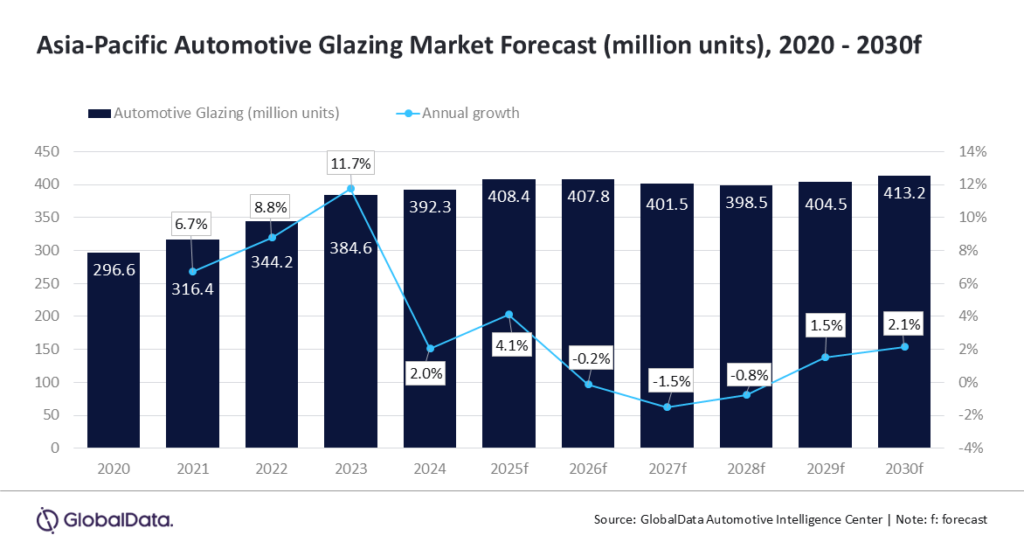
The Asia-Pacific (APAC) region is on the cusp of a transformative era in automotive design and engineering, driven by urbanization, rising incomes, and evolving environmental priorities. As consumers in India, China, Southeast Asia, and beyond increasingly demand vehicles that are attractive, energy-efficient, and safe, the automotive glazing sector is emerging as a critical lever shaping the future of the automotive market. Against this backdrop, the APAC automotive glazing market is projected to grow at a compound annual growth rate (CAGR) of 0.2% between 2025 and 2030, according to GlobalData, a leading data and analytics company.
GlobalData’s latest report, “Global Sector Overview & Forecast: Automotive Glazing Q3 2025”, reveals that the APAC automotive glazing market is poised to grow from an estimated volume of 408.4 million units in 2025 to 413.2 million units in 2030. In the glazing sector, switchable glazing, auto-dimming mirrors, and polycarbonate glazing are three of the fastest-growing segments in the region.
Madhuchhanda Palit, Automotive Analyst at GlobalData, comments: “Several compelling forces are accelerating glazing demand across the APAC automotive landscape. Firstly, climatic extremes—intense solar exposure, high heat, and humidity—amplify the need for glazing that offers strong UV and infrared shielding, and thermal comfort, reducing dependency on air-conditioning. Secondly, safety regulations are tightening: standards around impact resistance, visibility, and durability are compelling OEMs to incorporate laminated windshields, sturdier side and rear window designs, and glazing that mitigates risks in collisions.
“Furthermore, with electric vehicle (EV) adoption gathering pace, lightweight glazing materials—such as polycarbonate—are delivering key advantages: reducing overall weight, enhancing battery efficiency, and aligning with both regulatory and market pressures to lower emissions.”
Palit adds: “Technology is emerging as the backbone of glazing innovation in APAC. Infrared-reflective glazing, for example, is gaining traction as manufacturers apply advanced coatings to deflect solar heat without compromising visibility. Such glazing plays a dual role: elevating cabin comfort while supporting sustainability goals—particularly in EVs, where heat management translates directly into driving range.”
Smart glazing technologies—switchable glazing and auto-dimming mirrors—are no longer confined to high-end models. Sensor integration, adaptive tinting, and electrochromic materials are being increasingly adopted as visibility, driver comfort, and safety receive greater attention. Automakers are also pushing for glazing solutions that support vision systems—structures that enable cameras, HUDs (head-up displays), and ADAS (advanced driver assistance systems). Laminated glass with embedded functionalities, acoustic interlayers, and material innovations like polycarbonate are broadening the scope of what glazing can achieve.
Palit concludes: “Consumer preferences are shifting rapidly. The expanding middle class is no longer satisfied with basic functionality; aesthetic appeal, panoramic views, and premium finishing are increasingly sought after, even in more affordable vehicle segments. As panoramic sunroofs and moonroofs are becoming mainstream expectations, advancements in coatings and lightweight glazing materials are enabling these features to extend beyond luxury cars.
“Looking ahead, the growth of automotive glazing is set to exert considerable influence over the region’s automotive sector. As glazing moves from a supplemental feature to core design component, its role in vehicle differentiation, energy efficiency, and regulatory compliance will only deepen.”
