

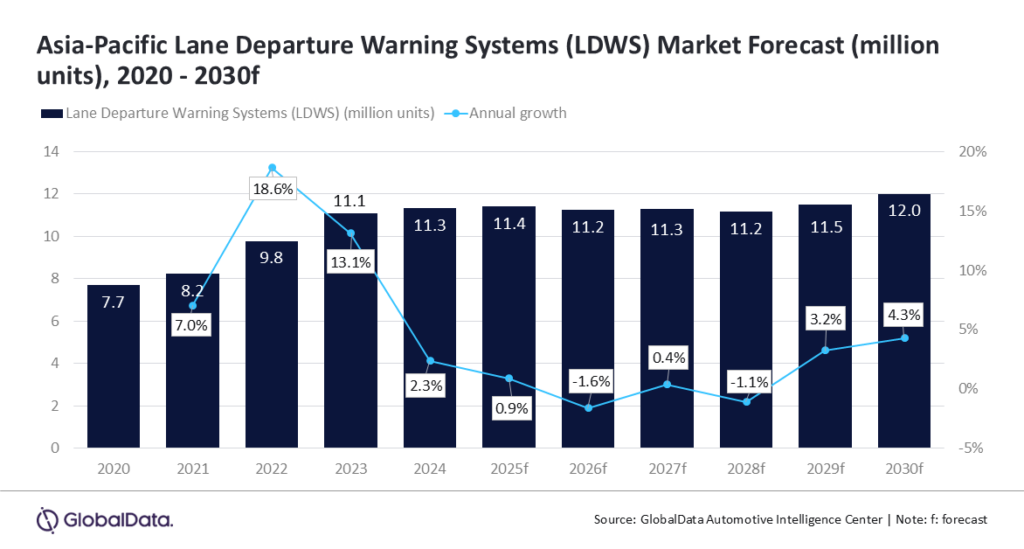
Driver assistance technologies are becoming a cornerstone for enhancing road safety in Asia-Pacific (APAC), with lane departure warning systems (LDWS) emerging as one of the most impactful innovations. These systems—which rely on sensors like cameras, radar, or LiDAR—warn drivers when their vehicle veers out of lane, thereby reducing crash risk. Against this backdrop, the APAC automotive LDWS market is projected to grow at a compound annual growth rate (CAGR) of 1.0% between 2025 and 2030, according to GlobalData, a leading data and analytics company.
GlobalData’s latest report, “Global Sector Overview & Forecast: Sensors Q3 2025,” reveals that the APAC automotive LDWS market is estimated at 11.4 million units in 2025 and is expected to reach 12.0 million units by 2030.
Madhuchhanda Palit, Automotive Analyst at GlobalData, comments: “Safety rating programs like ASEAN NCAP are proving critical in APAC, creating measurable incentives for LDWS adoption. Under the “Safety Assist” categories, vehicles equipped with LDWS tend to score higher, enhancing their appeal to buyers. Manufacturers are increasingly aware that performance in crash tests and driver-assistance assessments can strongly influence brand image and sales.”
Palit adds: “The growth of the sensor-based LDWS market in APAC is fueled by rising passenger vehicle production and shifting consumer expectations. As economies in Southeast Asia, China, India, South Korea and Japan continue to produce more cars, automakers are integrating LDWS and similar active safety technologies as standard or near-standard features. As road fatalities and traffic congestion stories make headlines, consumers in APAC are becoming more safety-conscious, which is driving demand for vehicles offering advanced protection. What was once considered a premium feature has started becoming mainstream, especially in middle-segment cars.”
Additionally, innovations in sensing, computing, and artificial intelligence (AI) are improving both reliability and affordability of lane departure systems. Cameras with broader dynamic range, radar modules with finer resolution, and software capable of adapting to varied road environments—from urban jungles to monsoon-soaked highways—are emerging. Key players—OEMs and Tier-1 suppliers alike—are investing heavily in R&D to enhance system performance under local APAC conditions, such as night driving, poor lane marking, or heavy traffic.
Palit concludes: “Looking ahead, the growth of LDWS in the APAC automotive market is likely to be significant. As regulators tighten safety mandates and NCAP programs raise the bar, LDWS will transition from “nice-to-have” to “must-have”. For manufacturers, LDWS represents both a compliance requirement and a competitive differentiator. For consumers, it offers peace of mind and improved safety—two qualities increasingly valued across APAC markets.
“While uncertainties remain—such as variation in regulation across countries and cost pressures in entry tiers—the trend is clear: lane departure warning systems are set to reshape safety expectations and product offerings in APAC’s automotive sector. As component costs decline, integration becomes easier, enabling LDWS to be bundled with other driver assistance systems and become standard in more models—even lower-cost ones.”
