

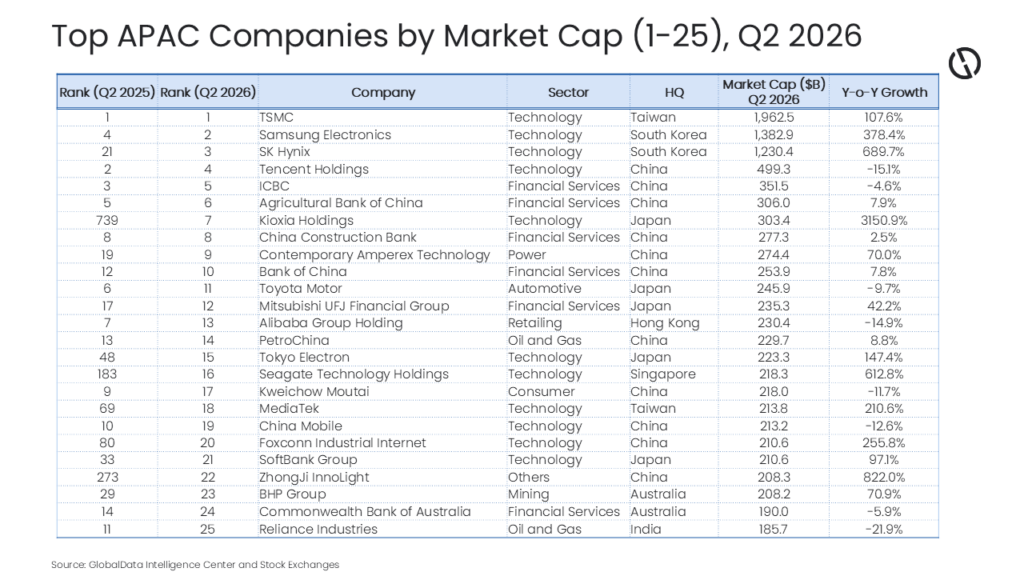
Asia-Pacific’s (APAC) second quarter (Q2) 2026 market capital table tells one dominant story: the AI infrastructure buildout has become the region’s single biggest wealth-creation and wealth-destruction engine, splitting winners and losers along lines that have little to do with traditional sector logic, according to GlobalData, a leading intelligence and productivity platform.
The memory supercycle
SK Hynix (+690%), Samsung (+378%) and Kioxia (+3,151%) are the standout gainers, and the mechanism is straightforward: hyperscaler demand for high-bandwidth memory (HBM) used in AI accelerators has outstripped supply. Samsung and SK Hynix reportedly raised HBM3E prices by nearly 20% for 2026 deliveries as NVIDIA’s H200 and rival ASIC demand from Google and Amazon intensified — unusual given HBM3E was expected to cede ground to HBM4.
Seagate’s 613% jump and Kioxia’s outlier surge reflect the same squeeze spilling into enterprise storage, as AI data centers devour capacity once earmarked for PCs and phones. TSMC’s steady 108% climb to become APAC’s first ~$2 trillion company is the quieter half of this story: it makes the chips that everyone else’s AI ambitions depend on.
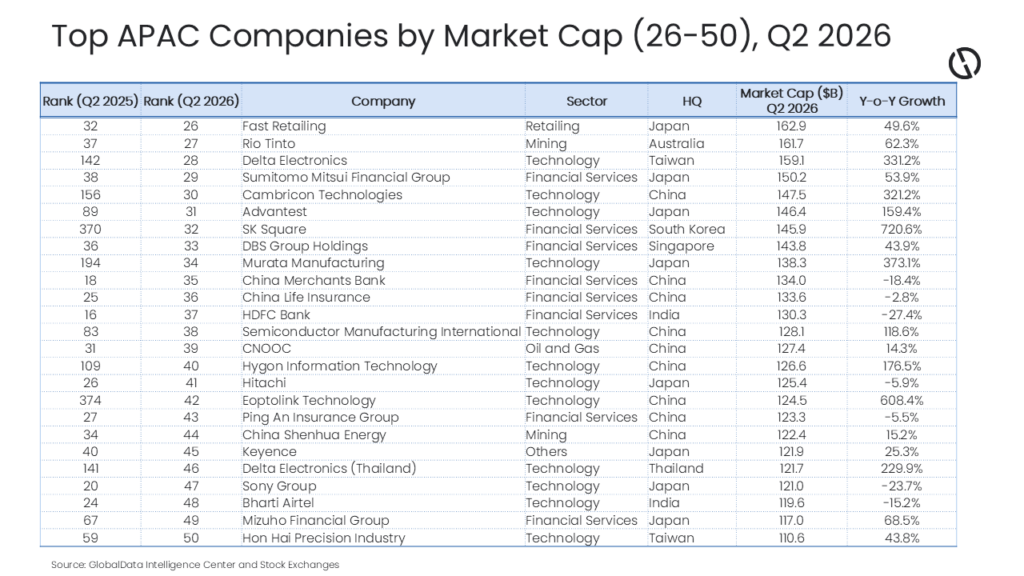
Murthy Grandhi, Company Profiles Analyst at GlobalData, comments: “China-based Cambricon’s 321% gain is a policy story as much as a business one. Beijing’s self-sufficiency push, amplified after DeepSeek confirmed its models could run on domestic silicon, made Cambricon China’s most expensive stock by price-earnings ratio, with shipment targets of 500,000 AI accelerators in 2026 versus roughly 116,000 in 2025 — though SMIC’s ~20% yields on its 7nm node remain a real bottleneck. ZhongJi InnoLight and Eoptolink (both up over 600%) ride the same wave as optical-interconnect suppliers to AI data centers.”
China’s internet giants stumble
Tencent (-15%) and Alibaba (-15%) fell for the opposite reason as their hardware peers rose: AI costed them money without yet making them any. Alibaba’s March-quarter revenue grew a weaker-than-expected 3%, and the company posted its first operating loss since early 2021 as AI spending weighed on results, while both face a Chinese consumer slowdown and intense domestic competition, widening the gap with AI-hardware-exposed markets like Taiwan and Korea.
Grandhi adds: “India presented a contrasting picture. Reliance Industries, HDFC Bank and Bharti Airtel all ranked lower than a year earlier. The declines do not necessarily signal deteriorating business fundamentals; instead, they underscore how global investors aggressively reallocated capital toward semiconductor and AI beneficiaries that delivered stronger earnings revisions and higher long-term growth expectations.”
Japan quietly emerged as one of the biggest strategic winners outside semiconductors. Beyond Tokyo Electron and Advantest, financial institutions including Mitsubishi UFJ Financial Group, Sumitomo Mitsui Financial Group and Mizuho Financial Group posted strong market-cap gains. Expectations that Japan is gradually exiting decades of ultra-low interest rates have improved earnings prospects for banks through wider lending margins, while corporate governance reforms continue attracting foreign capital.
Grandhi concludes: “Looking ahead, GlobalData anticipates that the divergence between AI hardware and broader AI spending is likely to persist into Q3-Q4 2026. Memory suppliers should retain pricing power as HBM4 ramps, while Chinese internet platforms and India’s financial and energy heavyweights will need clearer monetization or policy support to stem outflows. Two potential catalysts could reprice the entire table: the timing of OpenAI’s IPO and any change in US–China export controls.
“More broadly, sustaining today’s leadership depends on whether AI-related capex remains elevated through late 2026, even as markets contend with ongoing US–China tech tensions, tariff uncertainty, tighter chip controls, Middle East geopolitical risks that may affect energy prices, and the path of global interest rates. Despite likely volatility, June rankings indicate investors still award the highest valuations to AI-infrastructure enablers, with traditional sectors increasingly competing for capital in a market shaped more by technological change than economic size alone.”
