

The combined market capitalization of the top 50 companies in the Asia-Pacific (APAC) region surged to $8.3 trillion for the quarter ended 31 March 2025 (Q1), reflecting a 14% year-on-year increase. Technology firms led the charge, with Taiwan Semiconductor Manufacturing Company (TSMC) and Tencent Holdings dominating the rankings, while traditional sectors like automotive and energy faced valuation headwinds, reveals GlobalData, a leading data and analytics company.
Technology sector topped the list with 15 companies contributing a total market value of $3.1 trillion. Geographically, China led the rankings with 21 companies collectively valued at $3.9 trillion, followed by Japan with 13 companies at $1.5 trillion, and India with six companies accounting for $0.8 trillion.
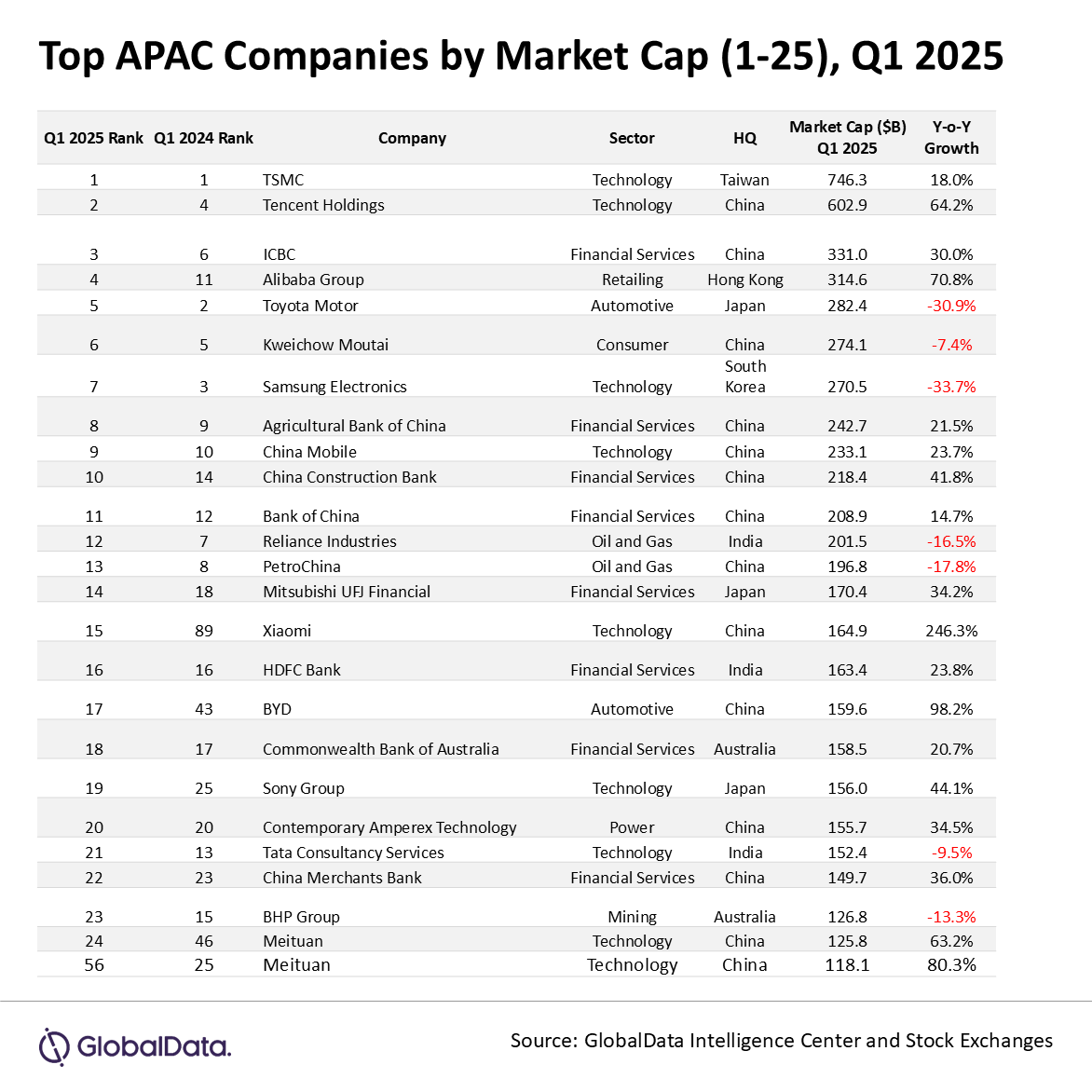
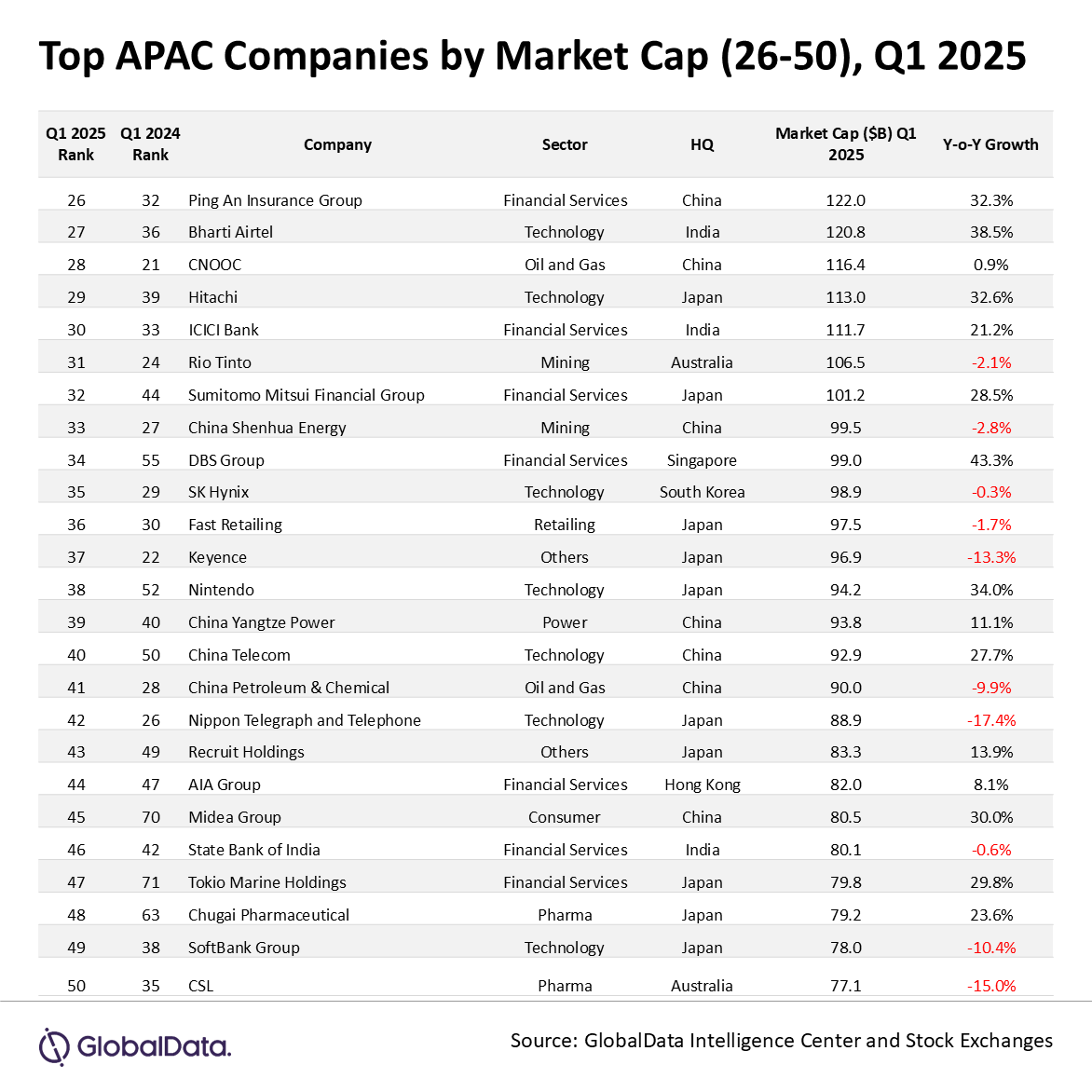
Murthy Grandhi, Company Profiles Analyst at GlobalData, comments: “In Q1 2025, APAC equities delivered mixed results, driven by contrasting macroeconomic conditions. China led gains amid policy support and tech resurgence, with Xiaomi (+246%), BYD (+98%), and Alibaba (+71%) outperforming. India sustained momentum on strong fundamentals, while Japan and South Korea lagged due to currency volatility and sector headwinds, with Toyota Motor (-31%) and Samsung Electronics (-34%) declining. Overall, the growth was concentrated in China and India, offset by softness in North Asia’s developed markets.”
Technology leads the charge
Taiwan Semiconductor Manufacturing Co (TSMC) maintained its top position with a $746.3 billion market cap, despite a 12% quarter-on-quarter (QoQ) dip. The decline, though notable, reflects the sector’s frothy valuations and temporary demand normalization after a strong Q4 2024 driven by global AI and high-performance computing chip demand. Year-on-year, TSMC grew 18%, supported by the structural global chip shortage and geopolitical demand shifts from China to Taiwan.
Meanwhile, Tencent Holdings saw an impressive 64% YoY and 22% QoQ growth, reaching $602.9 billion. The surge is attributed to the rapid monetization in its AI-powered cloud services and international gaming segments, coupled with easing of China’s regulatory crackdown on tech conglomerates—restoring investor confidence.
Xiaomi was the quarter’s dark horse, skyrocketing 246% YoY. The sharp rebound stems from the aggressive market share gains in Europe and Southeast Asia, capitalizing on Huawei’s persistent export restrictions. Moreover, its foray into electric vehicles and AIoT (AI + IoT) platforms is now yielding monetizable results.
Alibaba Group surged from 11th to fourth in market cap rankings due to strong e-commerce recovery, strategic business reintegration, AI-driven cloud momentum, and easing regulatory pressures in China—boosting investor confidence and triggering valuation re-rating.
However, the tech sector had its own set of challenges. Samsung Electronics, despite holding the seventh position, witnessed a sharp 34% decline in market capitalization, driven by weak demand for its artificial intelligence chips, ongoing losses in its contract chip manufacturing division, and investor concerns stemming from a leadership reshuffle following the unexpected passing of co-CEO Han Jong-Hee in late March. This contrast highlights the divergence in performance even within a thriving sector.
Toyota Motor, once a pillar of stability, fell from second to fifth as its market cap dropped 31% YoY. While the firm remains operationally sound, investors are punishing its perceived lag in EV innovation relative to BYD and Tesla. Toyota’s hybrid-focused strategy, although profitable, has not matched the sentiment-driven momentum of full EV plays.
Financial services resilience
Chinese financial institutions continue to maintain a commanding presence. ICBC, Agricultural Bank of China, and China Construction Bank stood at third, eighth, and tenth respectively, with YoY growth exceeding 20%. This resilience is tied to the country’s fiscal policy pivot—stimulus in housing and infrastructure lending, despite broader concerns around deflation and demographic drag.
India’s HDFC Bank and ICICI Bank continue their ascent, bolstered by a high-yield environment, robust credit growth, and an increasingly formalized economy. Their digital banking pivots are attracting foreign institutional flows amid India’s outperforming equity indices.
Emerging leaders and rising stars
Meituan and DBS Group quietly outperformed, with YoY gains of 63% and 43% respectively. Meituan’s rebound suggests revived domestic consumption in China, while DBS benefits from rate tailwinds in a higher-for-longer US Fed environment.
Grandhi concludes: “In Q2 2025, APAC companies are expected to face uneven performance amid renewed Trump-era tariffs, heightened US-China trade tensions, and rising global stagflation risks. Export-driven firms may see margin pressures, particularly in technology and manufacturing, while domestically focused companies in India, Japan, and ASEAN could offer resilience. Volatility in commodities may weigh on miners and energy players, prompting a rotation into defensives like financials and utilities. Firms with strong fundamentals, pricing power, and local demand exposure will likely outperform.”
