

The BIOSECURE Act could impact more than 120 US biopharmaceutical drugs partnered with Chinese companies “of concern” named in the bill. Of these, approximately half are in clinical trials (Phases I to III) and a third are in early-stage preclinical studies and discovery, reveals GlobalData, a leading data and analytics company.
In January 2024, the US Senate and House of Representatives introduced the BIOSECURE Act to prevent the US companies that collaborate with “foreign adversary biotech companies” from accessing US federal funding mechanisms such as the contracts, loans, and grants. The bill mentions major Chinese companies WuXi AppTec, BGI, MGI, and Complete Genomics along with their subsidiaries, parents, affiliates, and successors, citing them as risks to the US national security. In May 2024, US lawmakers amended the BIOSECURE Act, allowing existing contracts with Chinese companies until 1 January 2032.
Alison Labya, Business Fundamentals Analyst at GlobalData, comments: “More than 45 US-headquartered companies have entered into contract service agreements (CSAs), licensing agreements, or partnership deals with Complete Genomics, WuXi Biologics Cayman, WuXi AppTec, or BGI Genomics, and their subsidiaries.”
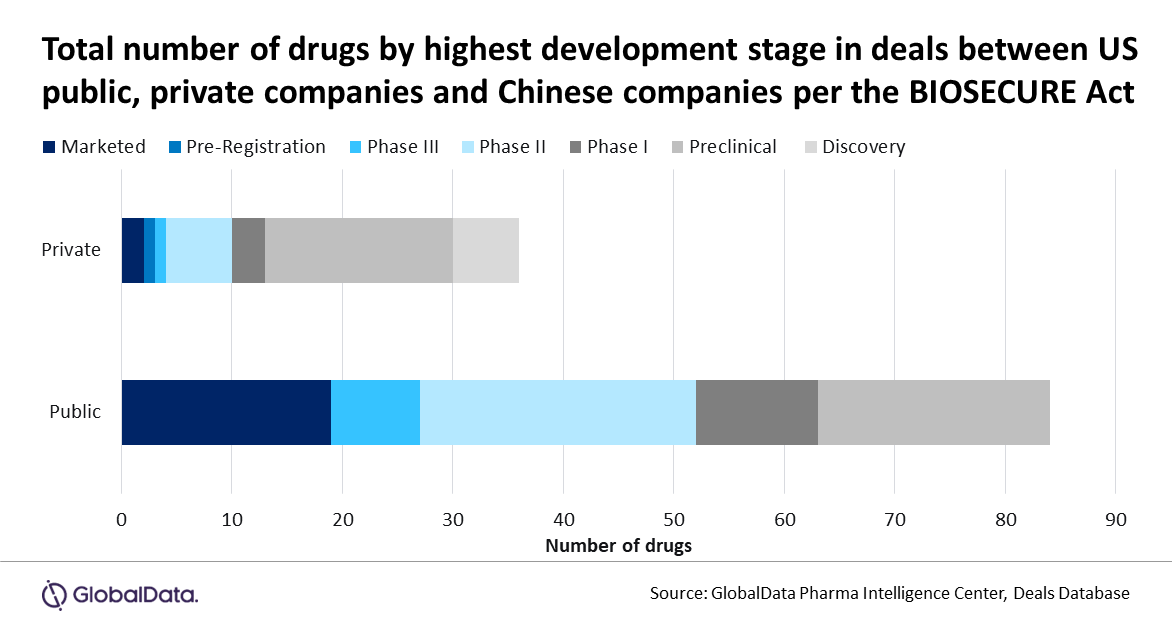
More than two-thirds of drugs that could be at stake due to the BIOSECURE Act were developed by public companies in the US, of which approximately 60% are marketed or in late clinical stage (Phase II-III) trials.
Labya adds: “This demonstrates long-standing relationships between significant players in the biopharmaceutical industry and those major Chinese companies, given that it typically takes more than a decade to bring a drug to market.”
Several biopharmaceutical companies, including Merck, Gilead Sciences, and Vertex Pharmaceuticals, have cited increased costs, delays in clinical trials, US Food and Drug Administration (FDA) regulatory submissions and launch of drugs as potential impacts of the BIOSECURE Act.
As biopharmaceutical companies look to diversify suppliers before the 2032 deadline set by the BIOSECURE Act, CDMOs headquartered outside of China may experience increased growth over the next decade.
Labya concludes: “Indian CDMOs such as Cipla, Syngene, and Aurobindo may be well-positioned for increased growth due to their cost-effectiveness and highly skilled workforce. However, growing concerns of US dependency on offshore suppliers may also result in a shift towards US companies selecting domestic CDMOs.”
Note: Data in the chart includes all contract service agreements, licensing agreements, and partnership deals globally between Complete Genomics, WuXi Biologics Cayman, WuXi AppTec, and BGI Genomics, or their subsidiaries and US-based company, where at least one innovator drug is involved, as well as deals with and without a deal value disclosed in the public domain.
