

South Korea’s biopharmaceutical sector is experiencing a surge in innovator drug licensing agreements, with a total deal value of $7.86 billion year-to-date (YTD) in 2025, marking a 113% increase from 2024, according to GlobalData, a leading data and analytics company.
Ophelia Chan, Senior Business Fundamentals Analyst at GlobalData, comments: “The momentum is largely attributed to billion-dollar agreements among large pharma companies like Eli Lilly and GSK. The growth follows a dip in 2024, when total deal value dropped to $3.67 billion due to macroeconomic challenges.”
The South Korean government has played a pivotal role in the licensing recovery through proactive initiatives. In January 2025, the National Bio Committee was established to enhance the country’s competitiveness in novel drug and advanced biopharmaceutical technology development. This initiative builds on ongoing reforms as the government aims to reduce drug development timelines from 13.7 years to six years and cut costs from KRW2 trillion ($1.43 billion) to KRW1 trillion ($718.5 million).
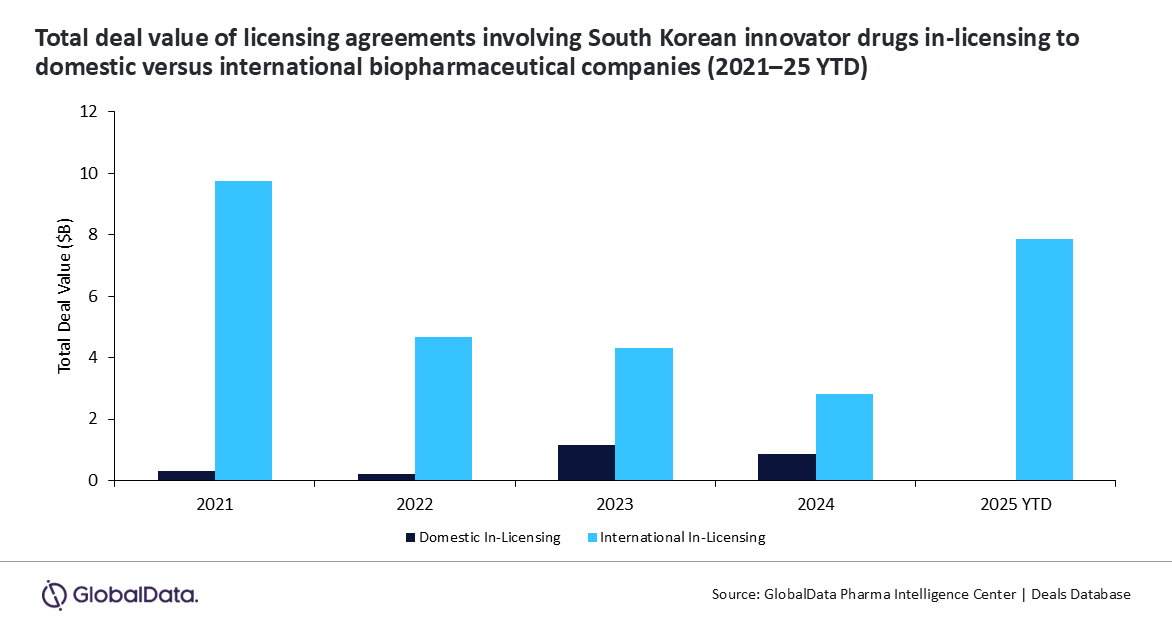
International biopharmaceutical companies have been actively in-licensing South Korean drugs, with a total licensing agreement value of $29.4 billion over the past five years, with Western companies accounting for 79% ($23.3 billion). This highlights South Korea’s strategic position as a gateway to Asian markets and a source of innovative drugs. Out-licensing of South Korean drugs to international firms surged by 180% ($5.1 billion) from 2024 to 2025 YTD, with a decline in domestic licensing indicating a shift towards cross-border collaborations.
In April 2025, GSK’s partnership with the South Korean biotech company ABL Bio, valued at up to $2.78 billion, focuses on neurodegenerative diseases through the Grabody-B platform. Similarly, Lilly’s $1.3 billion licensing of Rznomics’ trans-splicing ribozyme platform for hearing loss treatment showcases South Korea’s growing influence in drug delivery and advanced therapeutics on a global scale.
Chan concludes: “Once primarily recognized for generic drug production, South Korea is now transitioning into a global hub for novel innovative drug discovery and advanced drug technologies, bolstered by government support and increasing international investment. This transition positioning the country as a strategic bridge between Western and Asian markets.”
For further insights into the latest Deal Trends in the Pharma Sector, please see GlobalData’s Venture Capital Investment Trends In Pharma – Q2 2025 and M&A Trends in Pharma – Q2 2025 reports.
Note: A single deal may include multiple drugs across various indications and modalities. This figure includes all announced and completed innovator licensing agreements across all active development stages (marketed, pre-registration, Phase III, Phase II, Phase I, pre-clinical, and discovery) for licensee companies headquartered in South Korea versus the rest of world from 2021 to 2025 YTD with a lead drug in the deal. The analysis includes the highest deal stage, which is the highest development stage of the most advanced drug in the deal at the time of the deal.
