

Low-code, no-code (LCNC) platforms are becoming popular as companies are pouring millions into digital transformation to cut down lengthy development cycles to create new applications that meet immediate business needs. In line with this, companies’ discussions around LCNC grew by 18% year-on-year in 2022, reveals GlobalData, a leading data and analytics company.
GlobalData’s Company Filings Database reveals that companies’ discussions around low code, no code, which is the new paradigm in application development that reduces or eliminates the need for coding, has increased gradually in recent years.
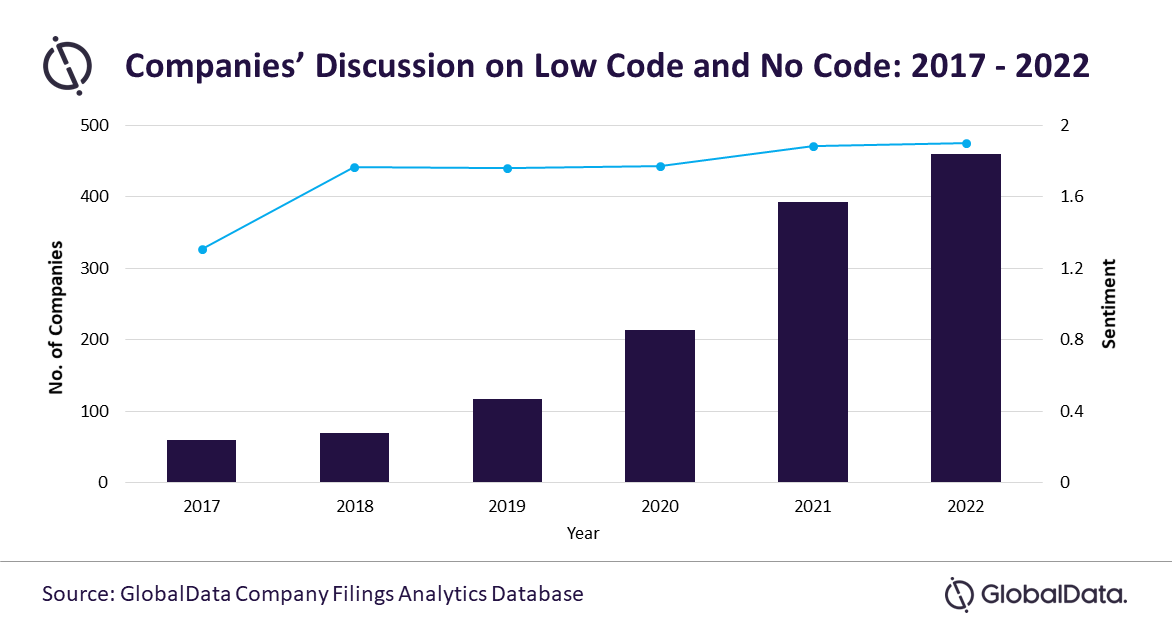
Misa Singh, Analyst at GlobalData, comments: “Low code is recognized as a connected toolset to implement automation programs more successfully in the face of escalating prices, skill shortages, and changing consumer expectations. Low-code architecture using prebuilt templates, API-microservices, and workflow automation allows to address the present skill shortage and offset deploying expensive IT resources.”
eClerx Services believes that the growing demand for low-code, no-code, robotic process automation, smart automation (AI/machine learning), consulting, and platform installations has contributed to the doubling of automation services.
New York-based UiPath released a 22.10 version of its platform that helps robots interpret both structured and unstructured data and gain browser-based access to a low-code development platform. It also equips them with an ability to create public facing apps as well as expanded process and task mining capabilities.
Magic Software’s low code and metadata platforms include pre-written technical and administrative functions that are essentially ready-made business application coding. This allows developers to skip the technical code-writing stage of application development and integration, focus on creating the proper logic for their apps, and proceed efficiently with deployment. Furthermore, the company believes that developed economies such as the US and Canada will play a significant role in the market expansion for low-code development platforms.
JFE Holdings mentions that, in addition to low-code development tools, the company supports in-house development using workflow systems to increase operational efficiency and promote changes like eliminating stamps and switching to a paperless system.
Duck Creek Technologies talks about investing in a software-as-a-service (SaaS) insurance platform with new targeted capabilities to extend products, platforms, and low code configuration tools, into their platform. Software firm i3 Verticals mentions about investing in low code application technologies.
Singh concludes: “Low code can save expenses and avoid delays while delivering new apps more quickly to users and staff. It enables software development with less physical and human resource investment than before, which could promote innovation through digitalization.”
