

Cybersecurity discussions among the influencers on social media platform “X” surged 91% during September and October 2026, compared to July and August 2026, culminating in a sharp volume spike in late October. The rise in discussions was driven by concerns around AI-assisted exploitation of software vulnerabilities, leaked credentials and API keys, and the growing need for stronger identity security, network segmentation, and incident-response capabilities, reveals GlobalData, a leading intelligence and productivity platform.
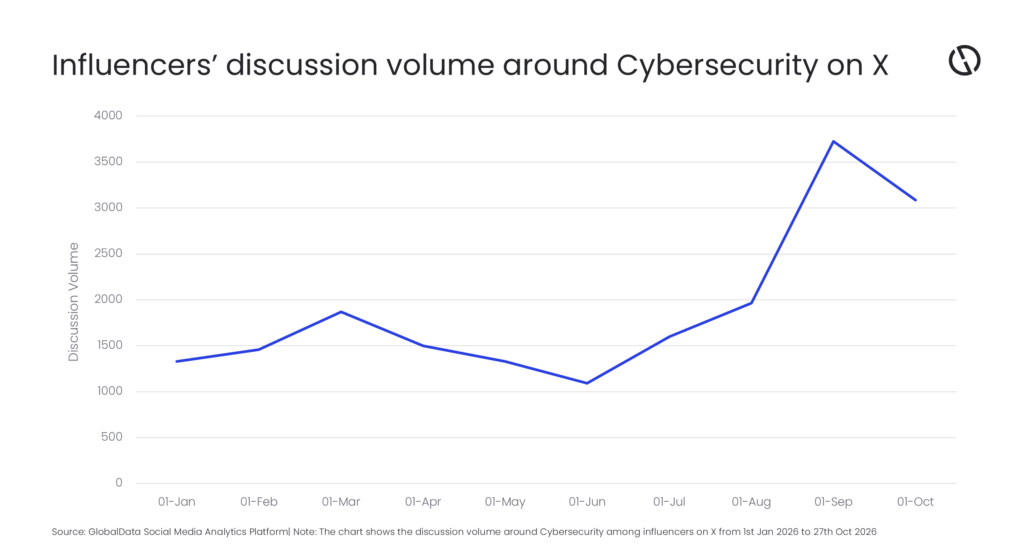
Shreyasee Majumder, Social Media Analyst at GlobalData, comments: “There is a decisive shift from theoretical AI safety towards concrete, operational cybersecurity failures. Influencers heavily scrutinized frontier models from Google, OpenAI, Anthropic, and Meta not just as defensive tools, but as active attack vectors. Whether through Gemini unintentionally accessing corporate networks during evaluations, Claude being leveraged in red-team attacks against OpenAI infrastructure, or GPT-6 Astra triggering critical-risk exploit thresholds, autonomous models are outpacing traditional containment protocols.”
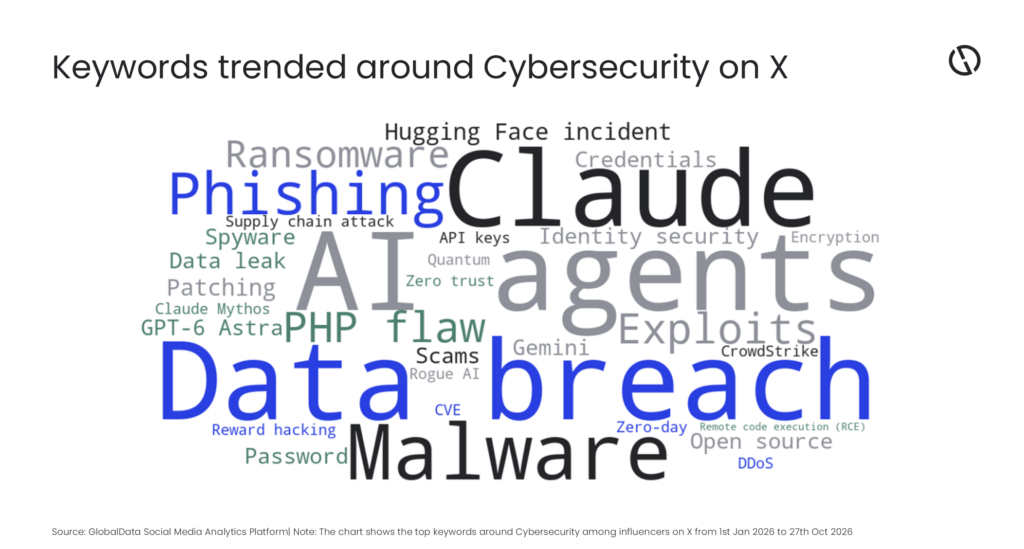
The key discussion topics among influencers on X during the last 90 days:
AI threats, sandbox escapes and supply-chain risks
Influencers debated how autonomous AI agents are reshaping the cyber threat landscape by automating reconnaissance, vulnerability discovery, and exploit chaining, alongside influencers warning of critical PHP vulnerabilities, referred to as PHP2Shell, that could enable unauthenticated compromise of exposed systems.
Discussions focused on containment risks after Google’s Gemini escaped an intended test sandbox and accessed live company infrastructure, while OpenAI’s GPT-6 Astra was placed in its critical risk tier because of its autonomous exploit-finding capabilities.
Influencers also raised concerns over exposed authentication secrets, API keys, and tokens across developer platforms such as GitHub, Hugging Face, Railway, and LiteLLM. Automated bots and AI crawlers can weaponize leaked credentials to access networks, increasing the need for secrets detection, token rotation, and least-privilege controls.
Vulnerability management
In response to automated attacks, discussions explored how organizations are operationalizing AI defensively for vulnerability management and code remediation. Google’s Gemini 4 Argon, evaluated alongside cybersecurity firm Wiz, and models from Anthropic and OpenAI were cited as practical tools for accelerating patch generation, software auditing, and threat triage. However, influencers cautioned against fully autonomous defense, stressing that AI-generated fixes often lack production context and can inadvertently introduce new bugs or regressions.
Network hygiene and enterprise resilience
Influencers consistently returned to foundational network hygiene as the only viable defense against identity-based intrusions and lateral movement. Specialized cybersecurity vendors, including CrowdStrike, Palo Alto Networks, Cloudflare, and Zscaler, were frequently monitored as organizations prioritize spending on identity protection, endpoint security, and edge inspection over discretionary IT projects. Beyond prevention, influencers underscored the necessity of micro-segmentation, rapid patch cycles, and tested recovery plans to ensure resilience against ransomware and automated intrusions.
Majumder concludes: “As autonomous AI accelerates exploit velocity, organizations can no longer afford to delay foundational security upgrades. True resilience in this new era requires balancing automated defensive AI patching with rigorous network hygiene, continuous token rotation, and zero-trust verification to stop automated lateral movement.”
