

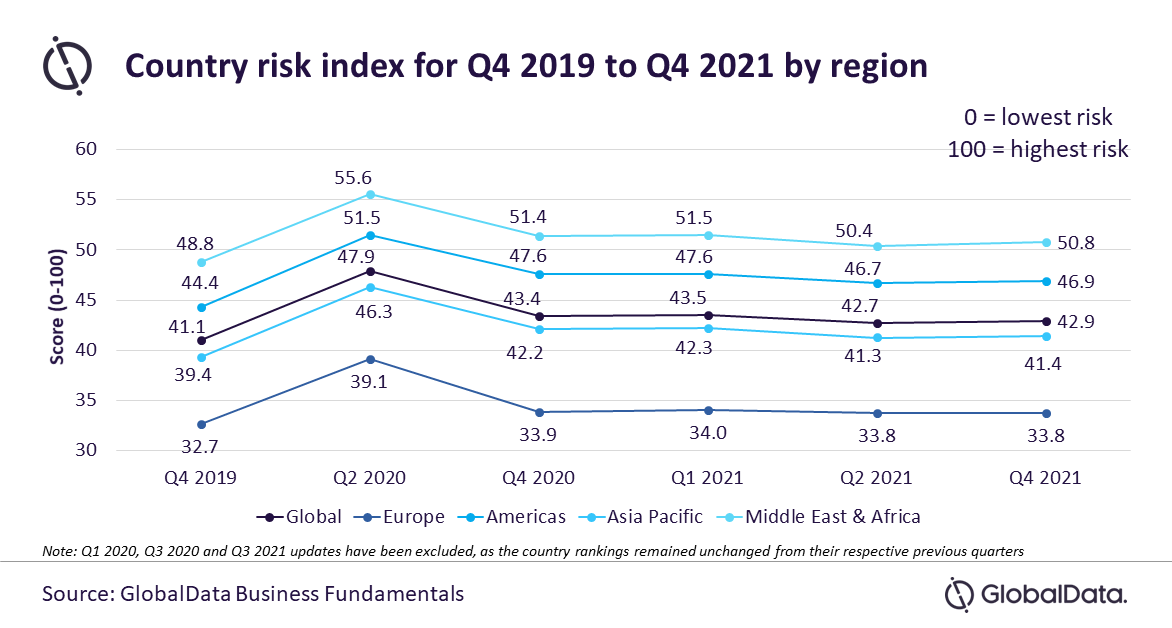
With Omicron variant spreading at the lightening speed and the consequent reimposition of restrictions may dwindle the recovery path of the global economy. Supply chain disruption, rising price levels, uneven vaccination drive and mass cancellation of flights came out to be major risk factors globally towards the end of 2021. GlobalData’s report, ‘Country Risk Index (GCRI) Q4 2021’, finds that global risk increased marginally to 42.9 out of 100 in Q4 2021 from 42.7 in Q2 2021.
Bindi Patel, Business Fundamentals Analyst at GlobalData, comments: “The detection of a new highly transmissible variant, named Omicron, in November 2021 has deterred the global economic recovery prospects. Along with it, the rising demand, coupled with the soaring costs of raw materials amid production cuts of coal, is driving up global prices of goods. In November 2021, the inflation rate increased to its highest level in the US (in 30 years), in the UK (since May 1992), in Germany (since July 1992), in Canada (since March 2003), and in Brazil (since February 2016). GlobalData expects the global inflation rate to rise from 2.5% in 2020 to 3.5% in 2021 and further to 3.7% in 2022. To tame inflation levels, Central Banks gradually started monetary tightening, which may have a negative effect on investor sentiments.”
Europe – Inflationary pressure and fiscal concerns looms large
Although Europe remained the region with the lowest risk in Q4 2021, with a score of 33.8 out of 100, the risk score increased marginally over the last update due to the emergence of the Omicron variant which has yet again made Europe the epicentre of the pandemic. In addition to it, rising inflationary pressure, high fiscal deficits and continuous protests within the region could potentially knock Europe’s economic prospects off track.
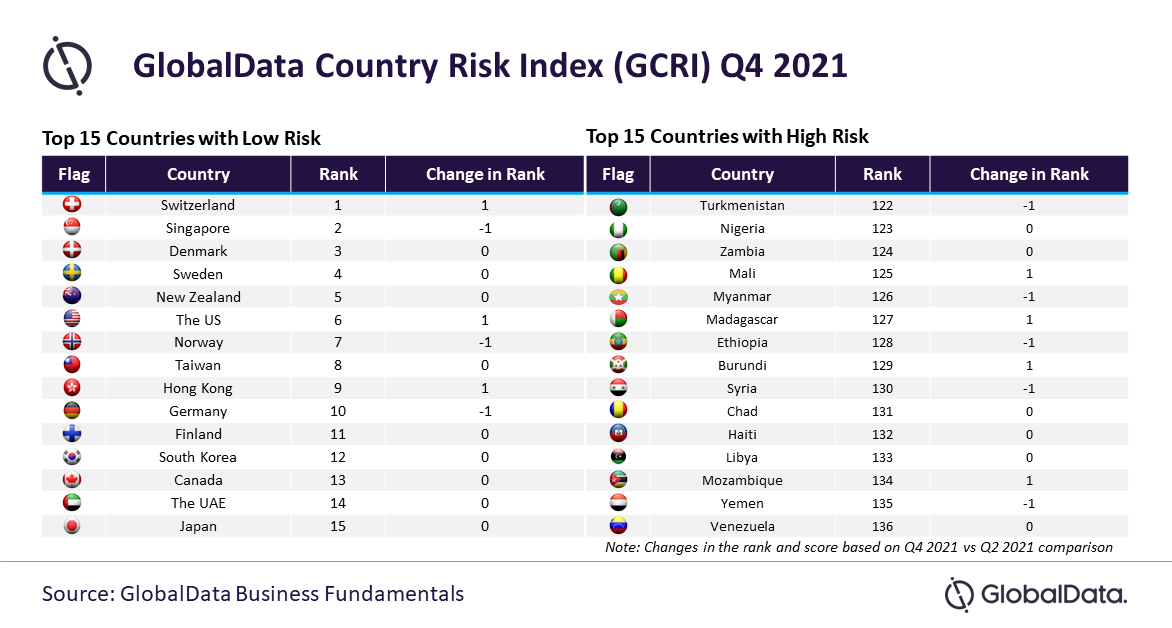
Switzerland, Denmark, Sweden, Norway, Germany, and Finland continue to remain in the list of top 15 nations with the least risk in Q4 2021.
Asia-Pacific – Renewed restrictions and slowdown in China remained main concerns
The Asia-Pacific region’s risk score increased in Q4 2021 over the previous quarter. Renewed lockdowns slowed down economic growth and recovery for some countries in the Asia-Pacific region. In December 2021, China ordered a lockdown for 13 million people in the northern city of Xi’an. Ahead of Christmas, New Zealand delayed its plan to open international borders and South Korea imposed partial restrictions.
Property market crisis, along with energy crisis, hampered economic recovery in China. GlobalData revised down its 2021 and 2022 GDP growth rate forecast for China from 8.6% and 5.7% in June 2021 to 7.8% and 5.0%, respectively, in December 2021.
Meanwhile, Singapore was the second lowest-risk nation in Q4 2021 GCRI update. Due to the implementation of timely policies with respect to tackling the COVID-19 pandemic along with fully vaccinating more than 80% of the population as of January 2022, the country experienced positive economic recovery.”
Americas – Vulnerability of Latin American countries continues
The Americas region was the second highest in terms of risk worldwide, with a score of 46.9 out of 100 in Q4 2021. Panama, Peru, and Jamaica exhibited the swiftest improvements in their rankings in Q4 2021 GCRI update, reflecting a steady economic recovery amid the phasing out of pandemic restrictions. On the other hand, the risk rankings of Cuba, Argentina, and Colombia fell further, as inflation and the debt crisis worsened.
Several American nations witnessed violent anti-government protests in H2 2021. Political uncertainty is on the rise in Brazil, Colombia, and Costa Rica amid the upcoming elections in 2022. On the other hand, countries such as Brazil and Argentina are struggling with double-digit inflation.
In the Q4 2021 GCRI update, the US and Canada remained in the list of top 15 nations with the least risk.
Middle East and Africa – The continued geopolitical turmoil is weighing down growth prospects
The Middle East and Africa (MEA) region witnessed highest risk among all regions in Q4 2021, at 50.8. Communal unrest in poorer areas has resulted in an uneven vaccination rollout and volatile food prices.
“Due to the continuous geopolitical tensions within the MEA region, there has been an uneven economic recovery. Countries including Israel and Saudi Arabia posted positive economic growth mainly due to revival of oil activities and a very strong vaccination drive. However, countries including Syria, Libya, Yemen, and Lebanon continue to face the worse humanitarian crises along with skyrocketing poverty.”
Libya, Mozambique, and Yemen were the countries regarded by GlobalData to have the highest risk in the MEA region.
