

2022 was set to be the year when Europe’s economy pulled away from the pandemic’s firm grip and commenced a phase of robust economic recovery. However, Russia’s invasion of Ukraine has shattered all these expectations and changed the picture perilously. Consequently, GlobalData, a leading data and analytics company, has slashed its 2022 gross domestic product (GDP) growth rate forecast for Western Europe from 4.0% in February 2022 to 3.3% in April 2022. For Eastern Europe, the GDP growth projections for 2022 have been cut by 6.5% to -2.9% in April 2022, as compared to the February 2022 forecast.
Against a tumultuous backdrop of surging commodity and energy prices, protracted supply chain constraints ensuing from the coronavirus outbreak, the new crisis has further exacerbated global supplies, battered consumer confidence, and decelerated economic growth.

Jasleen Sandhu, Senior Economic Research Analyst at GlobalData, comments: “Skyrocketing global prices, including oil and gas and wheat prices, have further fueled an already record-high inflation rate. Businesses have been struggling to withstand implausibly high costs that could disrupt production and hamper market competition, while the purchasing power of households across the continent has plunged to record lows.”
According to GlobalData’s Country Analytics April 2022 forecasts, the inflation rate will accelerate to 3.6% in Western Europe and 8.4% in Eastern Europe in 2022, the highest level since the introduction of the single currency. These forecasts are up by 1.6 and 3.1 percentage points, respectively, from the February 2022 projections.
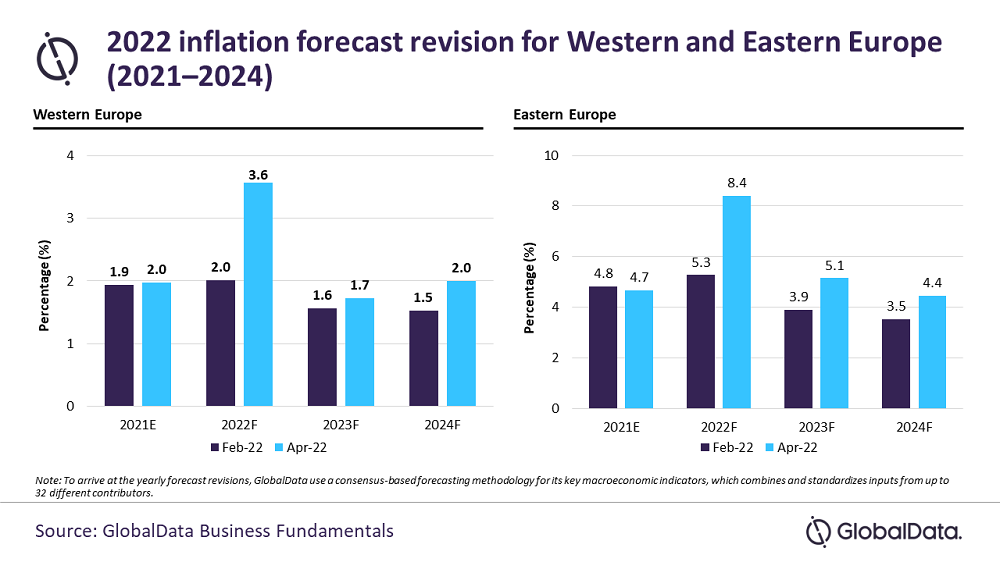
The ongoing war in Ukraine and its reverberating consequences – including explicit embargoes, implicit bans, and voluntary withdrawal from trade that the G7 nations imposed on Russia – are exerting further upward pressure on prices. Russia has halted its gas supplies to Poland and Bulgaria, delivering on its threats to cut off gas flows to nations that fail to pay for fuel in rubles.
Sandhu continues: “The war-related supply shock and the resulting reduced economic output may prove particularly crucial for the EU member states with stronger ties to Moscow. The member states have harnessed swift and judicial initiatives to combat the ongoing crisis. These include humanitarian aid to Ukrainian refugees, fiscal and economic assistance to Ukraine and continued budget and monetary support to the economy to overcome production disruption and climbing inflationary pressure. However, these policies will compel the governments to confront distressed public finances.”
Moreover, the European Union cannot phase out its dependence on Russian energy imports without bearing significant economic impact, especially in the absence of inexpensive alternatives. The best way to ease the blow is to reduce consumption, ramp up its green transition, and diversify energy sources.
Sandhu concludes: “As Moscow continues to mount its offensive against Kyiv, concern over Europe’s future only grows. Ongoing global supply chain disruptions and economic slowdown has slammed the brakes on Europe’s post-coronavirus revival. The continent is posed to face short-term stagnation and high pricing pressures, highlighting the broadening economic spill overs from the war and leaving a high degree of uncertainty looming over the severity and prolongation of these effects.”
