

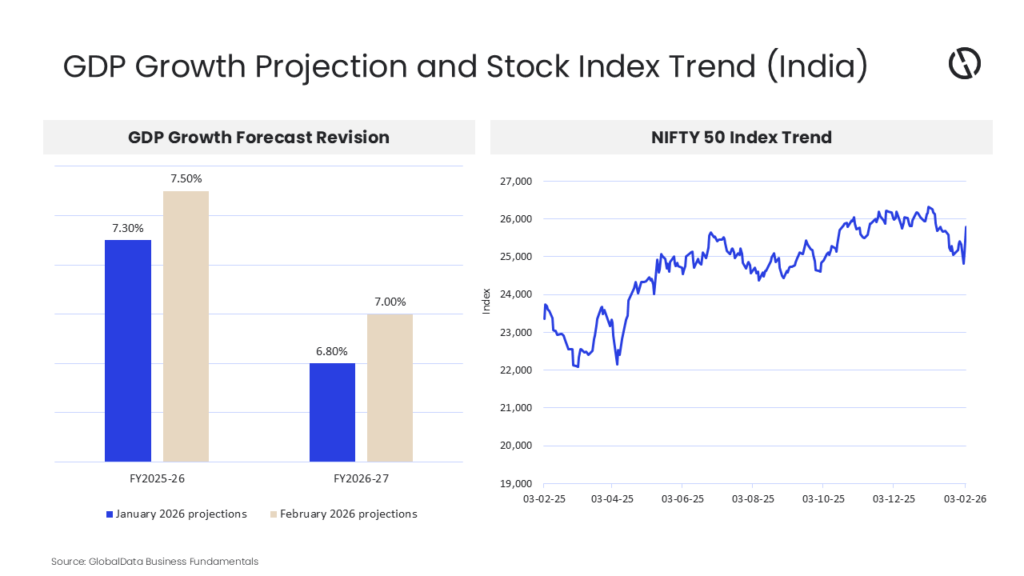
Following the conclusion of two landmark trade agreements, first with the European Union in January 2026 and then with the US in February 2026, India’s economic outlook has strengthened markedly. Reflecting this momentum, GlobalData, a leading intelligence and productivity platform, has revised its economic growth forecast for India to 7.5% in FY2025-26, up from its earlier projection of 7.3%, citing improved trade prospects and stronger investor confidence.
Ramnivas Mundada, Director of Economic Research and Companies at GlobalData, comments: “Taken together, the EU and US agreements are a meaningful positive shock to India’s external sector. They improve market access, lower tariff headwinds, and reduce uncertainty for export-oriented industries, which supports a higher FY26 growth trajectory.”
EU trade agreement: Access expansion and 2030 trade target
The EU deal establishes a preferential trade framework spanning a combined consumer base of about 2 billion people. Under the agreement, India is expected to receive preferential access to 97% of EU tariff lines, a move that could significantly benefit key export categories such as engineering goods, auto components, textiles and apparel, chemicals, and select value-added agricultural products. The agreement also sets an explicit ambition to scale up bilateral trade. India–EU bilateral merchandise trade is targeted to rise from $136.54 billion to over $200 billion by 2030, implying sustained export momentum and deeper supply-chain linkages over the medium term.
Mundada adds: “The EU agreement is structurally important because it provides broad-based tariff-line coverage and a credible pathway to lift merchandise trade above $200 billion by 2030. That visibility supports corporate capex and supply-chain investments in India.”
US agreement: Tariffs lowered, broader strategic commitments
A separate agreement with the US reduces tariffs on Indian goods to 18% from 50%, improving price competitiveness for Indian exports in the US market and potentially supporting higher volumes across manufacturing categories. India, in turn, has committed to zero tariffs on American goods, alongside measures that include a shift in energy sourcing from Russia to the US and a large import commitment. As reported, the package includes a $500 billion commitment for American technology and energy imports, which may support domestic industrial upgrading, energy security, and downstream investment, if executed in a phased and predictable manner.
According to the ITC Trade Map, the US was India’s largest export destination in 2024, accounting for 18.3% of total exports. The deal, therefore, offers meaningful relief to Indian exporters.
Market reaction in India
Indian equity markets responded positively on the agreements, with investor attention centered on export-linked sectors. Companies exposed to US and EU demand, such as industrial manufacturing, auto ancillaries, pharmaceuticals, specialty chemicals, and logistics, were in focus, reflecting expectations of improved order flows and margin resilience under a lower-tariff regime. The rupee also benefited from an improved medium-term trade outlook, alongside broader risk-on sentiment.
Following the EU deal announcement on January 28, 2026, the NIFTY 50 rose 0.7%. In early trade on February 3, 2026, the index gained 2.8% after the US deal. The rupee strengthened 1.77% to 90.36 per US dollar on February 3, 2026.
Macro implications: Productivity, currency stability, and investment
India’s Economic Survey 2025–26 characterizes these agreements as “productivity engines,” reflecting the potential for trade liberalization to lower input costs, widen market access, and boost scale efficiencies. Over FY2025-26, the combined effect is expected to support export growth, attract incremental investment into tradeable sectors, and help stabilize the rupee and equity markets by improving the balance-of-payments outlook.
Mundada concludes: “While implementation details, such as rules of origin, compliance pathways, competitiveness, and transition timelines will determine the pace of benefits, the direction of travel is clearly supportive of higher growth and stronger external competitiveness.”
