

The monetary measures and temporary relief packages conducted by major economies are expected to have a positive impact on inflation over the coming months, according to GlobalData. However, the leading data and analytics company notes that the anticipated reduction in inflation is not as high as governments hoped. Further, the pass-down of energy costs to households and businesses will continue to be a major concern.
Inflation to fall in major economies but elevated levels expected until 2023
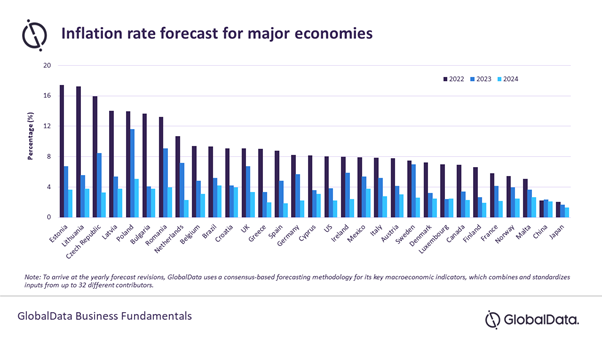
According to GlobalData’s Macroeconomic database, inflation is expected to fall by 4.7 percentage points (pp) to 4.7% for the Euro area between 2022 and 2023, while the US will see a 4.2pp fall to 3.8% and the UK will experience a 2.3pp fall to 6.8%. All of these economies are set to fall below the 3.3% mark by 2024.
Ramnivas Mundada, Director of Companies and Economic Research at GlobalData, comments: “Despite all of the monetary measures and temporary relief packages put in place since Q4 2021, countries worldwide have not been able to have as much control over inflation as they’d like. This year has witnessed a historical peak in the inflation rates of most major economies, and GlobalData anticipates this to stay at elevated levels for the months ahead.”
Sensible policies to reduce inflationary pressure by 2023
On a country level, sensible policies and relaxation of supply constraints will ease the inflationary pressure of countries such as Germany (8.2% in 2022 to 5.7% in 2023), France (5.8% to 4.1%), Italy (7.9% to 5.2%), the Netherlands (10.7% to 7.1%), Japan (2% to 1.6%), and Brazil (9.3% to 5.2%). Many of these countries introduced stimulus measures to control inflation, including a hike of the US Federal Reserves’ key policy rate by 375 basis points (bps) during January to November 2022; a rise of the key policy rate in the Euro area from 1.25% to 2% in October 2022; and the Bank of England announcing its biggest rate hike in 33 years, moving up by 75 bps to 3% in November 2022.
Major economies announced stimulus packages including the US ($433 billion/1.9% of GDP), Germany ($338.7 billion/8% of GDP), the UK ($138.7 billion/4.4% of GDP), Japan ($200 billion/4.1% of GDP), and China ($219 billion/1.2% of GDP) among others.
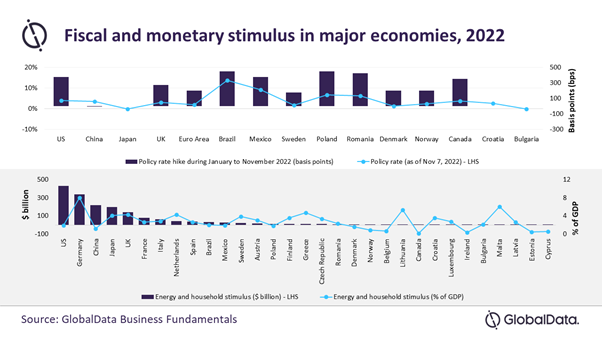
Further, the harder-hit countries such as Germany, Italy, France, Greece, and Poland introduced additional measures, including caps on profits for electricity producers, freezing electricity prices, a reduction in the VAT rate on energy products, reforms of the housing allowance, changes to income tax thresholds, one-time allowances for pensioners and students, and the introduction of promotional tickets for public transport.
Mundada continues: “Such targeted measures are the need of the hour to help businesses and households cope with rising prices, while monetary policies will continue to tame inflation. However, some monetary measures will have a great economic impact, as the rising cost of borrowing will weaken domestic demand.
“While inflation is set to lessen, GlobalData expects high energy bills to continue to be a major issue moving forward. Planned energy consumption reduction measures put in place to avoid blackouts will only add to the financial distress and continued pressure on already debt-laden developed nations.”
