

Physical AI conversations among influencers on X rose sharply in August 2026 and remained elevated through October, driven by developments across hardware ecosystems, autonomous mobility, humanoid robotics, and industrial deployment. Influencers framed the technology as a major expansion beyond software-only models, examining how chipmakers, platform providers, and engineering firms are establishing the infrastructure for embodied systems, says GlobalData, a leading intelligence and productivity platform.
Shreyasee Majumder, Social Media Analyst at GlobalData, comments: “Influencer discussions indicate that physical AI is drawing greater attention as companies across the technology value chain position themselves to capture the opportunity. Conversations centered on the expanding ecosystem of chipmakers, software providers, robotics developers, and industrial technology companies, alongside the role of autonomous mobility in bringing AI into real-world operations. Furthermore, humanoid robotics also gained prominence, with influencers focusing on companies developing proprietary hardware and software capabilities to support commercialization.”
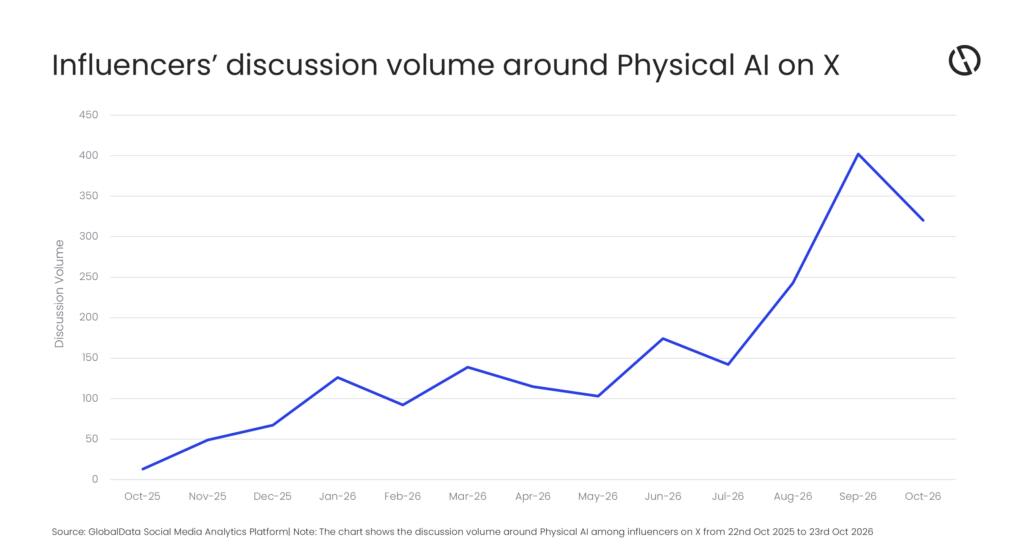
The key discussion topics among influencers on X during the spike in last 90 days:
Companies position physical AI as ecosystem opportunity
Influencers discussed physical AI as a competitive opportunity extending beyond robotics developers to autonomous vehicle companies, chipmakers, industrial technology suppliers, and AI software providers. NVIDIA featured prominently in discussions about robotics and autonomous systems, particularly owing to its open models and open-source resources for robotics developers. Discussions also identified Intel, Qualcomm, Huawei, Black Sesame, and Horizon Robotics as competitors or alternative suppliers in physical AI chips and software tools.
Autonomous mobility companies broaden physical AI narrative
Influencers frequently connected physical AI with autonomous driving, robotaxis, and self-driving trucks. NVIDIA’s Alpamayo 2 was discussed in relation to robotaxi decision-making, including path planning, edge-case handling, and the ability to explain driving actions. Applied Intuition was associated with deploying autonomous trucks with HUMAIN, while Zoox was discussed as a company that has been developing autonomous-driving technologies linked to physical AI for several years. Tesla, Samsung Electro-Mechanics, and LG Innotek also featured in discussions about the camera-module supply chain for Tesla’s Cybercab.
Humanoid robotics discussion centers on commercialization
Influencers focused on XPeng’s Iron humanoid as an example of a company developing greater control over its physical AI technology stack. Discussions indicated that XPeng plans to begin selling the robot in the second half of 2027 after initially testing it in its own stores and offices. The company’s in-house Turing chip attracted attention because of its stated role in supporting software compatibility, cost control, and supply-chain stability. Other companies discussed in the humanoid robotics context included Tesla’s Optimus program, Skild AI, Mind Robotics, and Weaver Robotics.
Industrial and logistics deployment remains commercial test
Influencers assessed physical AI through its potential to operate in factories, warehouses, homes, logistics networks, and public roads. ASUS’s decision to rename its AIoT business around physical AI and Renesas’ opening of a physical AI and Robotics Lab were cited as evidence of growing interest among engineering and semiconductor companies. Discussions also covered Figure’s Helix 2.5, Agility Robotics’ Digit 5, Einride’s cab-less truck on German public roads, and Waymo’s expansion into new markets. Amazon’s robotics operations and its FAR PRISM initiative further connected physical AI with large-scale warehouse and logistics applications.
