

The US Bureau of Labor Statistics’ Job Openings and Labor Turnover Survey (JOLTS) for August 2023 revealed a surprising increase in job openings to 9.1 million, surpassing the consensus estimate of 8.8 million. Markets took this as a signal of strong economy and increased pressure on US Fed, which closely monitors JOLTS data for signs of labor market slack, to keep interest rates elevated. However, contrasting real-time employment trends suggest a potential challenge to this narrative, observes GlobalData, a leading data and analytics company.
GlobalData’s US Active Jobs index, derived from companies job postings dataset, shows significant weakening in employment trends, falling 15% month-on-month (MoM) in September, the second highest on record since 2019.
Adarsh Jain, CFA, Director of Financial Markets team at GlobalData, comments: “GlobalData’s real-time Active Jobs index, which closely tracks JOLTS data, points to cooling labor market in the US. On previous three occasions when GlobalData’s Active Jobs index has fallen by more than 10% MoM, the JOLTS data has fallen on each of those occasion, by an average of 12%, and we expect the September JOLTS number to reflect this weakness. Markets pricing in Fed’s tightening bias based on JOLTS data, with S&P falling 1.4% on the day seems excessive, as more real-time data points to a more subdued labor market.”
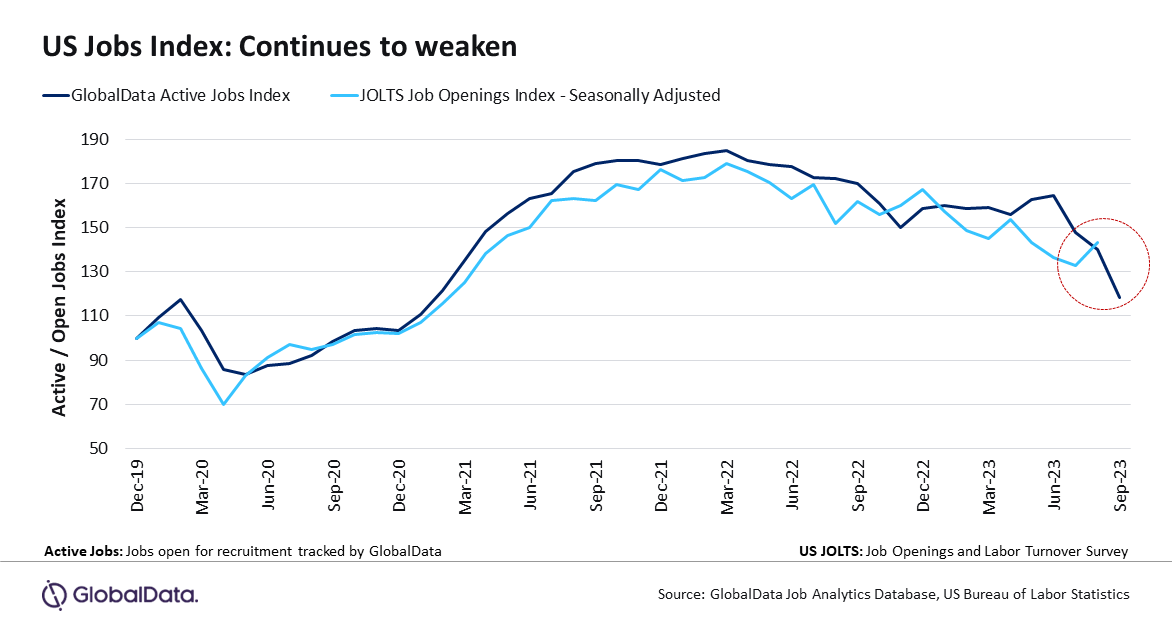
The fall in GlobalData’s Active Jobs index has been led by heavyweight sectors like Retail, Technology and Pharma, crucial to the overall economic health. For instance, Dollar General, a discount retailer, which reported weak Q2 numbers in August and lowered its sales and earnings outlook for 2023, has meaningfully reduced its pace of hiring recently as job postings on the company website slows.
Jain continues: “The US retail sales, excluding gasoline sales, have been modest with 0.2% rise in August. Added to this, a discount retailer like Dollar General pointing to weaker end demand suggests consumers are grappling with the impact of persistent inflation. In such a scenario, cutting back on hiring is an early indicator of companies re-calibrating their labor requirements lower in the face of weaking consumer demand.”
The ADP payroll data released on 04 October 2023, which tracks private employment using anonymised payroll data, supports the weakening job market, with just 89,000 increase in payrolls in September against the consensus expectation of 160,000 and much below the August reading of 180,000. The S&P 500 retraced half of the losses post JOLTS data release a day before with 0.8% rise.
The US Non-farm payroll, to be released on 06 October, will provide a better employment picture as it is done on larger sample and is more real-time compared to JOLTS. GlobalData’s proprietary Non-Farm Payroll nowcasting model, which uses high frequency jobs data, estimates 90,000 job additions, which is also well below the consensus estimate of 170,000 job additions.
Jain concludes: “The 11 consecutive rate increases by the US Fed are starting to have an impact on tempering end consumer demand, whilst also slowing down job demand and wage growth. More high frequency real-time jobs data are starting to pick-up on this trend and GlobalData expects US employment trends to weaken further, giving Fed some leeway to hold off on further tightening.”
