

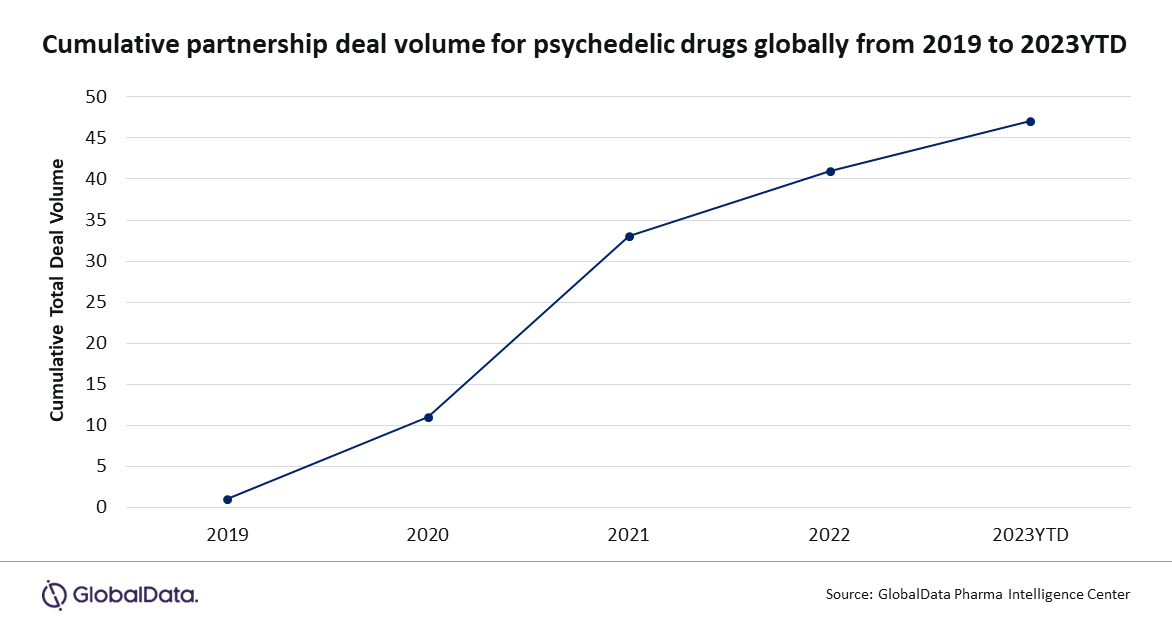
The landscape of psychedelic drug development has witnessed a remarkable surge in recent years, with a 500% increase in partnership deals from 2019 to 2023. More than 40 collaborations since 2019 have propelled the exploration of innovative psychedelics like psilocybin and LSD, showcasing their potential in addressing conditions such as depression and anxiety. Despite regulatory challenges, the evolving recognition of psychedelic clinical applicability points towards a promising future for these therapeutic advancements, reveals GlobalData, a leading data and analytics company.
Psychedelic drugs, such as those derived from psilocybin, lysergic acid diethylamide (LSD), and midomafetamine (MDMA), demonstrated promise in depression, anxiety disorder, and substance abuse. However, the US Controlled Substance Act, which classifies psychedelic drugs as a Schedule I controlled substance, has made the R&D of psychedelic drugs as potential therapeutics challenging.
Alison Labya, Business Fundamentals Analyst at GlobalData, comments: “The growth in partnership deals involving innovator psychedelic drugs aligns with the regulatory environment recognizing the clinical applicability of psychedelic drugs, which could accelerate innovative psychedelic drug development in the future.”
The US had the highest number of private biotech companies with 63 involved in psychedelic drug development, closely followed by Canada and the UK with 29 and 15 private biotechs, respectively.
Labya adds: “In August 2020, Health Canada was the first regulatory authority to approve a clinical trial for psilocybin-assisted therapy with amendments in Canada’s Special Access Program in January 2022 enabling healthcare practitioners to request psychedelic drug access for patients.”
In September 2023, Canadian biotech company Clearmind Medicine entered a co-development partnership deal with Johns Hopkins University School of Medicine for the Phase I/II trial of its serotonin receptor 1A agonist, CMND-100, for alcohol use disorder.
In June 2023, Clearmind Medicine also entered a co-development partnership deal with Hebrew University of Jerusalem and Israel-based company SciSparc to evaluate CMND-100 with SciSparc’s dual cannabinoid receptor 1/2 agonist palmidrol in obesity and metabolic syndrome.
Meanwhile, Australia-based biotech company Psylo signed a co-development partnership deal with Daiichi Sankyo to advance its non-hallucinogenic psychedelic drugs indicated for chronic mental illnesses, including serotonin receptor 2A agonists PSYLO-3001, PSYLO-3002, PSYLO-5001, and PSYLO-1001.
Labya concludes: “The increase of partnership deals involving innovator psychedelic drugs over the last five years could see further clinical trials with the potential to gain regulatory approval in indications such as depression, ADHD, eating disorders, and addiction. However, biopharmaceutical companies developing psychedelic therapeutics require careful consideration of psychedelic drug clinical trial design for a favorable risk-to-benefit ratio to enable bringing their drugs to market.”
Note: Data in the chart includes all announced and completed partnership deals globally from 2019 to 2023YTD. Includes deals where at least one drug involved is a psychedelic therapeutic with innovator drug type, where stages of development discovery, preclinical, Phase I, Phase II, Phase III, pre-registration, and marketed are considered.
