

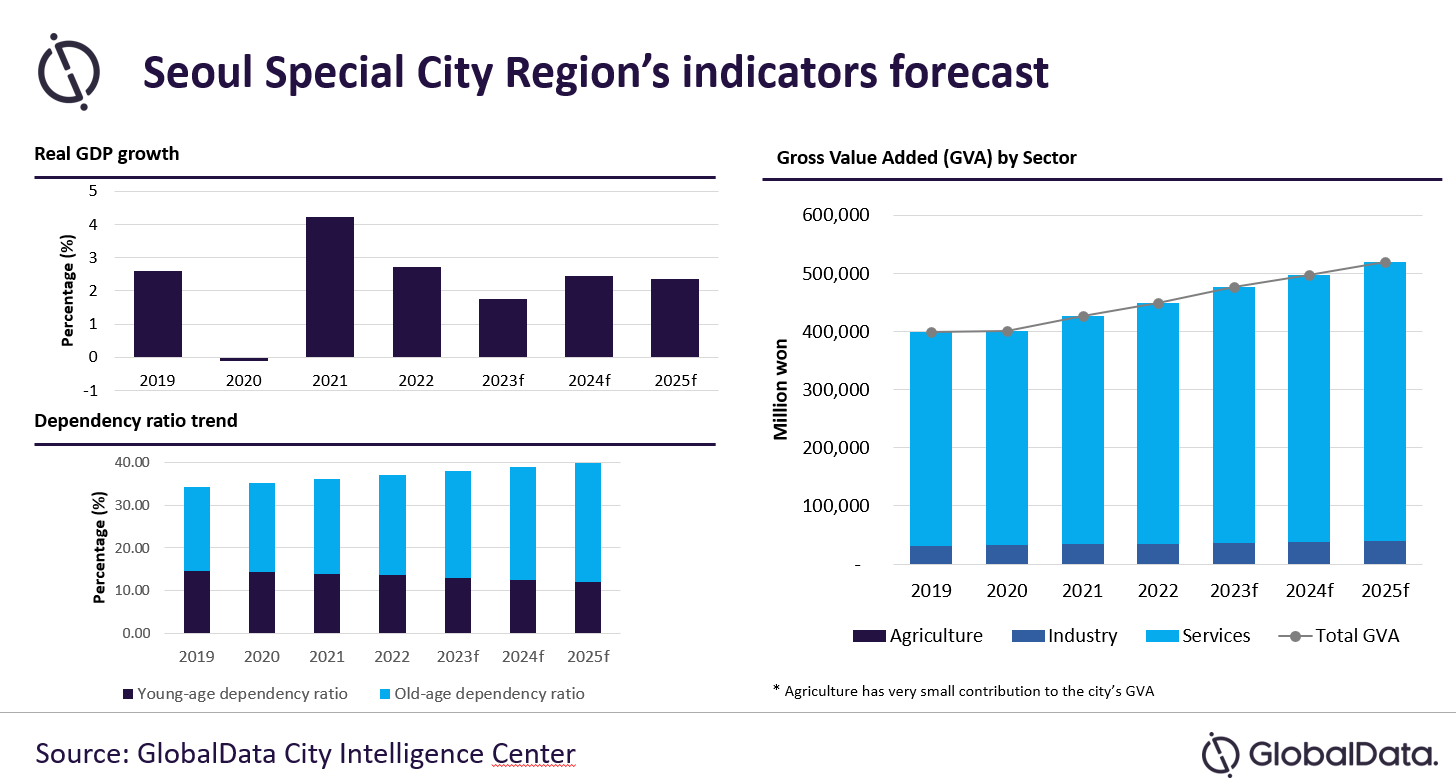
Over the past few decades, the economy of Seoul Special City (Seoul) has experienced a steady growth, largely attributed to the strong performance of its service sector. However, the city’s economy remains vulnerable to a wide range of risks from ballooning real estate market amid monetary policy tightening regime, high dependency on China, modest recovery in domestic demand due to elevated inflationary trend and high domestic debt in 2023. Against this backdrop, the city economy is set to slow down from 2.7% in 2022 to 1.7% in 2023, forecasts GlobalData, a leading data and analytics company.
GlobalData’s latest report, “Seoul_PEST+Sector_2023 Outlook Report,” reveals that Seoul city region contributed 23% to the country’s GDP in 2022. The economy of the region faced a series of internal and external challenges having consequences on critical sectors in 2022. In the wake of the recurrent rate hikes in 2022, the real estate sector growth slowed due to Seoul city’s large exposure to real estate market and quirky renting practices in housing market. China’s zero-COVID policy took a toll on tourism and allied sectors’ recovery in 2022. Elevated inflation coupled with rapid increase in interest rate curbed the purchasing power and raised the household debt burden, hence, dampened the household demand.
Sheo Rama, Economic Research Analyst at GlobalData, comments: “The availability of abundant educated manpower and a strong emphasis on science, technology, engineering, and mathematics (STEM) education in the South Korean education system is a boon for the Seoul economy. Massive R&D investments on the national level ($23.1 billion in 2022) is one of the main reasons behind the Seoul’s impressive growth in the financial and industrial sectors over the past few years. Seoul is a production hub for popular global brands such as Hyundai Motor Company, KIA corporation, LG electronics, Heesung Electronics.”
The establishment of the Seoul Investment Agency and a new digital financial support center to attract overseas financial companies, the establishment and expansion of professional networks by the Seoul Metropolitan Government (SMG) to promote Seoul as the Asian Financial City in recent years, are envisaged to play a key role in the financial sector’s growth. With a mission to increase the number of FinTech companies in the city from 150 in 2021 to 1,000 by 2030, and the number of overseas financial companies from 150 in 2021 to 250 by 2030, the SMG has targeted to achieve FDI amounting to $30 billion in the financial sector of the city by 2030.
Aditi Dutta Chowdhury, Economic Research Analyst at GlobalData, comments: “However, the overbearing regulations and complex tax structure have been taking a toll on the prospective foreign investments in the city. Seoul’s ambition to become the financial hub of the world is being impeded by its relatively high corporate tax rates compared to other leading cities such as Tokyo, Shanghai, and Singapore.”
The local government is set to launch KRW5 trillion ($3.9 billion) Seoul Vision 2030 Fund this year to foster investment in small and medium-sized enterprises (SMEs) and startups in the city.
Meanwhile, the already existing political and economic bottlenecks with North Korea have been aggravated by the Russian-Ukraine war, which has put the efforts of cooperation between the two nations on a backfoot, which might deter foreign investment in the city region.
Chowdhury concludes: “The challenge of rapidly rising aged population in terms of workforce availability in the long-run can pose downside risk to the investment in the city. An exquisite ICT infrastructure along with a highly educated workforce, a robust infrastructure for digital finance, remain as the major strengths of the city. Providing incentives to businesses on a wider scale and reducing taxes can go a long way in boosting the economic growth of the region.”
