

The biopharmaceutical industry had a positive year in 2024, with obesity drug developers continuing to witness success. Nearly all (19) of the top 20 players publicly traded global biopharmaceutical companies reported revenue growth in 2024, with an overall 7.9% year-on-year (YoY) increase in aggregate revenue to $880.4 billion, reveals GlobalData, a leading data analytics and consulting company.
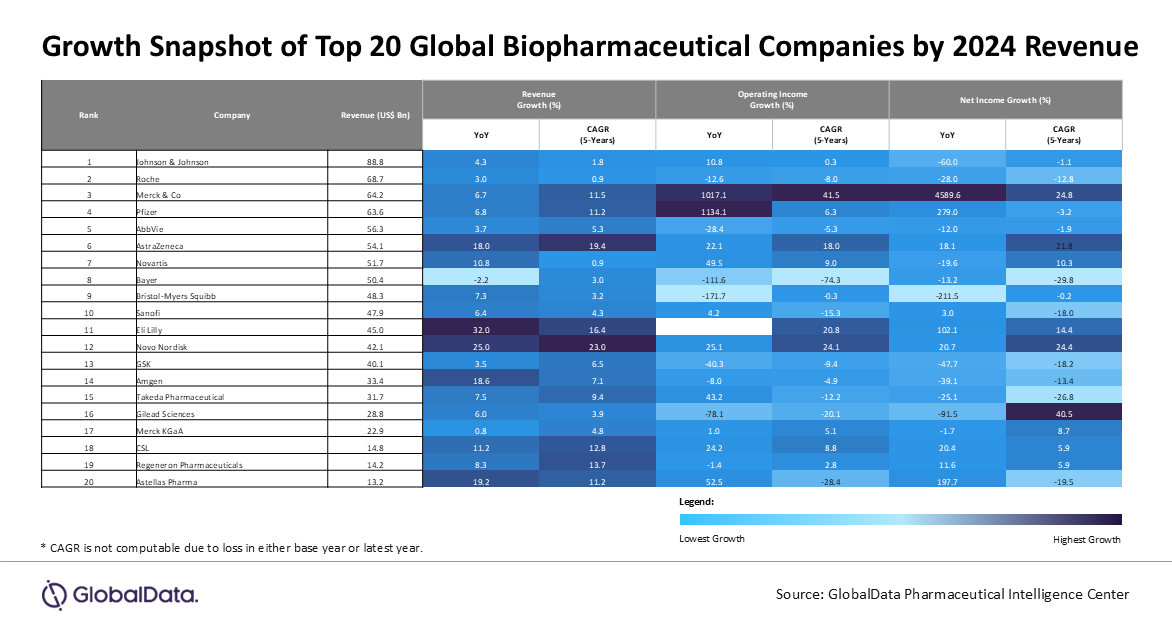
Seven out of the top 20 companies registered over 10% YoY revenue growth from 2023 to 2024. They include Eli Lilly (32%), Novo Nordisk (25.5%), Astellas Pharma (19.2%), Amgen (18.6%), AstraZeneca (18%), CSL (11.2%) and Novartis (10.8%).
Eli Lilly experienced the highest revenue growth of 32% to $45 billion in 2024, followed by Novo Nordisk with 25.5% to $42.1 billion, both fueled by the strong successes of their blockbuster drugs for obesity and diabetes. Eli Lilly’s Mounjaro and Zepbound generated total global sales of $16.5 billion in 2024, while Novo Nordisk’s Ozempic and Wegovy amassed combined global sales of $25.9 billion. Eli Lilly’s revenue growth was further driven by its breast cancer drug Verzenio, which recorded global sales of $5.3 billion in 2024.
Alison Labya, MSc, Business Fundamentals Analyst at GlobalData, comments: “Eli Lilly is projected to see 34.3% revenue growth to $59.2 billion in 2025, whereas Novo Nordisk is expected to see only a 16.4% increase to $47.7 billion, with the gap widening between these two companies, according to GlobalData’s Sales and Forecast database.”
Astellas Pharma also demonstrated strong performance with revenue growth to $13.2 billion, driven by the sales of Xtandi for prostate cancer, which registered global sales of $5.98 billion in 2024.
Half (10) of the top 20 companies recorded over 10% YoY growth in their operating profit in 2024, and among those, Pfizer (1,134.1%), Merck & Co (1,017.1%), Eli Lilly (99.7%) and Astellas Pharma (52.5%) reported more than 50% growth. Pfizer’s massive increase in its operating profit was attributed to ongoing cost-cutting initiatives saving $4.5 billion by the end of 2025. Meanwhile, the strong success of Merck & Co’s Keytruda led to a surge in its operating profit growth of 1,017.1% and was further enhanced by lower royalty rates and reduced R&D expenses. On the other hand, Bristol-Myers Squibb (-171.7%), Bayer (-111.6%), and Gilead Sciences (-78.1%) reported more than a 50% decline in their operating profit in 2024.
Labya continues: “In terms of profitability, four out of the top 20 companies achieved over 100% growth in net profit; Merck & Co (4,589%), Pfizer (279%), Astellas (197.7%) and Eli Lilly (102%). Merck & Co’s growth was primarily driven by its operating income, as well as the absence of legal settlement charges, which had impacted its net income in 2023 due to the Zetia antitrust case, while Eli Lilly’s growth was primarily driven by an increase in gross margin.”
Meanwhile, 11 companies reported YoY decline in profitability, with Bristol-Myers Squibb (-211.5%), Gilead Sciences (-91.5%) and Johnson & Johnson (-60%) reporting more than 50% decline. Bristol-Myers Squibb and Gilead Sciences’ decrease in operating income by 171.7% and 78.1%, respectively, and net income by 211.5% and 91.5% was primarily attributed to impairment charges and in-process research and development (IPR&D) expenses.
Labya concludes: “The top biopharmaceutical companies have witnessed a rebound in growth, with obesity drug developers continuing to reap success. Eli Lilly is poised to outpace Novo Nordisk in revenue growth over the next few years to capture long-term market share from Novo Nordisk in obesity and type 2 diabetes. However, the momentum in revenue growth is anticipated to flatten in 2025, as the biopharmaceutical industry faces headwinds including loss of exclusivity for major drugs and drug pricing pressures in the US.”
