

In response to the US Federal Government’s historic announcement regarding Medicare price negotiations for pharmaceuticals under the Inflation Reduction Act, the top 20 global biopharmaceutical firms experienced varied market capitalization shifts in Q3 2023. These fluctuations highlight the industry’s response to evolving regulations, resulting in a slight 0.2% increase in the aggregate market capitalization from $3.56 trillion in Q2 2023 to $3.57 trillion in Q3 2023, reveals GlobalData, a leading data and analytics company.
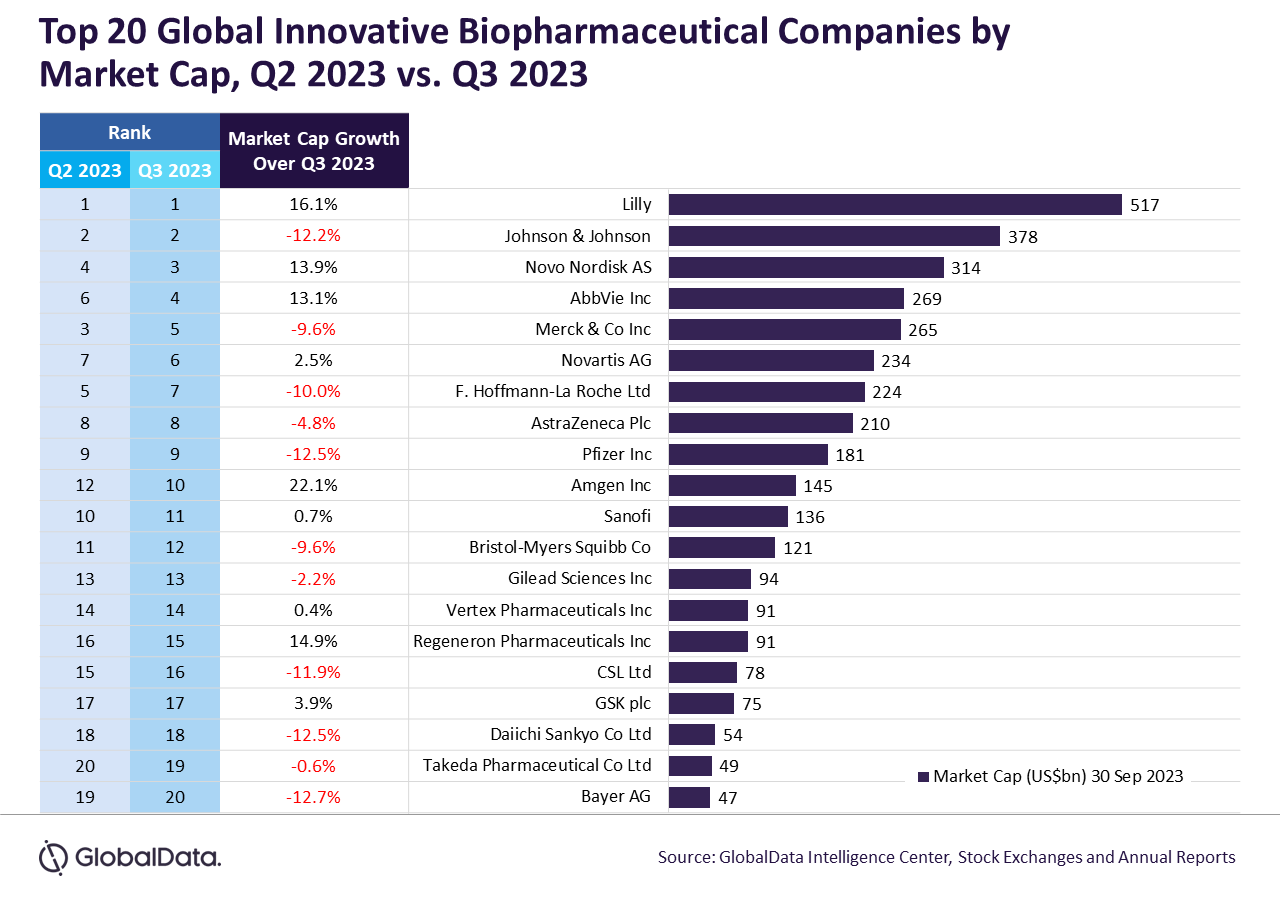
Out of the top 20 companies, nine saw their market capitalization surge by more than 10%, with significant gains achieved by Amgen (22.1%), Lilly (16.1%), Regeneron Pharmaceuticals (14.9%), Novo Nordisk (13.9%), and AbbVie (13.1%).
Ophelia Chan, MSc, Business Fundamentals Analyst at GlobalData, comments: “Lilly retained top position as its market capitalization surpassed $500 billion. Novo Nordisk’s market capitalization growth saw the company move up to third position in the list.”
Lilly’s and Novo Nordisk’s market capitalization growth over Q3 was boosted by the success of their weight loss drugs. Lilly’s injectable drug Mounjaro reported favorable late-stage trial results in SURMOUNT-3 and SURMOUNT-4 and is forecasted to reach drug analyst consensus global forecast sales of $27.3 billion by 2029. The positive data strengthens Lilly’s presence in the weight loss drug market and positions the company as a competitor alongside Novo Nordisk’s Wegovy and Ozempic.
Amgen witnessed the largest market capitalization growth, fueled by its improved second-quarter earnings, revenue and $27.8 billion acquisition of rare-disease drugmaker Horizon Therapeutics. This acquisition will strengthen Amgen’s inflammation portfolio by including first-in-class rare inflammatory disease drugs such as Tepezza, Krystexxa and Uplizna.
Regeneron’s market capitalization growth was attributed to the US FDA approval of its high-dose Eylea for eye diseases, a VEGF fusion protein, that reported $1.5 billion in global sales in Q2 2023, according to GlobalData’s Pharmaceutical Intelligence Center Drugs Database.
More than half of the top 20 biopharmaceutical companies reported a decline in market capitalization, of which six companies, Bayer (-12.7%), Daiichi Sankyo (-12.5%), Pfizer (-12.5%), Johnson & Johnson (-12.2%) and CSL (-11.9%) recorded negative growth of more than 10%.
Bayer’s market capitalization decline was primarily attributed to the company’s agriculture division, unrelated to its pharmaceutical business. Daiichi Sankyo’s fall in market capitalization was owed to the safety and effectiveness concerns for the jointly developed, datopotamab deruxtecan, with AstraZeneca.
Chan concludes: “The top biopharmaceutical companies, including Johnson & Johnson, are reaping the consequences over the first US drug price negotiations, an effort by the government to cut its healthcare spending. The first 10 drugs under Medicare price negotiations include Johnson & Johnson’s Imbruvica, Stelara, and Xarelto with a total drug sales of $15.98 billion in 2022. The top biopharmaceutical companies will need to mitigate the financial implications of pricing pressures and replenish revenues as the US drug market reshapes.”
