

- JPMorgan Chase retains top spot
- Chinese and Indian banks post strong gains
- GlobalData warns of recession fears and tariff impact clouding Q2 outlook
The aggregate market capitalization (MCap) of the top 25 global banks increased by 20.1% year-on-year (YoY), reaching $4.7 trillion in the first quarter (Q1) ended 31 March 2025. Most of the stocks rose in Q1, benefiting from the central banks’ interest rate cuts, according to GlobalData, a leading data analytics and research company.
Murthy Grandhi, Company Profiles Analyst at GlobalData, comments: “Most of the central banks implemented rate cut in 2024, which benefitted the their net interest income. However, now most of the central banks are likely to pursue a cautious approach toward interest rate cuts because of stubborn inflation, which is expected to get further aggravated due to the imposition of tariffs.”
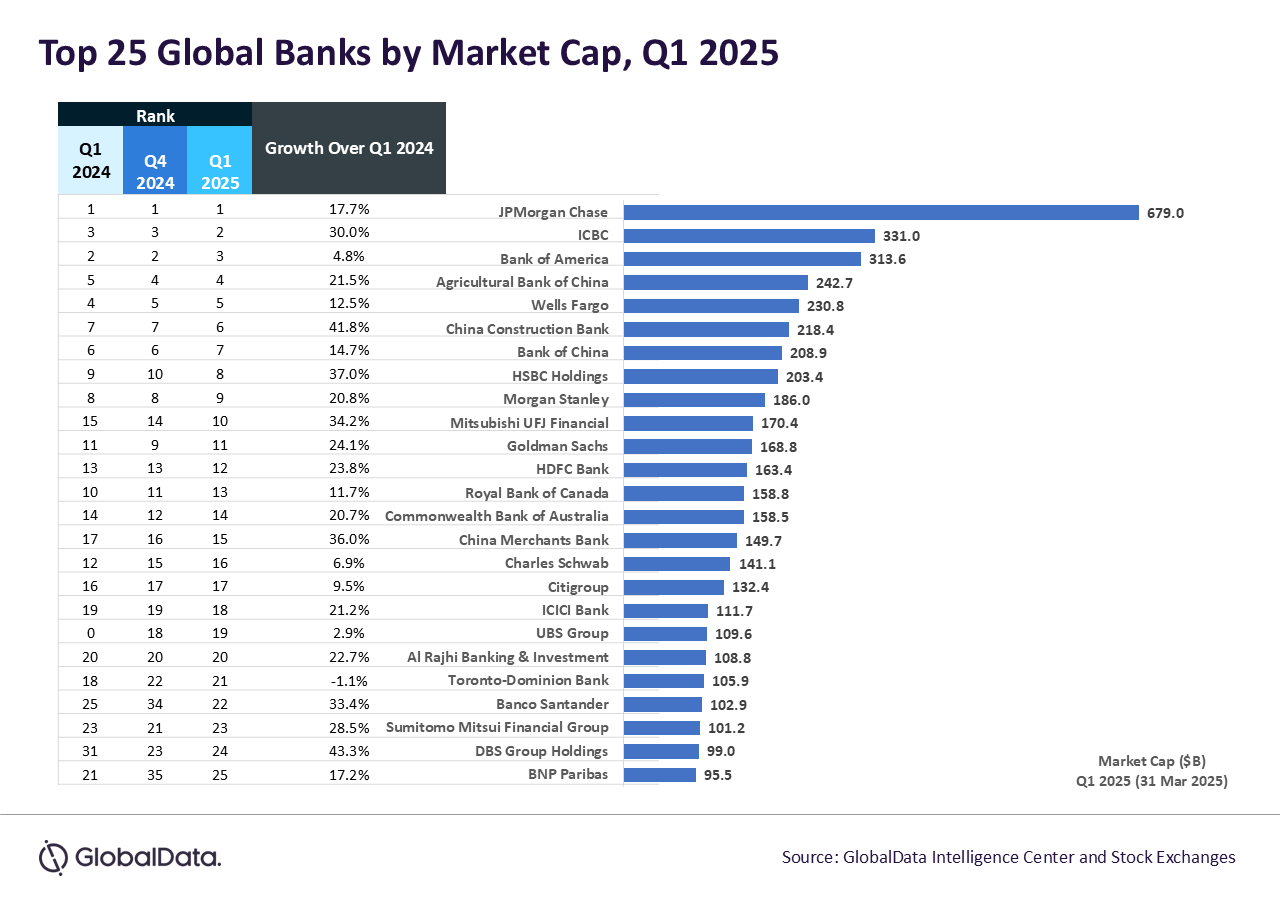
US banks lead the chart
JPMorgan Chase continues to remain as the world’s largest bank by MCap, recording an increase of 17.7% to $679 billion by the end of Q1 2025. This growth was primarily fueled by higher investment banking fees in its Commercial & Investment Bank division, which enabled it to outpace its competitors.
Goldman Sachs and Morgan Stanley witnessed 24.1% and 20.8% growth respectively, benefitting from the improved capital market activity and resilient wealth management performance.
However, TD Bank’s MCap declined by 1.1% to $105.9 billion, reflecting subdued retail banking growth and concerns over mortgage delinquencies amid a cooling Canadian housing market.
Chinese big four banks see 20% rise
The market value of China’s top four banks, ICBC, Bank of China, Agricultural Bank of China, and China Construction Bank, experienced growth in the range of 15%-40% over the year. It was largely driven by loan growth, government-led stimulus support for infrastructure financing, and improved asset quality metrics.
European banks presented strong results. HSBC Holdings saw a 37% increase in MCap to reach $203.4 billion, as it focused on its Asia-centric strategy. Banco Santander also recorded a 33.4% rise in market value reaching $102.9 billion driven by European central banks rate cuts and recent specter of massive public spending in Europe has given a fresh boost to major banking stocks.
DBS Group Holdings recorded a 43.3% rise in market value due to strong business performance, which is in line with expectations.
Indian banks demonstrated resilience, with HDFC Bank emerging as a standout performer, with its MCap growing by 23.8% to $163.3 billion, highlighting the strength of India’s expanding digital banking and credit ecosystem. ICICI Bank’s market cap also recorded a 21.2% increase to $111.7 billion, mainly due to trading at attractive valuations and strong business growth.
Grandhi concludes: “GlobalData predicts that the latest US tariffs have heightened global recession fears, which could reduce consumer spending, and curtail business borrowing, thereby negatively impacting banks’ loan demand and profitability. Global financial markets have seen increased volatility, with significant decline in banking stocks and rising risks of loan defaults. To mitigate these effects, banks must diversify revenue streams, strengthen risk management, and invest in digital transformation. The Q2 2025 outlook hinges on trade negotiations, monetary policy responses, and global economic trends, which remain highly uncertain.”
