

- JPMorgan Chase retains top spot
- European banks post strong gains
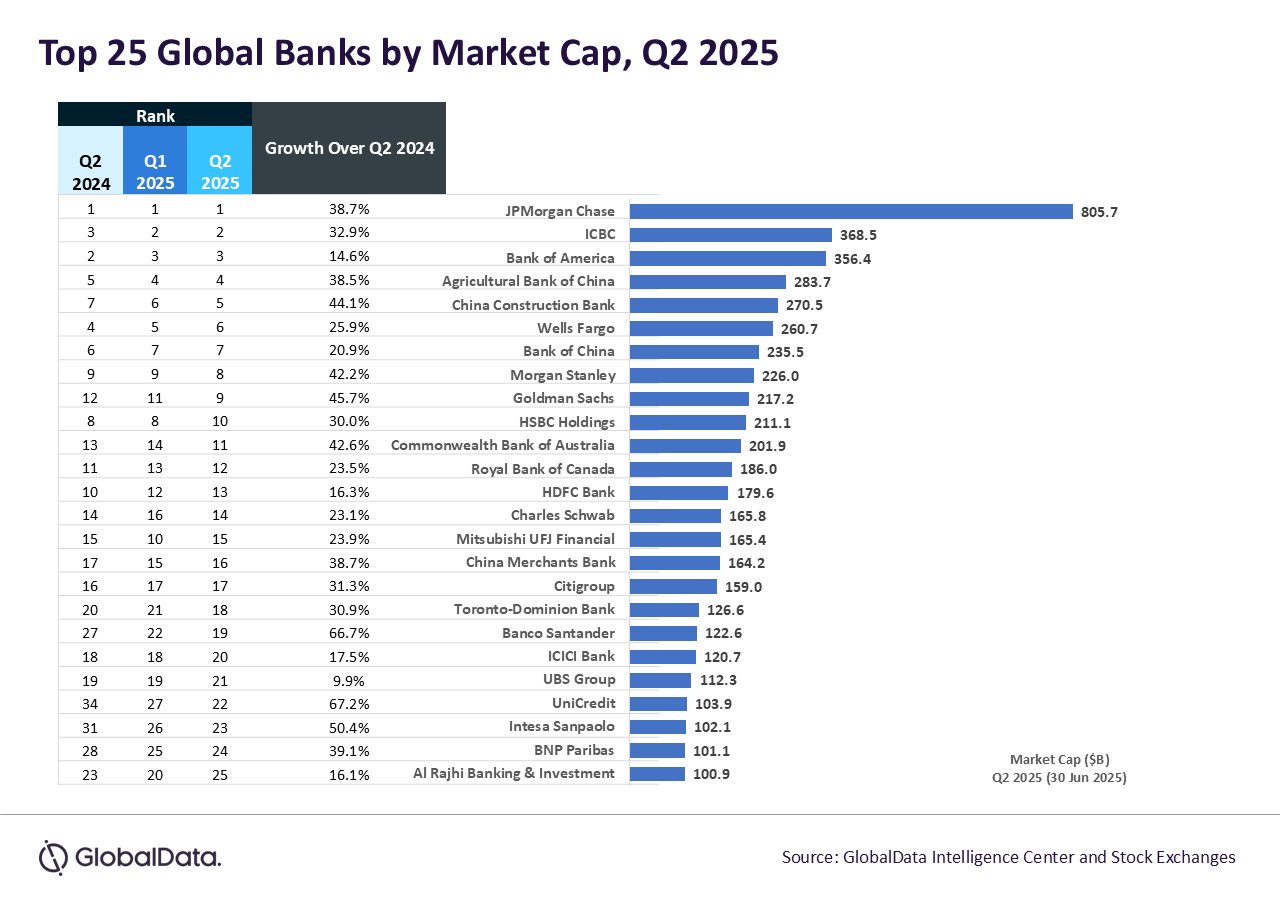
The aggregate market capitalization (MCap) of the top 25 global banks increased by 31.9% year-on-year (YoY), reaching $5.3 trillion in the second quarter (Q2) ended 30 June 2025, as continued central banks’ interest rate cuts and strong capital market activity led to a rise in most of the banking stocks, according to GlobalData, a leading data analytics and research company.
Murthy Grandhi, Company Profiles Analyst at GlobalData, comments: “A notable easing of inflationary pressures facilitated a dovish shift among key central banks. The European Central Bank (ECB) spearheaded this transition, reducing its deposit rate to 2.0% by end of June. The Bank of England (BoE) also implemented a 25-basis-point cut to its rate, lowering it to 4.25% in May. Meanwhile, the Reserve Bank of India (RBI) announced a significant 75-basis-point reduction, bringing its policy rate down to 5.5%. This monetary easing has directly spurred a robust rally in the banking sectors of Europe and India.”
US banks lead the chart
The US Federal Reserve’s stringent monetary policy has supported American lenders to post gains. JPMorgan Chase continues to remain as the world’s largest bank by MCap, recording an increase of 38.7% to $805.7 billion by the end of Q2 2025. This growth was primarily fueled by higher investment banking fees in its commercial and investment banking division, which enabled it to outpace its competitors.
Notably, Goldman Sachs (+45.7%) and Morgan Stanley (+42.2%) gained sharply as capital markets activity rebounded with the resurgence of initial public offerings (IPOs) and mergers and acquisitions (M&As). Bank of America (+14.6%) showed moderate gains as it recorded flat growth due to the simplification of its business structure by exiting from 14 international consumer markets.
Chinese big four banks see more than 20% rise
The market value of China’s top four banks, ICBC, Bank of China, Agricultural Bank of China, and China Construction Bank, experienced growth in the range of 21%-44% in the second quarter. It was largely buoyed by a recovery in real estate-linked credit and improved loan growth.
European banks UniCredit (+67.2%), Banco Santander (+66.7%), and Intesa Sanpaolo (+50.4%) emerged as surprise outperformers. Their performance reflects strong investor confidence in banks’ returns and resilient earnings, with deal-making activity, particularly in Italy.
APAC Banks
Commonwealth Bank of Australia (+42.6%) advanced amid a strong housing rebound and low delinquency rates. Mitsubishi UFJ Financial (+23.9%) saw modest gains as Japan’s ultra-low-interest rate policy continues to weigh on margins. HDFC Bank (+16.3%) and ICICI Bank (+17.5%) remained steady, driven by India’s high GDP growth and expanding retail credit demand.
Grandhi concludes: “GlobalData anticipates that the second half of 2025 will pose significant challenges for global banks, driven by two primary headwinds: US-led tariffs and the ongoing crisis in the Middle East. The imposition of tariffs is expected to dampen global trade, adversely impacting banks’ trade finance revenues and increasing credit risk among multinational clients facing supply chain disruptions. This slowdown may lead to reduced loan demand and pressure on investment banking fees.
“Simultaneously, the Middle East crisis is likely to create volatility in energy prices, heightening inflation and constraining consumer and business spending. This dual risk could result in higher loan defaults and complicate central bank interest rate decisions.”
