

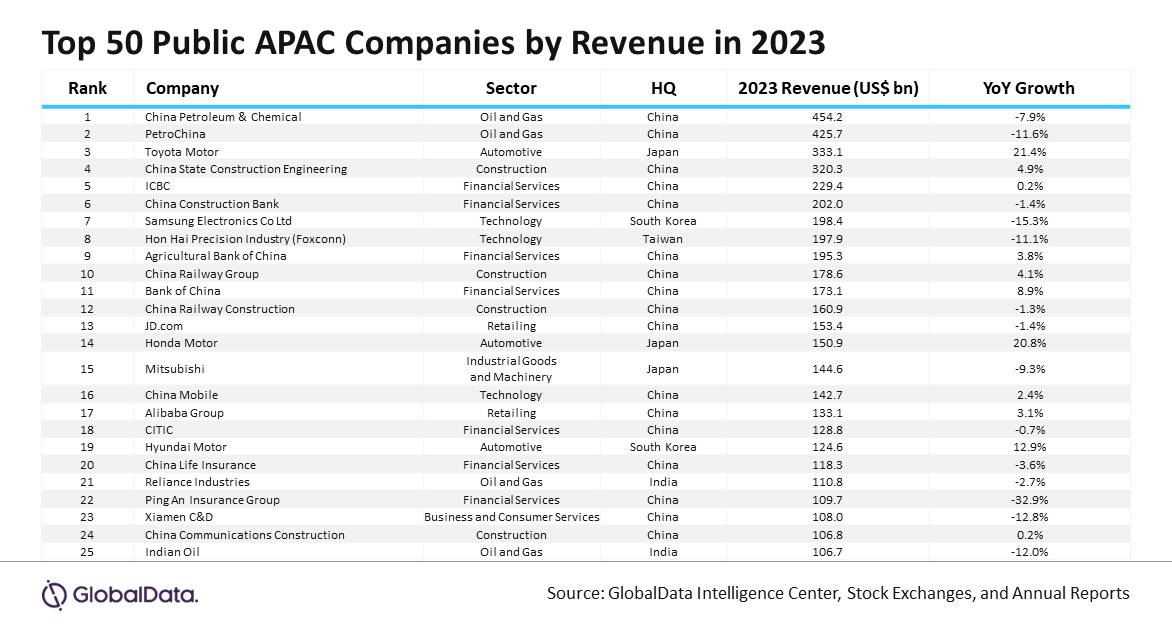
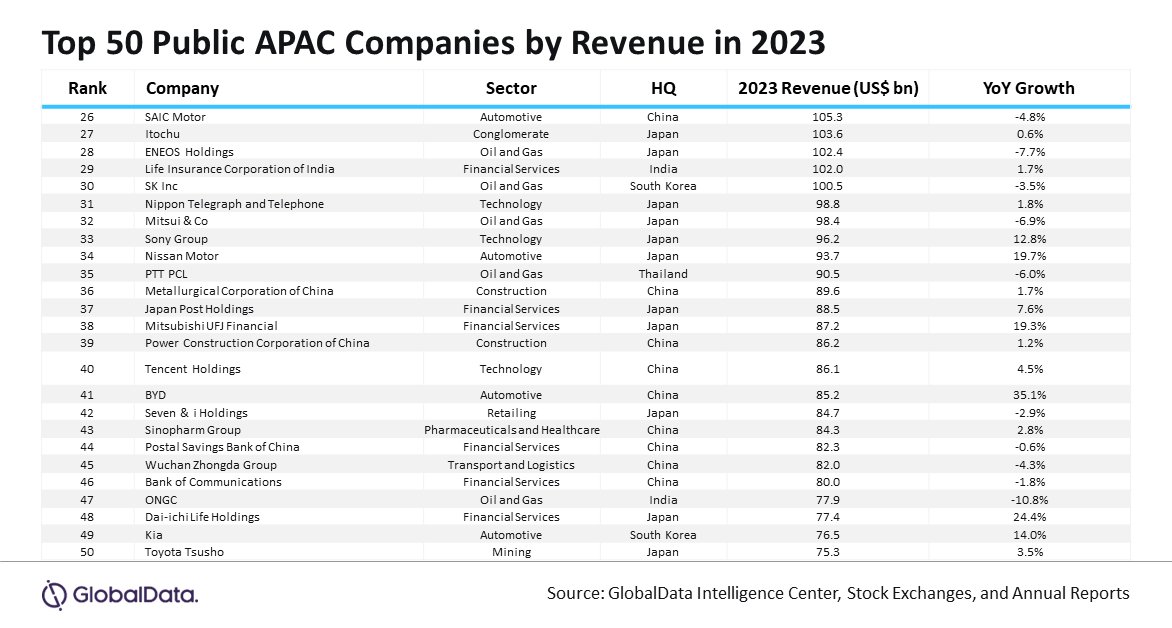
- China dominates the list with 26 companies
- BYD, Dai-ichi Life Holdings, and Toyota Motor gain over 20% in revenue
- Financial services sector tops the list with 13 companies
The top 50 listed companies in the Asia-Pacific (APAC) region faced a slight 0.8% year-on-year (YoY) dip in aggregate revenue, totaling $6.9 trillion, in 2023. The downturn was largely driven by the oil and gas sector’s struggles with pricing pressure and weak demand in China, counterbalanced by robust growth in the automotive sector and mixed performance in financial services, according to GlobalData, a leading data and analytics company.
An analysis of GlobalData’s Company Reports Database reveals that four companies from the top 50 list reported an increase of over 20% in their revenue, while seven companies reported an over 10% decline in revenue. The list included 26 companies from China, of which, 13 companies registered YoY growth.
Murthy Grandhi, Company Profiles Analyst at GlobalData, comments: “The APAC region continued its economic uptick, largely driven by robust private demand in emerging markets. However, the oil and gas sector, came under pricing pressure during 2023 due to softened prices of crude oil, refined oil, and chemicals.”
Grandhi adds: “China’s post-COVID-19 pandemic rebound in 2023 was lukewarm, with domestic demand up by 5.2%. This sluggish growth kept inflation low and left little room for additional policy stimulus. The lackluster business confidence, weighed down by the ongoing property market slump, further stalled economic momentum. As a result, Chinese enterprises saw an average revenue dip of 0.5% in 2023—a stark contrast to the 4.5% growth they enjoyed the previous year.”
The automotive sector revved up in 2023, boasting a 17% surge in total revenue to reach $969.3 billion, making up 14% of the region’s total earnings. Leading the charge were automotive giants BYD and Toyota Motor, with impressive annual revenue growth of 35.1% and 21.4%, respectively.
BYD’s stellar performance was fueled by the sale of over three million vehicles—a staggering 61.9% increase from the previous year—securing its spot as the global leader in new energy vehicle sales for the second year running. Meanwhile, Toyota Motor saw its revenue accelerate thanks to higher vehicle sales and a boost from favorable currency exchange rates.
Grandhi continues: “The financial services sector delivered a mixed performance in 2023, with total revenue hitting $1.7 trillion—a slight dip of 0.3%, but still contributing 24.1% to the overall earnings. Dai-ichi Life Holdings bucked the trend with a strong 24.4% YoY revenue surge, reaching JPY10.5 trillion ($77.5 billion), driven largely by its domestic insurance business, which made up 76% of its total revenue. On the flip side, Ping An Insurance Group faced a tough year, with its revenue plunging 32.9% due to declining income from its banking and asset management operations.”
The technology sector hit a rough patch in 2023, with aggregate revenue sliding by 4.7% to $820 billion, making up 11.8% of the total market. Samsung Electronics felt the pinch, seeing a 15.3% drop in revenue as it navigated a tough market landscape.
The downturn was largely due to plummeting semiconductor prices and sluggish demand, driven by inventory adjustments and economic slowdown fears that put a damper on purchasing sentiment. Hon Hai Precision Industry (Foxconn) also saw revenue shrink by 11.1%, impacted by the challenging macro environment, inventory adjustments, and a post-pandemic slowdown in end product demand.
On the sectoral basis, financial services topped the list with 13 companies, followed by oil and gas (9), automotive (7), construction (6), technology (6), retailing (3), others (5), and mining (1).
Grandhi concludes: “The economic outlook for the APAC region remains positive, bolstered by strong domestic demand in key emerging economies such as India, Indonesia, the Philippines, and Vietnam, which continue to support the economic growth momentum. Additionally, APAC exports are expected to benefit from the region’s trade liberalization framework, including major multilateral trade agreements such as the Regional Comprehensive Economic Partnership (RCEP) and the Comprehensive and Progressive Agreement for Trans-Pacific Partnership (CPTPP), as well as an expanding network of significant bilateral free trade agreements involving APAC economies.”
