

The recent UK-EU agreements on sanitary and phytosanitary (SPS) measures, carbon-market cooperation, and youth mobility could ease trade friction with the UK’s largest export market, but full alignment remains a long way off, according to GlobalData, a leading intelligence and productivity platform.
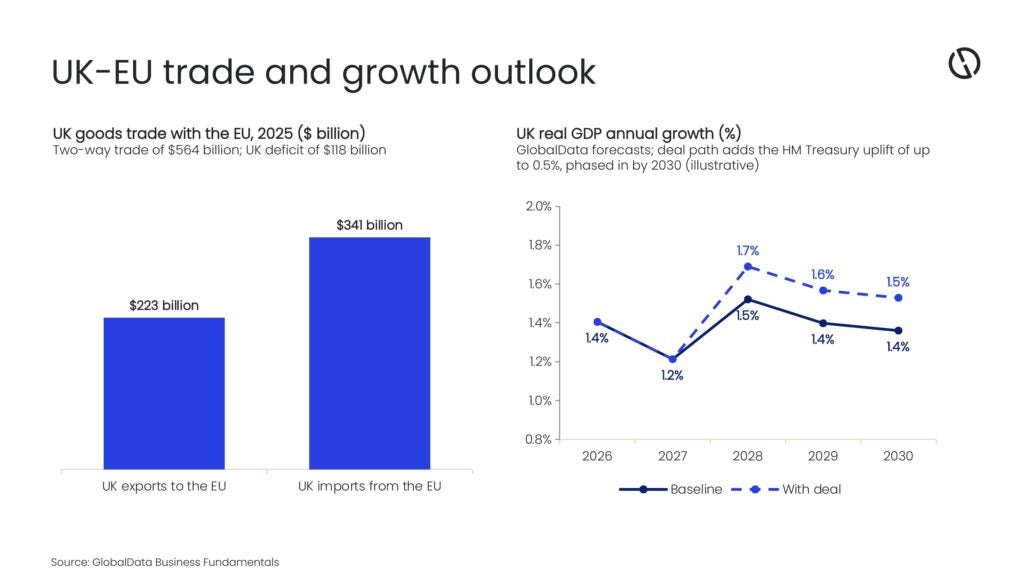
Prime Minister Andy Burnham unveiled the package on 20 November 2026. HM Treasury estimates that the measures could add up to 0.5% to national output, equivalent to GBP17 billion ($22.4 billion). GlobalData forecasts the UK GDP growth of 1.4% in 2026 and 1.2% in 2027 under the baseline scenario.
Trade, carbon, and mobility implications
According to the International Trade Centre (ITC), the UK goods exports to the EU reached $223.5 billion in 2025, compared with $341.1 billion of imports. The UK recorded a GBP37.3 billion ($49.2 billion) goods deficit in Q3 2026; exports to the EU fell 4.5% quarter on quarter, while non-EU exports rose 3.4%, as per the Office for National Statistics.
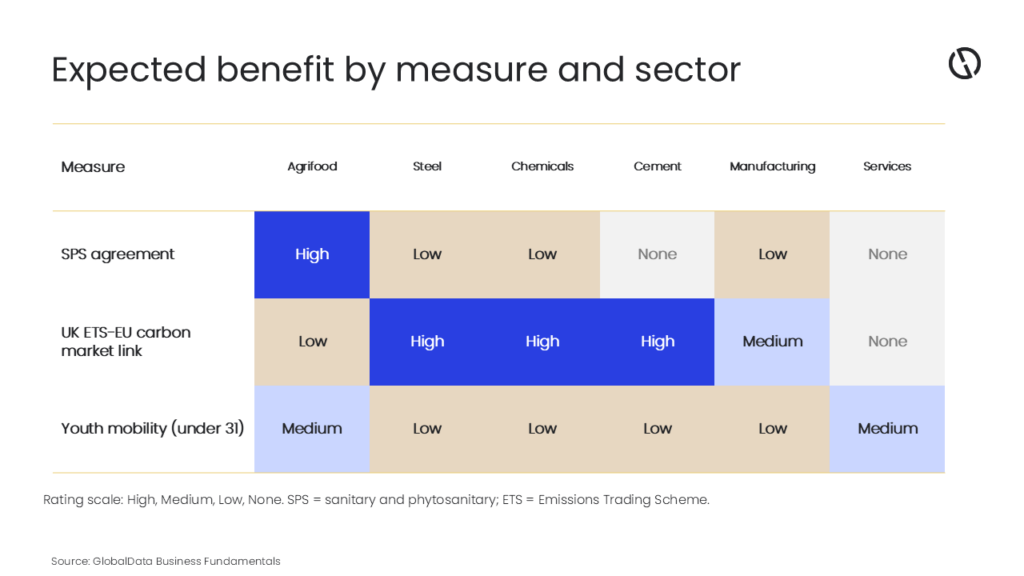
An SPS agreement could reduce post-Brexit costs for agrifood exporters. The UK government says a salmon shipment can cost up to GBP1,400 ($1,845.9), while the National Farmers’ Union reports agricultural exports to the EU have declined by more than 30% over the past decade.
Linking the UK and the EU carbon markets could simplify compliance for energy-intensive industries. The youth scheme would provide 100,000 three-year visas. The EU home-fee proposals of GBP9,800 annually ($13,144.3) could cost universities GBP570 million ($764.5 million) yearly, though higher enrollment may offset losses.
For businesses and universities, these targeted alignments indicate that pragmatic, sector-by-sector concessions are now the primary tool to reduce post-Brexit operational drag without rejoining the single market. However, adopting EU regulatory standards and absorbing potential higher education revenue losses may test domestic political support across key UK industries.
Annapurna Pillutla, Analyst, Economic Research team at GlobalData, comments: “Rebuilding ties with the EU directly targets administrative barriers affecting British exporters. Reconnecting carbon markets and easing sanitary border checks could reduce costs for manufacturers and food producers. However, an estimated 0.5% output boost may take time to materialize, and businesses are expected to continue to face the structural costs of operating outside the single market.”
Political hurdles remain
The deal has renewed debate over the UK’s relationship with the EU. Closer cooperation does not necessarily signal support for membership. Burnham stated that it would be “unthinkable” for the EU to readmit the UK without a referendum. The agreement does not restore single market or customs union participation, and any move toward membership would require negotiations and raise questions around sovereignty, immigration, regulatory alignment, and budget contributions. The Stay Out campaign group claims membership could cost the UK up to GBP39.3 billion ($51.8 billion) annually, though this is not an official estimate.
Pillutla concludes: “SPS alignment, carbon-market linkage, and youth mobility may deliver tangible benefits if implementation proceeds as planned. For businesses, the immediate priority is to assess how changing rules on trade, carbon pricing, and cross-border mobility could affect supply chains, costs, and access to the EU market.”
