

The COVID-19 pandemic has catalyzed the sales of prescription drugs in Japan, leaving the over-the-counter (OTC) healthcare sector in the doldrums. However, the renewed consumer focus on holistic health and wellbeing is expected to spur the demand for health supplements in the long-term. Consequently, Japan’s OTC healthcare market will expand at a modest compound annual growth rate (CAGR) of 0.7% from JPY1,327.8 billion ($12.1 billion) in 2021 to JPY1,377.9 billion ($14.2 billion) in 2026, forecasts GlobalData, a leading data and analytics company.
GlobalData’s latest report, ‘Japan OTC healthcare – Market Assessment and Forecasts to 2026’, reveals that the OTC healthcare sector will be mainly propelled by the ‘traditional medicines’ category with a value CAGR of 1.3% over 2021-2026, followed by the ‘vitamins and minerals’ category with 1.2% CAGR.
According to the report, drug stores & pharmacies was the leading distribution channel in the Japanese OTC healthcare market in 2021, followed by hypermarkets & supermarkets.
Amazon opened its first physical pharmacy in Japan in 2017. Despite the presence of e-commerce giants such as Rakuten and Amazon, online retail remains constrained by the stringent government regulations. Johnson & Johnson Services, Kracie, and Daiichi Sankyo were the top three companies, and Tylenol and Kracie were the leading brands in the Japanese OTC healthcare sector in 2021.
Anush Shaw, Consumer Analyst at GlobalData, comments: “As the COVID-19 pandemic has spurred the demand for vaccines and prescription drugs, the sales of OTC drugs have been sluggish. However, owing to the soaring medical expenditure for the aging population, insurers are lobbying for the approval of more generics.
“Despite their proficiency in developing high-quality medicines, Japanese drug makers are wary of investing in OTC healthcare due to the low profitability of non-prescription drugs. However, as a global pharma patent cliff is fast approaching, the expiry of several blockbuster drugs in Japan can pave the way for new generics and biosimilars through 2026.”
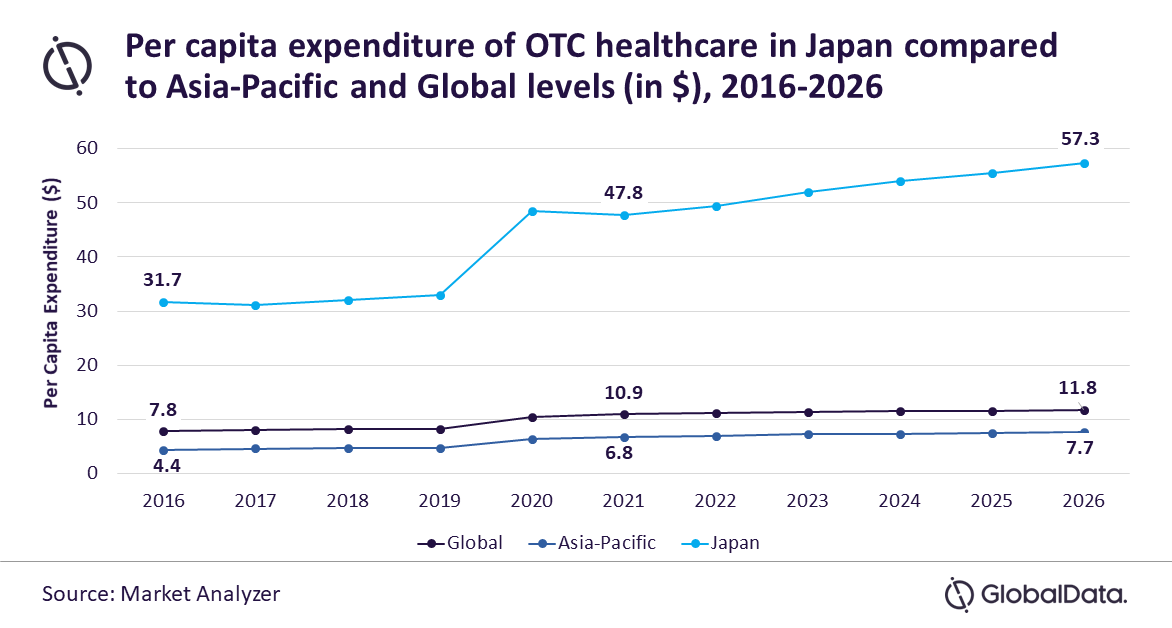
The penetration of generics is high in Japan as greying population is inclined to self-medicate to stay healthy and cut medical expenses. Consequently, the per capita expenditure (PCE) on OTC healthcare in Japan increased from $31.7 in 2016 to $47.8 in 2021, which remains far higher than the global average of $14.2, and the regional average of $8.1 in 2021. It is forecast to reach $57.3 in 2026, spurred by the demand for sleep aids, single-vitamins, and traditional medicine.
Shaw concludes: “Japan is experiencing sporadic outbreaks of the new COVID-19 mutant variants despite the high penetration of vaccines. Consumers are altering their lifestyles to adapt to the ‘new normal’. In a bid to improve the general health and wellbeing to ward off infections, consumers will patronize health supplements that can support immune health, digestive wellness, and weight management. The high affinity of elderly individuals for Japanese Kampo, Traditional Chinese Medicine, and Traditional Korean Medicine remedies for conditions such as metabolic syndrome will help sustain the demand for traditional medicine.”
