

On-premise consumption of hot drinks is on the rise in Indonesia due to the lifting of all remaining COVID-19 restrictions on public mobility and gatherings by the end of 2022. Though high inflation will remain a concern in the immediate future, the increasing public outdoor mobility and the rebound in foreign tourist arrivals will boost spending on hot drinks. Further, specialty tea and coffee shops and café chains are popularizing new premium products. As a result, the Indonesian hot drinks market is anticipated to grow from IDR46.9 trillion ($3.2 billion) in 2022 to IDR68.6 trillion ($4.4 billion) by 2027, registering a compound annual growth rate (CAGR) of 7.9% over 2022–27, says GlobalData, a leading data and analytics company.
GlobalData’s report, ‘Indonesia Hot Drinks – Market Assessment and Forecasts to 2027’ reveals that market growth will be spearheaded by the hot tea category, which will register the fastest value CAGR of 8.5% over 2022–2027. The hot coffee and other hot drinks sectors are projected to record a CAGR of 7.6% each.
Tim Hill, Key Account Director at GlobalData Singapore, comments: “With consumers returning to their workplaces and educational institutions, dining out or socializing more often at tea shops and cafés, on-premise consumption of hot drinks in Indonesia is accelerating. On-premise dynamics will improve further once authorities recall all the COVID-19 travel restrictions and the tourism sector fully recovers. Despite Indonesia being a major global producer of tea and coffee, value sales are disproportionately low as cheaper products dominate the mass market, while high-quality tea leaves and coffee beans are exported. As high food inflation remains a concern, affordable black tea and instant coffee will contribute to most of the sector’s sales through 2027.”
Bobby Verghese, Consumer Analyst at GlobalData, notes: “Indonesia is currently witnessing the proliferation of specialty coffee and tea shops, cafés, bistros, and tea kiosks. These venues are a favorite meeting point for younger Indonesians and tourists, particularly as alcohol consumption is restricted in the predominantly Muslim country. Multinational café chains, such as Starbucks, McCafé, and The Coffee Bean & Tea Leaf, and homegrown chains, such as Kopi Kenangan, Fore Coffee, and Kopi Janji Jiwa are making higher-priced products, such as artisanal tea, functional tea, bubble teas, and fresh ground coffee, more accessible to the masses.”
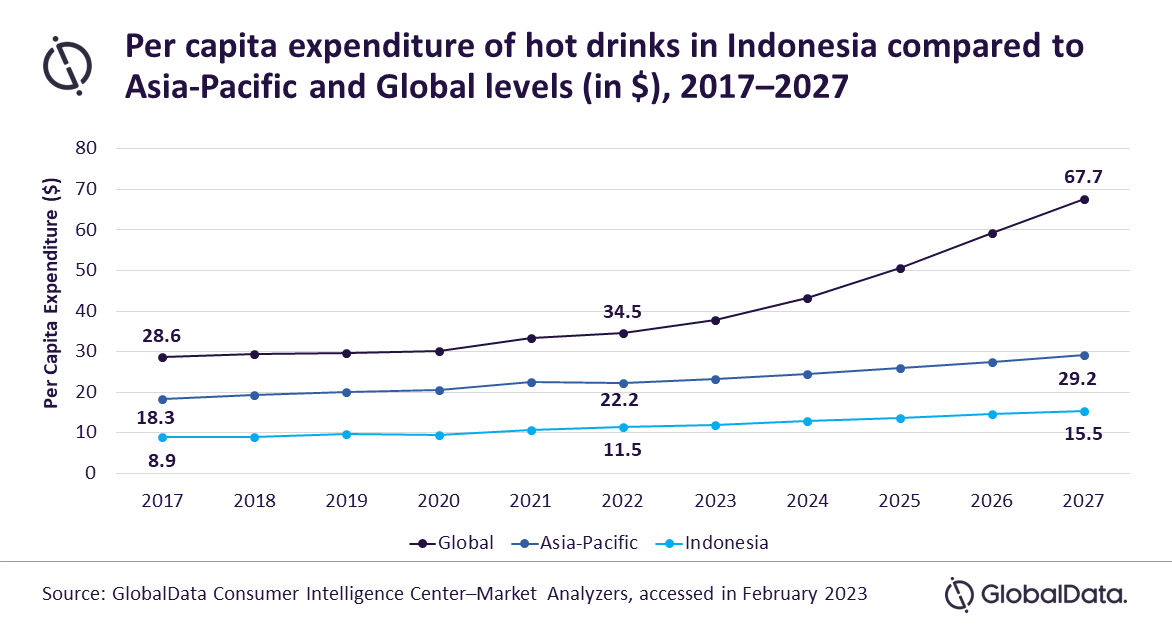
The per capita expenditure (PCE) on hot drinks in Indonesia increased from $8.9 in 2017 to $11.5 in 2022, lagging the Asia-Pacific average at $22.2 and the global average at $34.5. Indonesia’s PCE on hot drinks in Indonesia will surge to $15.5 by 2027, according to GlobalData.
Hill concludes: “PT Kapal Api Global, PT Gunung Slamat, and Nestlé were the top three companies by value sales in the Indonesian hot drinks market in 2022. Convenience stores was the largest distribution channel for hot drinks in 2022, followed by hypermarkets & supermarkets, and e-retailers. The e-commerce sub-channel has gained traction in recent years owing to the pandemic restrictions and will continue to expand amid spiraling inflation.”
