

Growing health and wellness priorities are fuelling robust consumer demand for high-protein foods. While meat remains the familiar protein source, the consumer appetite for legumes—beans and pulses—that can deliver meat-comparable protein levels is rapidly growing. Within this fast-growing plant-protein space, mung beans stand out as a prime innovation opportunity for manufacturers, says GlobalData, a leading intelligence and productivity platform.
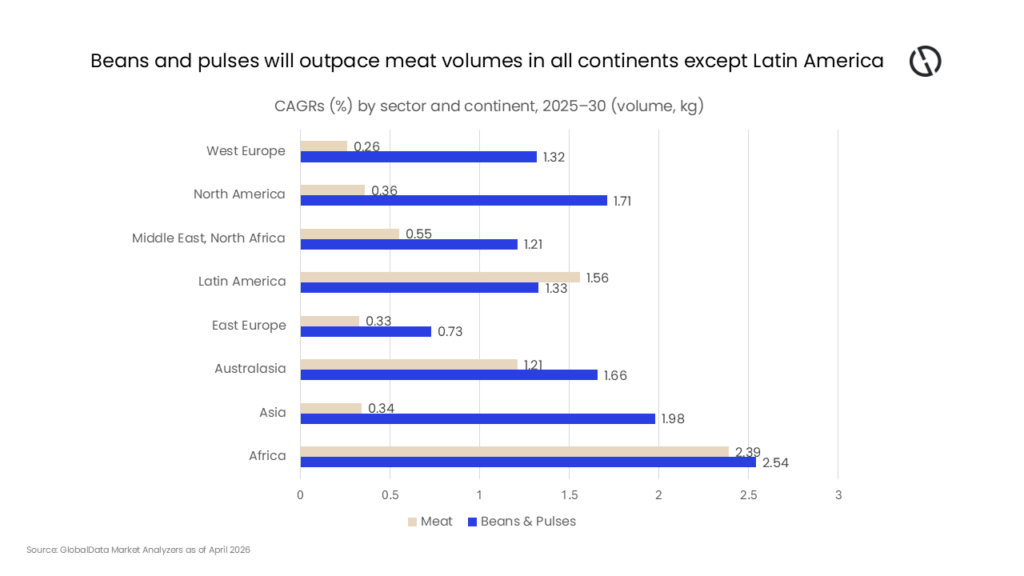
Volumes of beans and pulses sector will expand at a five-year compound annual growth rate (CAGR) of 1.7% through 2030, outpacing the growth of meat volumes, which will expand at a CAGR of 0.7% through 2030.† This dynamic is forecast for all continents—except Latin America, which will see meat volumes outpace beans and pulses volumes through 2030—showing that in almost all global regions, preference for beans and pulses will increase, despite growing from a smaller base than meats.
The American Heart Association (AHA) has released dietary guidance to improve cardiovascular health. One of its main recommendations urges consumers to choose healthy sources of protein and shift away from meats and toward plant-based sources such as beans, peas and lentils.
Eve Forshaw, Consumer Analyst at GlobalData, explains: “Consumers are interested in protein and value its health benefits; the AHA’s advice aligns with the emerging trend of ‘ZEBRA’ consumption—whereby consumers alternate between meat- and plant-based proteins to achieve a more balanced dietary profile.”
GlobalData’s Q1 2026 global survey* found that 50% of consumers plan to consume the same amount of protein over the next 12 months, while a further 36% plan to increase their intake. Additionally, consumers view protein content as a health indicator. GlobalData’s Q1 2025 global survey* found that 32% of consumers look for protein on packaging when deciding how healthy a product is.
At present, consumers are most familiar with meat-based protein sources. GlobalData’s Q1 2025 global survey found that only 7% of consumers are unfamiliar with both chicken and meat protein. Conversely, unfamiliarity with plant-based proteins remains relatively high, with 13% of consumers unfamiliar with soy protein, 21% unfamiliar with pea protein, and 38% unfamiliar with hemp protein, suggesting a global lack of understanding of plant protein sources.
Forshaw adds: “Despite lower familiarity with plant protein sources, there is a growing appetite for protein-rich plant-based foods.”
Mung beans offer a growth opportunity in the pulses sector as a protein-forward ingredient. Mung beans are high in protein, offering ~27g of protein per 100g, like that of chicken and red meats, and are used in a variety of dishes and recipes. Aside from their use as a whole bean, mung beans have properties which allow them to be made into other products, such as a plant-based scrambled egg substitute.
The Eat Just Food Company, headquartered in San Francisco, California, has conducted rigorous scientific tests and found that the protein isolate extracted from mung beans has the gelation property found in eggs that is required to achieve the structure and texture of scrambled egg, plus the ability to thicken, emulsify, and bind in foods like omelets, pancakes, and some baked goods. Mung beans offer a unique purpose in the plant-based market.
The AHA’s guidance and the rise of ‘ZEBRA’ consumption highlight a shift toward diversified protein choices whereby consumers are balancing plant and meat protein sources. While awareness of many plant-based proteins remains limited in comparison to animal proteins, bean and pulse volumes are set to outpace meat growth through 2030, indicating increasing openness to plant-based formats.
Forshaw concludes: “Mung beans stand out as a commercially attractive offering: they deliver meat-comparable protein levels in whole-food forms while also having properties like gelation, emulsification, and binding in their protein isolate. For manufacturers and investors, this dual role (cupboard whole-bean staple, plus functional use for plant-based eggs and adjacent applications) makes mung beans an exciting route to capture the next phase of plant-based protein growth.”
*GlobalData Q1 2025 and Q1 2026 global consumer surveys, 21,000 respondents across 42 countries.†GlobalData Market Analyzers, as of April 2026
