

The resumption in public outdoor movement with the relaxation of COVID-19 restrictions is expected to catalyze the growth of the South Korean over-the-counter (OTC) healthcare market. The heightened health and hygiene awareness triggered by the pandemic is motivating consumers to keep OTC prescriptions on hand. As a result, the country’s OTC healthcare market is projected to grow at a compound annual growth rate (CAGR) of 2.3% from KRW5.8 trillion ($5.1 billion) in 2021 to KRW6.5 trillion ($5.8 billion) in 2026, forecasts GlobalData, a leading data and analytics company.
GlobalData’s latest report, ‘South Korea OTC healthcare – Market Assessment and Forecasts to 2026’, reveals that the OTC market will be primarily driven by the traditional medicines category with a value CAGR of 2.7% over 2021-2026, followed by topical OTC medicines with a projected 2.5% CAGR. Anaesthetic products and antibiotic creams/gels will be one of the fastest-growing segments in the coming years, as South Koreans gradually revert to their pre-pandemic lifestyles.
According to the report, drug stores & pharmacies was the leading distribution channel in the South Korean OTC healthcare market in 2021, followed by food & drinks specialists, primarily due to the increasing consumer footfall in physical retail stores.
However, the e-commerce sales of OTC healthcare is constrained by stringent pharmaceutical regulations. Dong Wha Pharm, Boryung Pharm, and Almirall SA were the top three companies in the highly competitive South Korean OTC healthcare sector in 2021, and Dong Wha. and Boryung were the leading brands.
Anush Shaw, Consumer Analyst at GlobalData, comments: “The prolonged pandemic elevated consumer awareness about their health conditions. Having gained more knowhow of the use and side-effects of OTC healthcare products during the pandemic, South Koreans are self-medicating for minor health issues as they return to workplaces, educational institutions, retail outlets, and hospitality venues. They are adopting holistic self-care regimen that combines non-prescription drugs, such as analgesics and allergy care, with Traditional Korean Medicine, and multivitamins and other health supplements.”
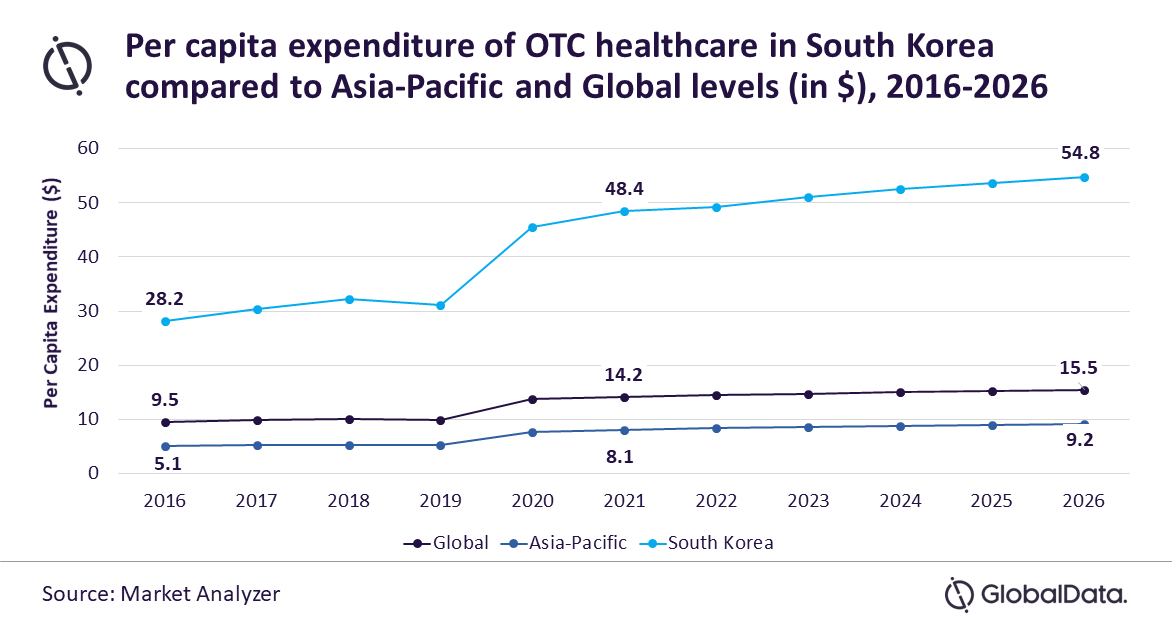
Consequently, the per capita expenditure (PCE) on OTC healthcare in South Korea surged from $28.2 in 2016 to $48.4 by 2021, surpassing the global average of $14.2, and the regional average of $8.1. It is forecast to reach $54.8 in 2026.
Shaw concludes: “With the support of World Health Organisation, and government funding, South Korea is emerging as a global R&D, manufacturing, and export hub for biotechnological and pharmaceuticals. This will accelerate the development and sales of new non-prescription drugs. Additionally, the government’s stringent regulations to clamp down on adulteration, illegal rebates, marketing, and the abuse of OTCs drugs are giving rise to a world-class OTC healthcare market. This will go a long way in building consumer trust and boosting the sales of OTC healthcare products in South Korea.”
