

The decline in live births, high inflation, and government initiatives to promote breastfeeding are constraining baby food consumption in Taiwan (Province of China). However, as consumers revert to the hectic pre-pandemic lifestyles, and more women join the workforce, value sales of baby food will increase in the coming years. As a result, Taiwan’s baby food market is forecast to expand at a moderate compound annual growth rate (CAGR) of 3 – 4% to reach TWD8.9 billion ($349.3 million) in 2028, according to GlobalData, a leading data and analytics company.
GlobalData’s report, ‘Taiwan Baby Food – Market Assessment and Forecasts to 2028’ reveals that baby milk held the highest value share in 2022. All categories, except baby drinks, are projected to expand by 2028, with the baby wet meals category forecast to register the fastest growth.
Shraddha Shelke, Consumer Analyst at GlobalData, comments: “A large proportion of Taiwanese consumers remained at home in 2022, due to the prevailing COVID-19 restrictions and remote working model. As parents prepared meals for their wards at home, overall baby food consumption in Taiwan (PRC) stagnated in 2022. However, with authorities lifting all COVID-19 restrictions in the last quarter of 2022, consumers have begun leaving their homes more often for studies, work, shopping, socializing, and leisure.
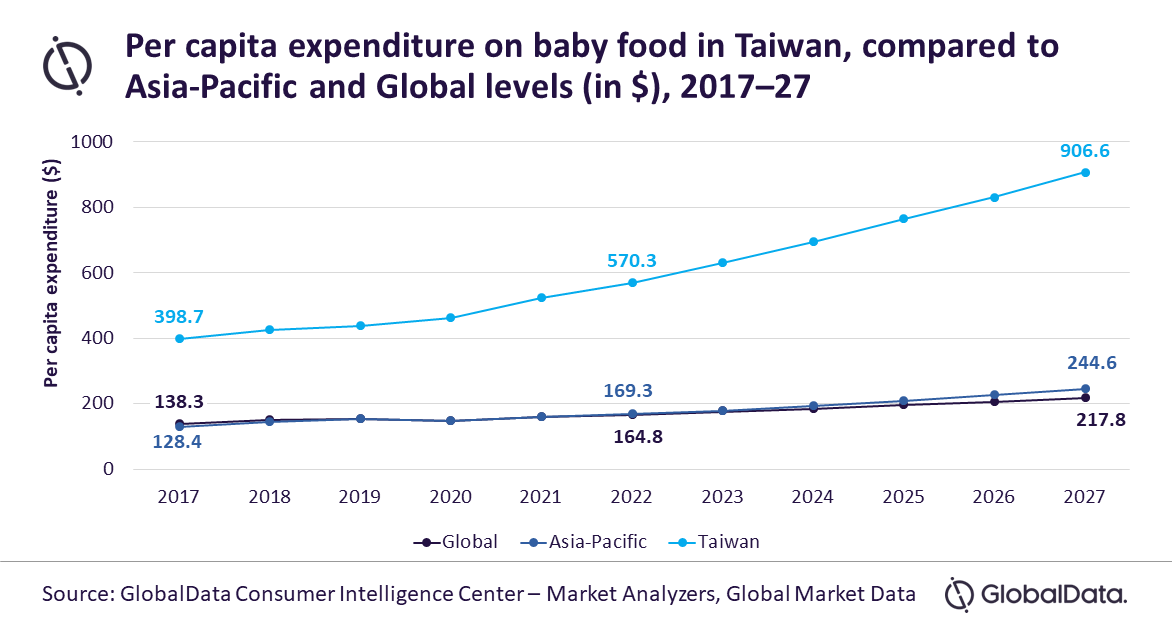
“As more parents transition to hybrid and onsite work, the demand for convenient and time-saving infant formula and baby meals is set to surge. Consequently, Taiwan’s per capita expenditure (PCE) on baby food will rise from $570.3 in 2022 to $906.6 by 2027, surpassing the Asia-Pacific average of $169.3 and the global average of $164.8 in 2022.”
Kiki Wu, Consumer Business Development Manager at GlobalData China, adds: “Drugstores & pharmacies was the largest distribution channel for baby food in 2022, followed by hypermarkets & supermarkets, and convenience stores. Nestlé, Abbott Laboratories, and PepsiCo were the top three leading companies in the competitive Taiwanese baby food sector in 2022. Nestlé’s S-26 and Abbott Laboratories’ Similac were the top two leading brands in 2022. However, e-commerce sales of baby food were disrupted by the Taiwanese government’s virtual ban on online infant formula sales to promote breastfeeding.”
In February 2023, Taiwan’s Ministry of Health and Welfare also mandated infant and follow-up formula packaging labels to be printed with a new logo from January 2025, featuring the slogans: “mother’s breastmilk is the best source of nutrition for infants” and “The Ministry of Health and Welfare cares for you”.
Shelke concludes: “Despite high inflation, parents are growing more inclined to purchase premium baby food for their wards in line with rising household incomes. For instance, many parents are shifting from cow milk products to goat milk products that are perceived to have greater nutritional benefits. Similarly, consumers are trading up from dried baby foods to wet baby meals. However, the strong government push for breastfeeding will suppress the growth of the baby milk category.”
